Saturn Rings 3D Explorer vs Ung Dung Thien Van
freetoolonline.com editorial team
Seeing Saturn's main rings as a labeled 3D lesson takes one page load in the Saturn Rings 3D Explorer - 0 MB installed, USD 0, no account.
An installed planetarium app costs setup time and disk space, and pays off when you need tonight's sky or Cassini image archives.
The numbers side by side
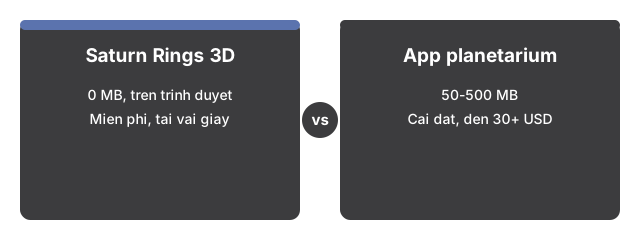

| Aspect | Saturn Rings 3D Explorer | Typical planetarium app |
|---|---|---|
| Install size | 0 MB - runs in the browser | 50 to 500 MB |
| Time to first view | Seconds - one page load | Minutes - download and setup |
| Price | USD 0 | USD 0 to 30+ |
| Works on a phone | Yes - lighter scene on small devices | Varies by app |
Where the browser scene wins
Where the browser scene wins for Saturn Rings 3D Explorer: everything runs locally with WebGL. For teaching why the Cassini Division looks empty - ~4,700 km at 117,580-122,170 km, A ring outer ~136,775 km, thickness ~10 m, and >95% water ice in the same view - it is the faster route by minutes.
Where a planetarium app wins
Where a planetarium app wins over Saturn Rings 3D Explorer: when you need the real sky tonight, shepherd-moon positions, or Cassini mission image galleries. This page is an educational approximation with exaggerated vertical thickness and no particle dynamics.
A reasonable rule
Use the browser scene for ring-structure intuition in under a minute; use a planetarium app or NASA PDS for observational planning and mission data. The NASA figures in the panel - Cassini Division ~4,700 km, 117,580-122,170 km, A ring ~136,775 km, ~10 m thickness, >95% water ice - stay accurate either way.
See when to use Saturn Rings 3D Explorer for session fit.