
Games
Free browser games - no install or signup required.
Last reviewed: 2026-08-02
Every game on this page runs entirely inside the browser tab: open the page and play. There is no download, no launcher, no account, and nothing to update.
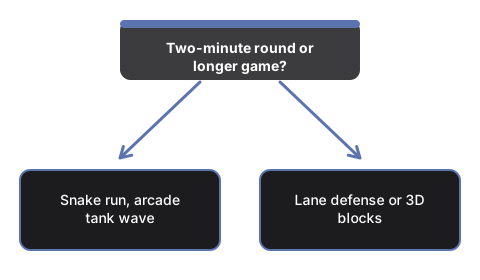
Not sure which one to open? Pick by the session you have - a two-minute snake run, an arcade tank wave, a tactical lane-defense stand, or open-ended 3D block building - and it starts the moment its page loads.
-
 Space Huggers - Free Run and Gun Platformer
Play Space Huggers, a free roguelike run-and-gun platformer with destructible environments.
-
 Level 13 - Text-Based Sci-Fi Survival Incremental Game Online
Level 13 - a free text-based survival incremental in the browser: explore a ruined underground City, gather resources, build a camp, and rebuild lost technolog...
-
 Snake Classic - Free Browser Snake Game, No Install
Snake Classic - Press an arrow key (or swipe on a phone) and the game starts instantly - eat the food, grow one segment, and dodge the walls and your own t...
-
 Retro Tank Battle - Free Online
Retro Tank Battle - Drive your tank with the arrows or WASD, fire with Space, and clear the wave of 6 enemy tanks before they destroy your base or your 3 l...
-
 Garden Defense - Free Browser Lane Defense Game
Garden Defense - Pick a defender card - Shooter (100 energy), Battery (50, makes more energy), or Wall (50, soaks damage) - then click or tap a cell to pla...
-
 Voxel World Builder - Free Online
Voxel World Builder - a free browser voxel sandbox: infinite terrain, six biomes, caves and ores, 35 block types, flying, and a day-night cycle.
-
 Sky Gates Flight - Free Online
Sky Gates Flight - Fly a little plane over the ocean and steer through the gates - green ones add their number to your power, red ones subtract it, and the...
-
 City Time Machine 3D - Free Online
City Time Machine 3D - Drag the 1945-2055 timeline and watch one city block's buildings, vehicles, signs, street lights, and people transform live in front...
-
 2048 Game - Merge the Numbers Puzzle - Free Online
2048 Game - Merge the Numbers Puzzle - Slide the numbered tiles with the arrow keys, WASD, or a swipe - equal tiles merge into their sum, and every move dr...
-
 City Drive Open World 3D - Free Online
City Drive Open World 3D - a free open-world driving game in the browser: a seeded neon night city with traffic, police chases, car damage, and an on-foot mode.
-
 Retro FPS Online - Play a Classic Shooter in Your Browser (Freedoom)
Play a complete classic first-person shooter in your browser: two full Freedoom campaigns, cached for offline play, with saves you can export to any computer.
-
 Retro Highway Racer - Free Online
Retro Highway Racer - a free lo-fi driving game in the browser: steer a randomly generated highway, jump rocks and trees, and beat the checkpoint clock.
-
 Hover Racing - Futuristic Racing Game Online
Hover Racing - a free anti-gravity racing game in the browser: pilot a hover ship down a neon 3D track, work the air-brakes, and chase your best lap.
-
 Retro Arcade Shooter - Free Online
Retro Arcade Shooter - a free lo-fi browser shooter: blast robot spiders through a dark server facility with WASD + mouse.
-
 Marble Maze - Free 3D Maze Game Online
Marble Maze - a free 3D maze puzzle in the browser: roll a ball through a procedurally-generated maze, find the exit, and the next level grows a size bigger.
-
 Asteroid Blaster - Free Online
Asteroid Blaster - a free browser space shooter: rotate, thrust, and blast drifting rocks before they hit your ship.
-
 Hex Puzzle Blocks - Free Online Hexagon Color-Match Game
Hex Puzzle Blocks - a free hexagon color-match puzzle: rotate the center hexagon to line up 3 or more same-colored blocks before they reach the middle.
-
 Procedural Horde Game - Free Online Browser Survival
Procedural Horde Game - a free browser horde survival game: move with WASD, auto-fire at nearby enemies, collect XP gems, and beat the skull boss after 45 seco...
-
 Chili Blast Shooter - Free Online Retro Vertical Shooter
Chili Blast Shooter - a free browser vertical shooter: move with WASD, auto-fire at waves of veggies, grab spread/speed/shield power-ups, and chase combos.
-
 Pixel Pipeline Reflex - Free Online Browser Reflex Game
Pixel Pipeline Reflex - a free browser reflex game: match Fetch, FIFO, Mix, and Light stages before the scan beam times out.
-
 Medieval Wall Defense - Free Online Incremental Castle Game
Medieval Wall Defense - a free browser incremental wave-defense game: place heroes on the wall, survive enemy waves, bank Research and Crowns, and return stron...
-
 Cyber Slide Puzzle - Free Online Sliding Tile Game
Cyber Slide Puzzle - a free browser sliding-tile (n-puzzle) game with 3x3, 4x4, and 5x5 boards, move counter, timer, and local best times.
-
 Starlight Breaker - Free Online Brick Breaker Game
Starlight Breaker - a free browser brick-breaker with a deer paddle, star ball, particle effects, and procedural Web Audio.
-
 Night Swarm Survivor - Free Online Canvas Horde Roguelite
Night Swarm Survivor - free browser horde roguelite: WASD or touch move, auto weapons, XP level-ups, stage bosses, achievements.
-
 Neon Tower Rush - Free Online Canvas Tower Defense Game
Neon Tower Rush - a free browser canvas tower-defense game: draft towers, defend six maps across 30 waves, upgrade to EX forms, and chase high scores.
-
 Cyber Neon Maze - Free Online First-Person 3D Maze Escape
Cyber Neon Maze - a free browser first-person 3D maze escape: procedural cyberpunk mazes, collectible orbs, laser traps, stamina sprint, and pointer-lock FPS c...
-
 Serpentine 3D - Free Online WebGL Snake Game in 3D
Serpentine 3D - a free browser WebGL 3D snake game: three difficulties, mobile joystick or keyboard, particle effects, and per-difficulty high scores saved loc...
-
 Neural Particle Life - Free Online Artificial Life Simulation
Neural Particle Life - a free browser artificial life sandbox: 2000 neural-network agents evolve on a toroidal grid with Start, Stop, and step controls.
-
 Neon Surge Loop - Free Online Roguelite Wave Shooter
Neon Surge Loop - a free browser roguelite shooter: steer with the mouse, auto-fire neon projectiles, collect XP gems, and pick level-up upgrades.
-
 Arrow Dodge Arena - Free Online 30-Second Reflex Dodge Game
Arrow Dodge Arena - a free browser reflex game: dodge red arrows for 30 seconds, collect blue star power-ups, and chase a local high score.
-
 Andromeda Star Shooter - Free Online Pixel Canvas Shooter Game
Andromeda Star Shooter - a free browser fixed-shooter: move left/right, fire pulses, clear descending ships, and climb levels.
-
 Pixel Spike Run - Free Online Pixel Endless Runner Game
Pixel Spike Run - a free browser endless runner: tap, click, or Space to jump over spikes; hold for higher jumps.
-
 Orbital Radius Shooter - Free Online Canvas Orbital Shooter Game
Orbital Radius Shooter - a free browser orbital shmup: WASD moves your ship, mouse aims, click to fire through escalating waves.
-
 Species Life Battle - Free Online Multi-Species Conway Life Battle Game
Species Life Battle - a free browser cellular-automata battle: place two colored species on a grid, run Conway Life rules, and watch territory fights.
-
 Gravity Orbit Golf - Free Online Gravity Golf Puzzle Game
Gravity Orbit Golf - free browser gravity golf: drag to slingshot a comet through procedural solar holes.
-
 One Tap Platformer - Free Online One-Tap Action Platformer
One Tap Platformer - free browser one-tap platformer: dash through vector-art stages with touch or mouse.
-
 Neon Circuit Racer - Free Online Neon Lane Dodge Game
Neon Circuit Racer - free browser lane racer: dodge traffic, build combo near-misses, use nitro boost, and chase a local best score.
-
 Pixel Necromancer - Free Online Pixel Necromancer Browser Game
Play Pixel Necromancer free in the browser: aim spells at villagers, resurrect undead with Space, buy rituals between levels.
-
 Thirteen Card Duel - Free Online Browser Card Battle Game
Play Thirteen Card Duel free in the browser: draw attack and defense cards, avoid the XIII death card, and beat the CPU across stages.
-
 Abyss Signal Diver - Free Online Underwater Exploration Browser Game
Play Abyss Signal Diver free in the browser: pilot a deep-sea sub, scan with sonar, find the signal source, and carry it to the surface.
-
 Inferno Soul Walker - Free Online WebGL Inferno Explorer Browser Game
Play Inferno Soul Walker free in the browser: first-person WebGL maze through infernal structures, collect 13 lost souls, and pull levers.
-
 Sketch Turf Battle - Free Online Sketch Turf Battle Browser Game
Play Sketch Turf Battle free in the browser: 3-minute doodle turf wars with paint bombs, four fighters, career and adventure modes.
-
 Glow Firefly Cat - Free Online Glow Firefly Cat Browser Game
Play Glow Firefly Cat free in the browser: summon fireflies, time shield bursts, evolve colors, and survive 3 minutes.
-
 Nova Star Barrage - Free Online Bullet-Hell Browser Game
Play Nova Star Barrage free in the browser: faction bullet-hell with talent trees, weapon fusion, and endless waves.
-
 Pixel Realm RPG - Free Online Top-Down Browser RPG
Play Pixel Realm RPG free in the browser: 8x8 tile top-down adventure with inventory, equipment, combat, and save/load across 15 maps.
-
 Neon Cat Chase - Free Online Neon Arcade Browser Game
Play Neon Cat Chase free in the browser: collect cheese, dodge dogs, and survive with nine lives across neon levels.
-
 Schematic Factory Line - Free Online Incremental Factory Browser Game
Play Schematic Factory Line free in the browser: mine ore, smelt ingots, assemble circuits, prestige Schematics, and open research tiers.
-
 Space Grid Puzzle - Free Online Space Puzzle Browser Game
Play Space Grid Puzzle free in the browser: tap grid squares, clear neutron stars, and solve space-themed levels.
-
 Thirteen Step Escape - Free Online Pixel Puzzle Browser Game
Play Thirteen Step Escape free in the browser: push crates, grab keys, and reach the flag in only 13 steps per level.
-
 Floor Thirteen Horror - Free Online Stealth Horror Browser Game
Play Floor Thirteen Horror free in the browser: explore 13 rooms, find keys, use your flashlight, and hide from It.
-
 Voxel FPS Arena - Free Online WebGL Shooter Browser Game
Play Voxel FPS Arena free in the browser: a compact WebGL voxel shooter with 2 levels, 3 weapons, and dynamic lighting.
-
 Lightning Math Battle - Free Online Math Quiz Action Browser Game
Play Lightning Math Battle free in the browser: answer math problems to charge lightning strikes across eight practice modes and four difficulty tiers.
-
 Precision Bounce Loop - Free Online Timing Arcade Browser Game
Play Precision Bounce Loop free in the browser: keep a ball bouncing on a moving tablet with WASD or arrow keys and combo scoring.
-
 Vim Motion Academy - Free Online Vim Tutorial RPG Browser Game
Play Vim Motion Academy free in the browser: learn h j k l and Vim commands through creature training, drills, and turn-based battles.
-
 Globe Siege - Free 3D Planet Tower Defense Browser Game
Defend a rotating 3D planet in your browser: place towers on a hex globe to stop waves of ground and air enemies.
-
 Void Trader - Free Space Trading Roguelike Browser Game
Mine ore, trade goods at stations, upgrade your ship, and survive deeper sectors in a free Canvas 2D space trading roguelike.
-
 Layer Flip Platformer - Free Online Dimension Toggle Game
Play Layer Flip Platformer free in your browser: toggle light and dark layers mid-jump across 25 hand-crafted stages.
-
 Violence Town - Free Turn-Based Browser RPG Game
Explore hand-authored zones, fight with a radial action wheel, manage inventory, and autosave a turn-based 2D RPG in the browser.
-
 Claudicus Quest - Free Medieval Browser RPG Game
Explore Brannford, Thornwood, and Greymoor Crypt in a turn-based medieval RPG with class select, quests, and local save.
-
 Neon Energy Arena - Free Online Neon Arena Roguelite Game
Neon Energy Arena - a free browser neon arena roguelite: WASD move, mouse aim, LMB shoot, F switch weapons, Shift dash, Space bomb, shop upgrades.
-
 Mono Minefield Grid - Free Online Minefield Clear Game
Mono Minefield Grid - free browser minefield clear: Easy/Medium/Hard grids, click to open, flag mines, chord numbered cells.
-
 Space Pi Defense - Free Online Base Defense Line Game
Space Pi Defense - free browser mouse accuracy game: draw defensive lines, grow your base across 13 levels, buy upgrades with coins.
-
 Mono Paddle Duel - Free Online Paddle Ball Duel Game
Mono Paddle Duel - free browser paddle duel: 1P vs CPU or hotseat 2P, Easy to Insane, first to 11.
-
 Head Soccer Arena - Free Online Head Soccer Pitch Duel Game
Head Soccer Arena - free browser head-soccer duel: 1P vs CPU or hotseat 2P, match timer, goals to win, power-ups.
-
 Idle Capitalist Loop - Free Online Idle Empire Tycoon Game
Idle Capitalist Loop - free browser idle tycoon: buy businesses, hire managers, cash and angel upgrades, Earth Moon Mars prestige.
-
 Mono Stack Blocks - Free Online Line Clear Stack Game
Mono Stack Blocks - free browser line-clear stack game: stack tetrominoes, clear rows, hold piece, ghost preview, local high scores.
-
 Mono Grid Duel - Free Online Grid Duel Game
Mono Grid Duel - free browser three-in-a-row game: 3x3 grid, vs CPU (Easy/Normal/Hard) or 2P hotseat, mouse and keyboard.
-
 Pipe Rotate Puzzle - Free Online Pipe Link Game
Pipe Rotate Puzzle - free browser pipe link game: rotate tiles to connect every pipe from the power source.
-
 Black Hole Square - Free Online Tap Puzzle Game
Black Hole Square - free browser tap puzzle: clear every square into the black hole with limited moves.
-
 Pixel Park Puzzle - Free Online Parking Game
Pixel Park Puzzle - free browser parking game: steer vehicles into marked bays, dodge cones, and clear campaign levels.
-
 Wash The Cat - Free Online Pipe Puzzle Game
Wash The Cat - free browser pipe puzzle: route water through tanks, pipes, and valves to shower a muddy cat.
-
 Ritual Catacombs - Free Online WebGL Horror Game
Ritual Catacombs - free WebGL horror in the browser: collect shards, open runic doors, survive cats and a nine-life boss.
-
 Potion Brew Shop - Free Online Point-and-Click Puzzle Game
Potion Brew Shop - free browser potion puzzle: click ingredients into the cauldron, brew orders for customers, unlock new bottles, and avoid too many mistakes.
-
 Cat Typing Race - Free Online Keyboard Typing vs AI Cat Game
Cat Typing Race - free browser typing duel: press A-Z to match on-screen letters, race an AI cat through levels and rounds, use bomb rocket snowflake perks.
-
 Unlucky Crossing - Free Online Halloween Street Cat Game
Unlucky Crossing - free browser arcade game: steer a black cat across Halloween streets, cause bad luck near humans for points, manage nine happiness lives, ea...
-
 Mystic Card Paw - Free Online Black Cat Poker Puzzle Game
Mystic Card Paw - free browser card puzzle: click five cards into poker combos, use cat abilities pounce purr hiss scratch, chase a high score.
-
 Cat Hop Cloud - Free Online Luck Cloud Hop Puzzle
Cat Hop Cloud - free browser luck puzzle: hop clouds, spend luck on jump distance, visit checkpoints, return to cloud 0.
-
 Herd Cats Home - Free Online Multi-Cat Isometric Puzzle
Herd Cats Home - free browser isometric puzzle: lead a black cat and color-matched cats onto home tiles within 13 steps per counter.
-
 Seasonal Witchcat - Free Online Season-Switching Adventure
Seasonal Witchcat - free browser adventure: explore a pixel world, switch spring/summer/fall/winter, collect hidden cats, shoot fireballs.
-
 Desk Cat Coder - Free Online Stealth Desk Platformer
Desk Cat Coder - free browser stealth platformer: guide a desk cat to the keyboard, type lines while the owner is away, distract with snacks, seven work days,...
-
 Boing Cat Platformer - Free Online Auto-Run Jump Game
Boing Cat Platformer - free browser auto-run platformer: time Space-bar jumps over spikes and gaps across three tile-built levels to a duck-held finish flag, a...
-
 DarkLine Paws - Free Online 3-in-1 Cat Mini-Game Bundle
DarkLine Paws - free browser 3-in-1 cat game: a raycasted first-person maze, a Tic-Tac-Toe duel against an unbeatable cat AI, and a rooftop building-hop runner...
-
 Mor Chess 2 - Free Online Chess Positional Puzzle Game
Mor Chess 2 - free browser chess puzzle: pick named positional ideas each turn to build a strong position against Black Cat, about 13 KB, no install.
-
 Black Cat on a Hot Tin Roof - Free Online Runner Game
Black Cat on a Hot Tin Roof - free browser rooftop runner: jump spikes, clear birds, gain a super power, and catch Black Bird in 60 seconds, about 16 KB.
-
 Machine Guard Corps - Free Online Lane Defense Auto-Battler
Machine Guard Corps - free browser sci-fi lane defense auto-battler: summon machines, evolve units, upgrade your tower, and defeat an adaptive alien hive, abou...
-
 Solo Battlefield - Free Online Last-Alive Combat Game
Solo Battlefield - free browser last-alive combat game: move with WASD, click to strike, clear 8 escalating levels, about 12 KB.
-
 Feast Night - Free Online Medieval Soul-Saving FPS
Feast Night - free browser medieval first-person game: walk the feast, answer with nod or shake, save souls from demons, about 17 KB.
-
 Rune Keeper - Free Online Draw-to-Move Arena Game
Rune Keeper - free browser draw-to-move arena: draw rune symbols to shift the runestone, clear enemies, about 28 KB.
-
 Bounce Back - Free Online Boomerang Roguelite Game
Bounce Back - free browser boomerang roguelite: throw, dash, clear 10 procedural levels, about 120 KB.
-
 Classic Pong - Free Online Canvas Pong Game
Classic Pong - free browser canvas table tennis: 1P vs AI, 2P local, or demo mode, about 60 KB.
-
 Thirteen Hours - Free Online Clock Chain Puzzle
Thirteen Hours - free browser clock-chain puzzle: tap timed clocks before the timer ends, about 30 KB.
-
 Quantum Shift - Free Online Particle Puzzle
Quantum Shift - free browser particle puzzle: arrow keys to move, touch blocks to match red or purple outlines, about 68 KB.
-
 Rollermaze - Free Online Maze Escape Puzzle
Rollermaze - free browser maze puzzle: roll a cuboctahedron through timed mazes, hit floor buttons to open paths, dodge sentinels, about 59 KB.
-
 Thirteen Case Files - Free Online Detective Puzzle
Thirteen Case Files - free browser detective puzzle: review police reports, protect or arrest suspects in a serial-killer case, about 10 KB.
-
 Googol Stopping Game - Optimal Stopping Number Puzzle
Free browser optimal-stopping puzzle: pick numbered tiles hiding huge numbers, quit when you think you hold the biggest.
-
 Bangbang Artillery - Cannon Duel vs Neural Net
Free browser artillery duel: aim angle and power, fire at a learning AI cannon.
-
 Rock Paper Neural - RPS vs Learning Neural Net
Free browser rock-paper-scissors vs a neural net that learns your habits.
-
 Egg Time Rewind - Nokia Shooter With Parallel Lives
Free browser Nokia-style shooter: die and time rewinds while parallel lives help.
-
 Iso City Sandbox - Free Isometric Tile City
Paint a tiny isometric city in your browser.
-
 Neuro Aim Arena - Free Neuroevolution Aim Duel
Fight evolving neural-network bots in your browser.
-
 Flexbox Froggy - Learn CSS Flexbox in the Browser
Guide frogs onto lilypads by writing CSS flexbox across 24 levels.
-
 Grid Garden - Learn CSS Grid in the Browser
Water carrot patches by writing CSS grid across 28 levels.
-
 Mochi and the Midnight Escape - Free Browser Platformer
Guide Mochi through nine pixel platformer levels.
-
 Swing Block Tower - Free Browser Stacking Game
Tap or click to drop swinging blocks onto a tower.
-
 Star Fuel Battle - Free Browser Spaceship Shooter
WASD move, Space fire.
-
 Progress Knight - Free Medieval Life-Sim Incremental
Climb careers, learn skills, manage coins and aging, then prestige for stronger runs.
-
 Miami Mice - Free Browser Beat-Em-Up
Fight feline martial artists in a procedural canvas beat-em-up.
-
 Orbital Order - Free Aufbau Electron Puzzle
Guide electrons into atomic orbitals with cursor attract and repel physics.
-
 Spike Sprint - Free Pixel Runner Game
Jump over pits and dodge spiked barrels in a free pixel runner.
-
 Neon Deep Space - Free Geometry War Shooter
Fly a neon ship through geometric bullet hell.
-
 Vim Master - Free Vim Lesson Game
Learn Vim commands in a browser editor with JSON lessons, XP, combos, and on-device saves.
-
 Quantum Optics Puzzle - Free Photon Puzzle Game
Place mirrors, polarizers, and detectors to guide photons through quantum optics levels.
-
 Eight Ball Pool - Free Browser Billiards Game
Play classic eight-ball pool in the browser vs AI or a friend.
-
 Emoji Slot Machine - Free Browser Emoji Slots
Spin circular emoji reels in the browser.
-
 Particle Clicker - Free Browser Physics Clicker
Play Particle Clicker free in your browser - click for particle events, spend on research, hire workers, and upgrade.
-
 The House Point and Click - Free Browser House Adventure
Explore linked rooms, collect inventory items, and solve a point-and-click house escape in your browser.
-
 Server Survival TD - Free Cloud Infra Tower Defense
Build CDN, database, and firewall services to survive rising traffic and DDoS in a free 3D browser tower defense.
-
 Connect Four AI - Free Browser Connect Four vs AI
Play Connect Four in the browser against AI, another human, or watch AI vs AI.
-
 Elm Street Delivery - Free Browser Courier Route Game
Plan courier routes, pick up fashion boxes, and keep customers happy in this free WebGL delivery game.
-
 Cube Smash 3D - Free Online Hammer Survival Game
Cube Smash 3D - free browser survival: your hammer auto-swings at cube blobs on a sunny meadow, collect gems, level up, pick upgrades.
-
 Crystal Cave Flyer - Free Online One-Button 3D Cave Flight
Crystal Cave Flyer - free browser one-button flight: hold to climb, release to sink, thread the rock walls and collect crystals.
-
 Sunset Soar - Free Online Momentum Gliding Game
Sunset Soar - free browser momentum glider: hold to dive down the slopes, release at the crest to launch, ride the hills into the sunset.
-
 Tower Building Game - Stack Blocks Highest
Play Tower Building Game online - stack blocks to build the highest tower.
Find your kind of game
The full list above holds every game here. To narrow it to the one that fits right now, find the row that matches what you feel like doing - each row links straight to the games that play that way, so you skip the games that are not for this session.
| You feel like | What a round is like | Open one of these |
|---|---|---|
| A quick reflex run | One short round, a near miss, then straight into another try for a better score. | Snake Classic, Serpentine 3D, Sky Gates Flight, Pixel Pipeline Reflex, Arrow Dodge Arena, Pixel Spike Run, Gravity Orbit Golf, One Tap Platformer, Neon Cat Chase, Precision Bounce Loop, Starlight Breaker |
| Shoot and clear the screen | Aim, fire, and clear the wave before the enemies, rocks, or ships reach you. | Retro Tank Battle, Retro FPS Online, Retro Arcade Shooter, Asteroid Blaster, Chili Blast Shooter, Neon Surge Loop, Andromeda Star Shooter, Orbital Radius Shooter, Pixel Necromancer, Nova Star Barrage, Voxel FPS Arena |
| Survive a swarm | Keep moving while your weapons fire on their own, grab upgrades, and outlast the crowd. | Procedural Horde Game, Night Swarm Survivor, Glow Firefly Cat |
| Defend a base | Spend what you earn on the right unit in the right spot, then watch the line hold or break. | Garden Defense, Medieval Wall Defense, Neon Tower Rush |
| Race or drive | Steer a car, ship, or hover craft, dodge what is ahead, and chase a faster lap. | City Drive Open World 3D, Retro Highway Racer, Hover Racing, Neon Circuit Racer |
| A puzzle to solve | No clock pushing you - line the pieces up, plan a few moves ahead, and clear the board. | 2048, Hex Puzzle Blocks, Cyber Slide Puzzle, Thirteen Card Duel, Space Grid Puzzle, Thirteen Step Escape |
| Explore a 3D maze | Walk passages you have not seen before, find your way out, and watch your back. | Marble Maze, Cyber Neon Maze, Abyss Signal Diver, Inferno Soul Walker, Floor Thirteen Horror |
| Build and tinker | No timer and nothing to lose - make something, press play, and watch it run. | Voxel World Builder, City Time Machine 3D, Neural Particle Life, Species Life Battle, Schematic Factory Line |
| Adventure and role-play | Carry gear, fight through stages, and keep your progress as the story grows. | Pixel Realm RPG, Sketch Turf Battle |
| Learn a real skill | Practice mental math or keyboard moves while a game keeps score for you. | Lightning Math Battle, Vim Motion Academy |
Your progress stays on your device
High scores, best waves, and saved voxel worlds live in this browser's local storage under a per-game key. Nothing is uploaded, there is no account system, and there are no cross-device leaderboards. Clearing this site's browsing data removes saved progress, so treat long-lived voxel builds accordingly - the builder includes an export option for keeping a copy of your world as a file.
What each genre asks of you
Only four games get a full breakdown below - a deliberate spotlight, not the whole catalog. The "Find your kind of game" directory higher up this page already routes all 50+ titles into mood-based picks; these four were chosen because each one trains a different core instinct, and most of the other games on this hub recombine one of these four mechanics.
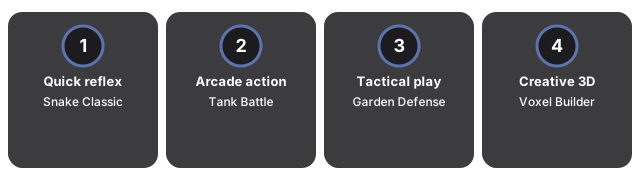
| Spotlight game | Session shape |
|---|---|
| Snake Classic | Rounds end fast; the pace rises every 5 foods |
| Retro Tank Battle | One 6-tank wave, 3 lives, a base to protect |
| Garden Defense | 5 waves of invaders across 5 lanes, an economy to manage |
| Voxel World Builder | No timer, no fail state - build until you are done |
The four games in the table above cover four classic genres, and each one trains a different instinct. The grid snake game is pure spatial planning: the only input is a direction, but every food you eat makes the snake longer and the corridor of safe moves narrower, so the late game is really about routing ahead of yourself rather than reacting. The arcade tank battle adds aim and cover to movement - brick walls break under fire, steel does not, so the map itself is a resource you spend: every wall you shoot through to reach an enemy is a wall that no longer shields your base.
The lane defense game removes reflexes almost entirely and replaces them with an economy. Energy arrives on a timer, batteries raise the rate, and every placement is a trade between offense now and income later - the classic tower-defense decision compressed into five lanes you can actually watch at once. The voxel sandbox drops goals altogether: it is a finite 48 by 48 lot, six block types, and a camera you orbit around whatever you decide to make. People use it the way they use grid paper - rough out a floor plan, mock up a pixel-art figure in 3D, or just stack something tall and flip the scene to night to see it in different light.
Each spotlight instinct has close cousins in the bigger directory above: spatial planning also shows up in the puzzle and maze rows, aim-and-cover carries into the racing and horde-survival rows, the lane-defense economy repeats in every "defend a base" row, and the voxel sandbox's open-ended building matches the factory and life-sim rows. So a game you like from this spotlight usually has several similar picks waiting in the fuller table.
Controls, in detail
Every game has a fullscreen button next to the canvas that keeps the on-screen controls visible, and the Escape key always returns to the normal page. On a keyboard: the arrow keys and WASD steer every 2D game, Space is the action key (fire in the tank arena, restart after a game over), and P pauses and resumes. On a phone or tablet the same games read swipes on the canvas as direction changes and taps as the action, and an on-screen pad with Up, Down, Left, Right and Action buttons appears below the canvas on touch devices. The 3D builder is pointer-driven everywhere: drag to orbit the camera, scroll or pinch to zoom, click or tap to place the selected block, and switch to Remove mode to take blocks away. None of the games require holding a button down for long stretches, so they play comfortably on a trackpad too.
Why browser games have gotten good
These pages exist because the browser platform quietly caught up with what small games actually need. The canvas element gives a 2D game a fast, resolution-independent drawing surface with a fixed-timestep game loop, so speed does not depend on how fast your machine renders; requestAnimationFrame keeps that loop tied to the display's refresh rate; WebGL puts real GPU rendering behind the 3D sandbox; and local storage gives all of them a place to remember a best score or a saved world without any account system. Because the code runs on your device, there is no lag from a game server and the games keep working on a flaky connection once the page has loaded - which is why each game here loads in seconds, works on the same URL on a phone and a desktop, and keeps going on a train once the page is open.
All these games are free and stay free. If a game cannot start, the page says so in plain language instead of showing a broken canvas - the 3D sandbox needs a browser with WebGL, which every current desktop and mobile browser provides.
Why trust these tools
- Ten-plus years of web tooling. The freetoolonline editorial team has shipped browser-based utilities since 2015. The goal has never changed: get you to a working output fast, without an install.
- No install, no sign-up. Open a tool and get a working output in seconds - nothing to download and no account to create. Tools that need heavy processing run it on our service, so even a low-powered machine gets the job done.
- Analytics stops at the page view. We measure which pages get visited, not what you type or upload inside a tool. There is nothing to sign in to and no profile is attached to your input.
- Open-source core components. The processing engines underneath (libheif, libde265, pdf-lib, terser, clean-css, ffmpeg.wasm, and others) are public and audit-able. We link to each one in its tool page's footer.
- Free, with or without ads. All tools are fully functional without sign-up. The Disable Ads button in the header is always available if you need a distraction-free run.