Planet Size Comparison 3D Explorer vs Alternatives
freetoolonline.com editorial team
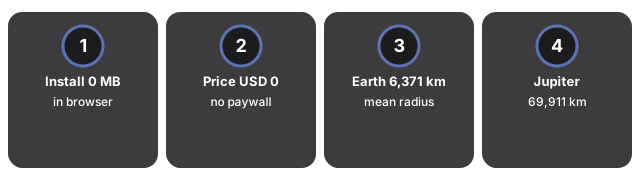
Learning planetary scale takes one page load in the Planet Size Comparison 3D Explorer - 0 MB installed, USD 0, no account. The Solar System 3D Explorer shows orbiting planets with compressed sizes for one-screen orbits. The Moon Phases 3D Explorer scrubs a synodic month for phase geometry, not radius comparison.
The numbers side by side
| Aspect | Planet Size Comparison 3D Explorer | Typical alternative |
|---|---|---|
| Install size | 0 MB - runs in the browser | App install varies |
| Price | USD 0 | Often paid or account-gated |
| Earth mean radius | 6,371 km (scale-accurate row) | Often compressed for orbit views |
| Jupiter mean radius | 69,911 km beside Earth in one row | Often not shown at true radius scale |
vs Solar System 3D Explorer
Solar System 3D Explorer prioritizes readable orbits - sphere sizes and distances are compressed. Planet Size Comparison 3D Explorer keeps radii scale-accurate in one row: Jupiter 69,911 km beside Earth 6,371 km with no orbital motion.
vs textbook diagrams
A textbook page shows static circles once. Planet Size Comparison 3D Explorer adds drag-to-orbit viewing, highlight buttons, and a spin toggle while listing nine NASA mean radii in the panel - still free and browser-only.
vs planetarium apps
Planetarium apps target tonight's sky positions and often need install. Planet Size Comparison 3D Explorer is a focused scale lesson with published radii (Sun 696,340 km, Mercury 2,440 km) and no ephemeris - load the URL and click a world.
See when to use Planet Size Comparison 3D Explorer for session fit.