
A scale model of the Sun and all eight planets, each sphere sized to its NASA mean radius.
Play spin rotates the lineup slowly so limb curvature stays visible; pause freezes the view for screenshots. Earth starts highlighted with radius 6,371 km in the panel table.
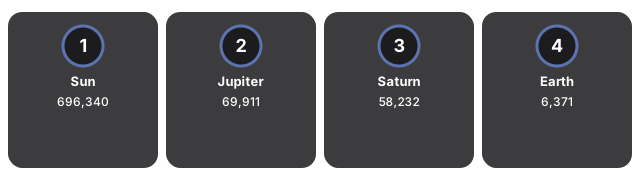
Sphere radii follow published NASA mean radii - Sun 696,340 km, Jupiter 69,911 km, Saturn 58,232 km, Earth 6,371 km, Mercury 2,440 km - while row spacing is widened for readability. This is an educational size comparison, not an orbital model.
Planet Size Comparison 3D Explorer
FreetoolOnline editorial teamCompare the Sun and all eight planets side by side with scale-accurate sphere radii - click any world to highlight it and read published NASA mean-radius figures in the panel.
Drag to orbit the view, scroll or pinch to zoom, and hold Play spin to rotate the lineup slowly so limb curvature stays visible - or pause it for a clean still frame.
- Nine spheres in one row with radii proportional to published NASA mean radii - Jupiter stays readable and the Sun dominates without faking a size
- The same comparison table sits inside the viewer's facts panel, so every mean radius in km is readable without leaving the scene
Teachers use it to show why Jupiter dwarfs Earth, students compare inner versus outer planet scale, and curious readers park on the two ice giants to see how close their radii really are.
| World | Mean radius (km) | Source |
|---|---|---|
| Sun | 696,340 | NASA fact sheet |
| Jupiter | 69,911 | NASA fact sheet |
| Saturn | 58,232 | NASA fact sheet |
| Uranus | 25,362 | NASA fact sheet |
| Neptune | 24,622 | NASA fact sheet |
| Earth | 6,371 | NASA fact sheet |
| Venus | 6,052 | NASA fact sheet |
| Mars | 3,390 | NASA fact sheet |
| Mercury | 2,440 | NASA fact sheet |
Everything renders on your device with WebGL through the vendored three.js engine, which loads once (about 0.7 MB) and is then cached - no account, no upload, and no scene data sent to a server.
The scene is an educational size comparison tuned to teach planetary scale - it does not show heliocentric distances, orbital motion, or mass. The spacing between worlds is widened for readability only and carries no distance meaning.
For a step-by-step walkthrough, the nine NASA mean radii in one table, and the sessions this scene does not fit, read the Planet Size Comparison 3D Explorer guide. The Space 3D collection also includes a Solar System 3D Explorer for orbiting planets with compressed sizes and a Moon Phases 3D Explorer for Sun-Earth-Moon phase geometry.
Depth: how this differs from the Solar System 3D Explorer
The two scenes keep different geometry honest, because they answer different questions. Fitting orbiting planets onto one screen forces the Solar System 3D Explorer to compress both the sphere sizes and the gaps between orbits - Neptune would otherwise sit about thirty times farther out than Earth and vanish off-frame. This page makes the opposite trade: it never fakes a radius, so Jupiter's 69,911 km sphere stays roughly eleven times wider than Earth's 6,371 km and the Sun at 696,340 km dwarfs every world, and the spin rotates the lineup in place rather than tracing orbits. Reach for the orbit-first view when you want layout and motion; stay here when the point is true proportional size - Uranus at 25,362 km sitting only just larger than Neptune at 24,622 km is a comparison an orbit-first scene cannot show without distorting it.
Frequently Asked Questions
What does Planet Size Comparison 3D Explorer show?
The Sun and all eight planets as spheres in one row with radii proportional to published NASA mean radii. Click any world button to highlight it, nudge the camera, and read its radius in km in the facts panel plus a full comparison table.
How is this different from Solar System 3D Explorer?
Solar System 3D Explorer shows planets orbiting the Sun with compressed sizes and distances so every orbit fits on one screen. Planet Size Comparison 3D Explorer keeps sphere radii scale-accurate side by side for a direct size lesson - spacing is widened for readability and there is no orbital motion.
What real figures does the panel include?
NASA mean radii in km: Sun 696,340; Jupiter 69,911; Saturn 58,232; Earth 6,371; Venus 6,052; Mars 3,390; Uranus 25,362; Neptune 24,622; Mercury 2,440. The table matches the spheres in the scene.
Are distances between planets shown to scale?
No. Only sphere radii are proportional to published mean radii. Row spacing is exaggerated so inner planets stay visible beside the Sun and Jupiter. For heliocentric distances and orbits, use Solar System 3D Explorer.
What does Play spin do?
Play spin rotates the entire lineup slowly so limb curvature stays visible on each sphere. Pause spin freezes the view for screenshots or classroom discussion while highlight buttons still work.
Is this an orbital or mass comparison?
No. The scene compares mean radius only - not mass, density, or orbital period. It is an educational visualization, not a planetary interior or gravity model.