
Throw something in a straight line across a spinning planet and, to anyone standing on the ground, it will seem to curve - to the right north of the equator, to the left south of it. Nothing pushes it sideways; the ground simply turns underneath. That is the Coriolis effect, and it steers hurricanes, trade winds, and ocean currents. Toggle the hemisphere and watch the path bend the other way.
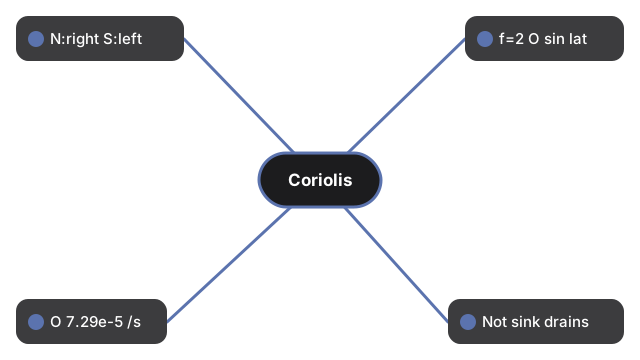
Published literacy: the Coriolis effect deflects moving things to the right in the Northern Hemisphere and the left in the Southern; its strength is f = 2 x Omega x sin(latitude) with Earth spin Omega = 7.29e-5 rad/s, greatest at the poles and zero at the equator.
Drag to orbit and scroll or pinch to zoom. Toggle the hemisphere, replay the launch, or pause the motion.
Coriolis Effect 3D Explorer
FreetoolOnline editorial teamThe Coriolis Effect 3D Explorer launches a parcel across a spinning planet and shows why its path curves: right of straight motion north of the equator, left south of it - purely because the ground rotates underneath, not because anything pushes the parcel sideways.
Nothing actually pushes the ball sideways - it travels in a straight line - but the ground rotates underneath it, so the track it leaves is curved. That apparent deflection is the Coriolis effect, and this explorer lets you launch a parcel and watch it bend against a straight, no-spin reference line.
The size of the bend is set by the Coriolis parameter, f = 2 x Omega x sin(latitude), where Omega = 7.29 x 10^-5 radians per second is Earth spin rate (one turn per sidereal day). It is strongest at the poles and falls to zero at the equator, which is why hurricanes cannot form right on the equator. The same effect makes storms spin counter-clockwise in the Northern Hemisphere and clockwise in the Southern, steers the trade winds, and organizes the great ocean gyres. It is an apparent force that appears only because we watch from a rotating frame, and it does no work - it changes an object direction, never its speed. Gaspard-Gustave de Coriolis wrote down the maths in 1835.
- A parcel launched across a rotating planet, seen from above the pole
- A straight no-spin reference line to compare against the curved track
- A hemisphere toggle that flips the bend from right to left
- Replay and pause controls
- Facts panel with f = 2 Omega sin(latitude) and the pole-to-equator range
- Runs fully in the browser with the vendored three.js engine - no account, no upload
Students see why moving air and water curve; teachers link the spin rate and latitude to the size of the bend; the curious learn why storms turn opposite ways in the two hemispheres.
| Figure | Value | Source note |
|---|---|---|
| Deflection direction | right (North), left (South) | Apparent, from the rotating ground |
| Coriolis parameter | f = 2 x Omega x sin(latitude) | Zero at equator, max at poles |
| Earth spin rate | Omega = 7.29e-5 rad/s | One turn per sidereal day |
| Not responsible for | sink and toilet drains | Too small at that scale (a myth) |
Everything renders on your device with WebGL. The 3D engine loads once (about 0.7 MB) and is cached; no scene data is sent to a server.
This is an educational visualization - the spin rate is hugely exaggerated so the bend appears in seconds, and the scene is not to scale.
For a step-by-step walkthrough, read the Coriolis Effect 3D Explorer step-by-step guide. The Space 3D collection also includes Seasons Earth 3D and Earth 3D Globe.
Frequently Asked Questions
What is the Coriolis effect?
It is the apparent curving of a moving object as seen from a rotating planet. The object travels straight, but the ground turns underneath it, so its track looks bent.
Which way does it deflect?
To the right in the Northern Hemisphere and to the left in the Southern Hemisphere. The scene has a toggle so you can watch the bend flip between them.
How strong is it?
Its strength is the Coriolis parameter f = 2 x Omega x sin(latitude), where Omega = 7.29e-5 rad/s is Earth spin rate. It is greatest at the poles and zero at the equator.
Why do hurricanes spin opposite ways?
Because the deflection is opposite in the two hemispheres. Air rushing into a low-pressure center curves right in the North (counter-clockwise spin) and left in the South (clockwise spin).
Does it make my sink drain a certain way?
No. That is a popular myth. At the scale of a sink or toilet the Coriolis effect is far too weak; the basin shape and how the water was moving decide the swirl.
Is this scene to scale?
No. The planet spin is hugely exaggerated so the path visibly bends within seconds. The direction of the deflection and its dependence on hemisphere are faithful.