
Watch long-exposure star trails build up around the celestial pole, with real literacy: sidereal day ~23h 56m 4s, rotation rate 15 deg per hour, and circumpolar-circle radius equal to latitude.
Published literacy: sidereal day ~23h 56m 4s; diurnal rate 15 deg/hour around the celestial pole; circumpolar-circle radius equals latitude in degrees.
Drag to orbit and scroll or pinch to zoom. Switch Equator / Mid-latitude / Near-pole, Play/Pause the rotation, or Reset the trails.
Star Trails 3D Explorer
freetoolonline.com editorial team
This explorer builds real star trails around the celestial pole - the long-exposure diurnal-motion effect photographers capture at night. Sidereal day ~23h 56m 4s; rotation rate 15 deg/hour; circumpolar radius equals the observer's latitude.
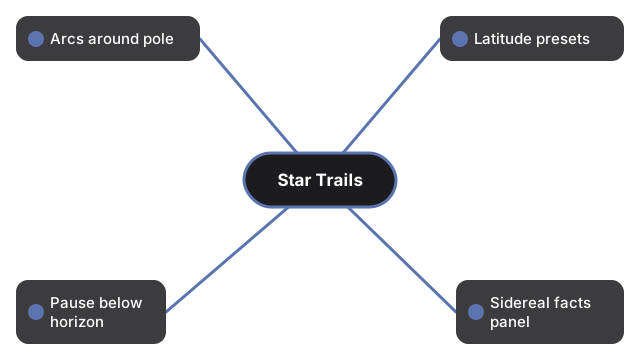
- Circular or partial-arc trails growing around a golden pole marker
- Equator, Mid-latitude, and Near pole presets change which stars stay circumpolar, because pole altitude equals the observer's latitude
- Play/Pause holds the motion; Reset clears the trails so they build again from empty
- Trails pause below the horizon and resume on rising
- Facts panel lists sidereal day, rotation rate, and circumpolar-star count
- Runs in the browser with three.js - no account, no upload
Circumpolar stars never set while others do - the pole-altitude-latitude rule explains why.
| Figure | Value | Source note |
|---|---|---|
| Sidereal day | 23h 56m 4s | Earth's rotation vs the stars |
| Diurnal rotation rate | 15 deg/hour | 360 deg per sidereal day |
| Circumpolar-circle radius | equals latitude (degrees) | Pole altitude = latitude |
Renders on-device with WebGL - engine loads once (~0.7 MB), cached, no data sent to a server.
An educational schematic using real pole-tilt geometry - not tonight sky, not a star catalog.
Star Trails 3D compared with its two sibling explorers
All three scenes are free and run in the browser; they teach different halves of diurnal motion, so the trade-off column is the one to read.
| Option | Strength | Access | Trade-off |
|---|---|---|---|
| Star Trails 3D (this page) | Circumpolar-circle and trail literacy | Free, in browser | Teaching schematic, not tonight sky |
| Constellation Sphere 3D | Static asterisms and magnitudes | Free web | Not a time-lapse trail view |
| Sidereal vs Solar Day 3D | Day-length comparison | Free web | Not the visual trail mechanism |
The when to use guide covers the classroom cases this scene suits and the ones a static asterism map serves better. Browse the rest of the Space 3D collection for related scenes.
Frequently Asked Questions
What does the Star Trails 3D Explorer show?
Stars that build growing trails around a golden pole marker as the scene rotates, with real pole-tilt geometry so latitude presets change which stars stay circumpolar.
How is this different from Constellation Sphere 3D?
Constellation Sphere 3D teaches static asterism shapes and star-catalog figures. This page teaches the diurnal-motion trail-building mechanism over time.
How is this different from Sidereal vs Solar Day 3D?
Sidereal vs Solar Day 3D compares day-length definitions. This page shows what that sidereal rotation actually looks like as circular star trails.
What determines whether a star is circumpolar?
A star stays above the horizon all night, tracing a full circle, when its angular distance from the celestial pole is smaller than your latitude.
Is this tonight real sky?
No. It is an educational diurnal-motion schematic with real pole-tilt vector geometry - not a star catalog matched to any specific date or location.
How long is a sidereal day?
About 23 hours, 56 minutes, and 4 seconds - slightly shorter than the familiar 24-hour solar day.