
Watch tidal heating flex Io into the solar system most volcanic body and keep a liquid ocean under Europa ice: Io has ~400 active volcanoes (NASA Juno); Europa keeps a subsurface ocean under a thin ice shell.
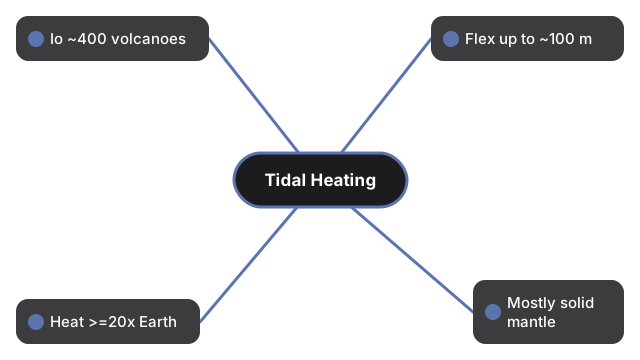
Published literacy: Io ~400 active volcanoes, surface flex up to ~100 m, heat flow at least 20x Earth; Europa subsurface ocean under a thin ice shell; driven by the 1:2:4 Io-Europa-Ganymede Laplace resonance.
Drag to orbit and scroll or pinch to zoom. Pause the orbits, or toggle the Europa ocean cutaway.
Tidal Heating 3D Explorer
freetoolonline.com editorial team
This explorer shows tidal heating: what the Io:Europa:Ganymede 1:2:4 resonance does to two moons. Io flexes with ~400 active volcanoes (NASA Juno); Europa keeps a subsurface ocean under thin ice.
Orbital Resonance 3D owns the 1:2:4 mechanics; Galilean Moons 3D owns the moon overview; this page owns the consequence.
- Io flexing with volcanic hotspots
- Europa ocean-cutaway toggle, plus Ganymede completing the 1:2:4 chain
- Facts panel lists volcano count, surface flex, heat flow, and the Juno finding
- Runs in-browser with three.js - no account, no upload
Io is the most volcanic body known; Europa's ocean is a leading habitability target.
| Figure | Value | Source note |
|---|---|---|
| Io active volcanoes | ~400 | NASA Juno estimate |
| Io surface flex | up to ~100 m | NASA |
| Io heat flow | at least 20x Earth | Published |
| Io interior (2025 Juno) | mostly solid mantle, localized melting | Juno gravity data |
| Europa | subsurface ocean, thin ice shell | Published |
| Resonance chain | 1:2:4 (Io:Europa:Ganymede) | Laplace 1771; predicted 1979 |
Renders on-device with WebGL - loads once (~0.7 MB), cached, no data sent to a server.
An educational schematic, not a solver - hotspots are stylized, the figures are real.
For the walkthrough, see the step-by-step guide. The Space 3D collection also includes Orbital Resonance 3D and Galilean Moons 3D.
Frequently Asked Questions
What does the Tidal Heating 3D Explorer show?
Io flexing with flickering volcanic hotspots and an Europa ocean-cutaway toggle, with Ganymede completing the 1:2:4 resonance chain. Literacy figures include ~400 Io volcanoes and a thin-ice-shell Europa ocean.
How is this different from Orbital Resonance 3D?
Orbital Resonance 3D teaches the 1:2:4 period-ratio mechanics itself. This page teaches the thermal and geological consequence - Io volcanism and the Europa ocean.
How is this different from Galilean Moons 3D?
Galilean Moons 3D gives a general four-moon overview. This page focuses specifically on tidal-heating outcomes for Io and Europa.
Does Io have a global magma ocean?
Recent NASA Juno gravity measurements (2025) indicate Io most likely has a mostly solid mantle with intense localized melting, not a shallow global magma ocean.
Is this an interior-structure simulator?
No. It is an educational schematic - not a magma-flow or interior-structure solver. Io flexing and hotspot flicker are stylized for visibility.
How many active volcanoes does Io have?
An estimated 400, according to NASA Juno mission data, making Io the most volcanically active body known in the solar system.