
Every 20 years or so, Jupiter catches up with slow-moving Saturn and the two line up in the sky - the famous great conjunction. This explorer runs their orbits so you can watch the line-ups happen and see how each one lands a little further around, tracing a slowly turning triangle.
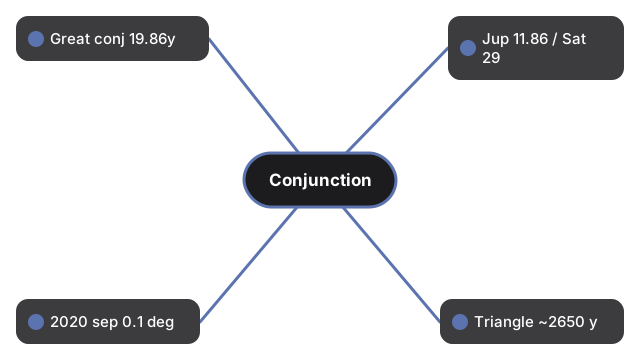
Published literacy: a great conjunction of Jupiter and Saturn happens every 19.86 years (from the synodic-period rule 1/S = 1/P_Jup - 1/P_Sat, with periods 11.86 and 29.46 years); the 2020 line-up on Dec 21 was just 0.1 degrees apart, the closest since 1623.
Drag to orbit and scroll or pinch to zoom. Change the speed, pause the motion, or hide the conjunction marks.
Planetary Conjunction 3D Explorer
When two planets line up in the same direction they are said to be in conjunction. The grandest of these is the great conjunction of the two giant planets, Jupiter and Saturn. Because Jupiter circles the Sun in 11.86 years while Saturn takes 29.46 years, the faster Jupiter catches up with Saturn and passes it every 19.86 years. This explorer runs both orbits so you can watch the line-ups happen and mark where each one falls.
That 19.86-year gap comes straight from the synodic-period rule, 1/S = 1/P_Jup - 1/P_Sat - the same arithmetic that sets how often any two planets meet. The last great conjunction, on 21 December 2020, brought the pair to just 0.1 degrees apart, the closest since 1623 and an easy naked-eye sight; the next is in 2040. Watch the orange markers the scene drops at each line-up: each new one lands about 117 degrees further around the sky, so three of them make a big triangle - and because the fit is not exact, that triangle slowly rotates, taking roughly 2,650 years to come full circle. Great conjunctions are the rarest of the naked-eye planet pairings, which is why they were watched so closely by ancient astronomers.
- Jupiter and Saturn orbiting the Sun at their real period ratio
- A bright line-up flash each time they share the same direction
- Orange markers that record every conjunction around the sky
- The slowly turning triangle (trigon) the markers trace
- A speed slider, pause, and a marks toggle
- Runs fully in the browser with the vendored three.js engine - no account, no upload
Skywatchers learn when the giants next meet; students connect the synodic-period rule to a real 20-year rhythm; teachers show why the conjunction triangle drifts across centuries.
| Figure | Value | Source note |
|---|---|---|
| Great conjunction period | 19.86 years | 1/S = 1/P_Jup - 1/P_Sat |
| Jupiter / Saturn periods | 11.86 / 29.46 years | Sidereal orbital periods |
| 2020 separation | 0.1 degrees | Closest since 1623; next 2040 |
| Triangle rotation | ~2,650 years | Marks advance ~117 deg each |
Everything renders on your device with WebGL. The 3D engine loads once (about 0.7 MB) and is cached; no scene data is sent to a server.
This is an educational visualization - orbits are drawn circular and not to scale, and the line-ups are shown from the Sun-centered view, so the exact Earth-sky date shifts a little. The numbers in the table are the real ones.
For a step-by-step walkthrough, read the Planetary Conjunction 3D Explorer step-by-step guide. The Space 3D collection also includes Retrograde Motion 3D and Kepler Orbits 3D.
Frequently Asked Questions
What is a planetary conjunction?
It is when two planets line up in the same direction in the sky. The most famous is the great conjunction, when Jupiter and Saturn appear closest together.
How often is a great conjunction?
Every 19.86 years. It follows the synodic-period rule 1/S = 1/P_Jup - 1/P_Sat, using orbital periods of 11.86 and 29.46 years for Jupiter and Saturn.
When was the last one, and the next?
The last great conjunction was on 21 December 2020, when the two planets were only 0.1 degrees apart - the closest since 1623. The next is in 2040.
Why do the conjunctions form a triangle?
Each line-up lands about 117 degrees further around the sky than the last, so three in a row make a big triangle. Because the fit is not exact, the triangle slowly rotates over about 2,650 years.
Are the planets actually close together?
No. They only appear close from our line of sight. In space Jupiter and Saturn stay hundreds of millions of kilometres apart during a conjunction.
Is this scene to scale?
No. The orbits are drawn circular and compressed so both fit the view, and the line-ups use the Sun-centered timing. The orbital periods and dates in the table are the real published values.