
On 14 February 1990, the Voyager 1 spacecraft - already well past Neptune and speeding away from the Sun forever - turned its cameras back toward home one final time. From about 40.5 AU away, Earth showed up as less than a single pixel, an accident of light barely visible inside a scattered ray of sunlight. Press play to watch Voyager recede to its real distance, then toggle the real photo layout to see the composition for yourself.
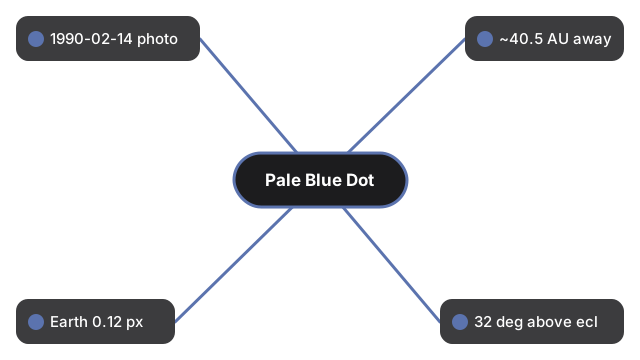
Published figures: the photo was taken 14 February 1990 at 04:48 GMT, from about 40.5 AU (3.7 billion miles / 6 billion km) away. Earth measured about 0.12 of a pixel in the final image.
Drag to orbit and scroll or pinch to zoom. Press Play, change the speed, or toggle the photo layout.
Pale Blue Dot 3D Explorer
By February 1990, Voyager 1 had already flown past Jupiter, Saturn, and every other planet it would ever visit, and was speeding out of the Solar System for good. Mission planners had one more idea before switching its cameras off forever to save power: turn them around, one last time, and take a "family portrait" of the Solar System it was leaving behind. The plan had been championed for years by Voyager imaging scientist Carl Sagan, and the exact command sequence was designed by JPL scientists Candy Hansen and Carolyn Porco.
On 14 February 1990, at 04:48 GMT, Voyager 1 captured 60 frames from about 40.5 astronomical units away - roughly 3.7 billion miles, or 6 billion kilometers. In one of them, Earth appeared as less than a single pixel: about 0.12 of a pixel, by NASA's own measurement, its light caught by pure chance inside a scattered ray of sunlight reflected off the camera's own optics. Thirty-four minutes later, at 05:22 GMT, Voyager 1 powered its cameras off for the final time. Sagan later titled his 1994 book after the photograph, writing of it: "Look again at that dot. That's here. That's home. That's us."
- Voyager 1 receding to its real, cited distance of 40.5 AU from Earth
- A recreated photo layout showing the scattered light rays and Earth's real sub-pixel dot
- A Play/Pause journey out to Voyager's actual vantage point
- A speed slider over the whole receding sequence
- Runs fully in the browser with the vendored three.js engine - no account, no upload
Anyone who has heard Sagan's "that's home, that's us" line gets to see, in 3D, just how far away Voyager really was when it looked back; students see a concrete example of how light artifacts and real astronomical distance combine in a single historic image.
| Figure | Value | Source note |
|---|---|---|
| Date taken | 14 February 1990, 04:48 GMT | Part of a 60-frame Family Portrait |
| Distance from Earth | about 40.5 AU | 3.7 billion miles / 6 billion km |
| Earth's size in the photo | about 0.12 of a pixel | Below the camera's resolution |
| Vantage point | about 32 degrees above the ecliptic | NASA |
| Cameras powered off | 34 minutes later, permanently | To save power for the ongoing mission |
Everything renders on your device with WebGL. The 3D engine loads once (about 0.7 MB) and is cached; no scene data is sent to a server.
This is an educational visualization, not a pixel-accurate reproduction of the real photograph - the Sun, Earth, and Voyager model are all enlarged for visibility, and the recreated photo layout is illustrative, built to demonstrate the real composition rather than reproduce it exactly.
For a step-by-step walkthrough, read the Pale Blue Dot 3D Explorer step-by-step guide. The Space 3D collection also includes Solar Wind Heliosphere 3D Explorer, which follows Voyager 1's later crossing into interstellar space in 2012.
Frequently Asked Questions
What is the Pale Blue Dot?
A photograph of Earth taken by Voyager 1 on 14 February 1990, from about 40.5 AU away, part of a 60-frame "Family Portrait" of the Solar System.
How small does Earth look in the photo?
Less than a single pixel - about 0.12 of a pixel, caught inside a scattered ray of reflected sunlight.
Whose idea was the photo?
Voyager imaging scientist Carl Sagan championed the idea; JPL scientists Candy Hansen and Carolyn Porco designed the exact command sequence.
What happened right after the photo was taken?
Just 34 minutes later, Voyager 1 powered off its cameras permanently, to save power for its ongoing journey out of the Solar System.
What is the famous quote about the photo?
Carl Sagan, in his 1994 book named after the image: "Look again at that dot. That's here. That's home. That's us."
How far away was Voyager 1 when it took the photo?
About 40.5 astronomical units - roughly 3.7 billion miles, or 6 billion kilometers.
Is this scene to scale?
No. The Sun, Earth, and Voyager model are enlarged for visibility, and the recreated photo layout is illustrative, not a pixel-accurate reproduction of the real photograph.