
When two galaxies swing past each other, gravity pulls the near side harder than the far side - and that difference flings their outer stars into long, curving tidal tails. This explorer runs a live restricted N-body of the encounter, the same idea Toomre and Toomre used in 1972.
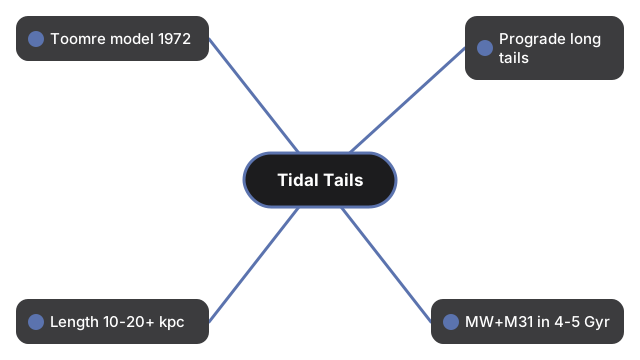
Published literacy: Toomre and Toomre (1972) proved tails form from close, roughly parabolic passages; prograde spin and comparable masses make the longest tails (the Antennae and the Mice); tails run 10 to 20 kpc, some over 100 kpc. The Milky Way and Andromeda merge in about 4-5 billion years.
Drag to orbit and scroll or pinch to zoom. Pause the encounter, or press Replay to run it again.
Galaxy Tidal Tails 3D Explorer
Galaxies are not solid objects - they are loose swarms of billions of stars held together by gravity. When two of them pass close, gravity tugs the near side of each disk harder than the far side, and that difference (a tidal force) tears the outer stars into long, graceful streamers called tidal tails. This explorer runs the encounter as a live restricted N-body: two galaxy cores orbit each other while hundreds of test-particle "stars" respond to their pull.
That is exactly how Alar and Juri Toomre settled the question in 1972. Skeptics had argued that gravity could only make broad smears, not thin tails. The Toomres modelled each galaxy as a disk of noninteracting test particles orbiting a central mass, sent one past another on a roughly parabolic orbit, and reproduced the crossed tails of the Antennae (NGC 4038/9) and the Mice (NGC 4676). Two things make the tails long and prominent: prograde spin (the disk turning the same way as the orbit) and comparable masses. Real tails stretch 10 to 20 kiloparsecs, and some exceed 100 kpc (one kpc is about 3,260 light-years). Our own Milky Way will grow tails like these when it merges with Andromeda in about 4 to 5 billion years.
- Two galaxy disks (blue and orange stars) swinging past each other
- Tidal tails and a bridge pulled out live by gravity as they pass
- A restricted N-body: stars feel the two cores, following the Toomre 1972 method
- Pause the encounter or press Replay to run it again
- Facts panel with Toomre 1972, the Antennae and Mice, and tail lengths
- Runs fully in the browser with the vendored three.js engine - no account, no upload
Students see why a near-far difference in pull makes tails, not smears; teachers connect prograde spin to tail length; curious readers watch a real 1972 result run in their browser.
| Figure | Value | Source note |
|---|---|---|
| Founding model | Toomre and Toomre, 1972 | Test-particle disks, parabolic passage |
| Longest tails when | prograde spin + comparable masses | Antennae, Mice |
| Tail length | ~10-20 kpc, some over 100 kpc | 1 kpc ~ 3,260 ly |
| Milky Way + Andromeda | ~4-5 billion years | Future merger |
Everything renders on your device with WebGL. The 3D engine loads once (about 0.7 MB) and is cached; no scene data is sent to a server.
This is an educational visualization - a simplified restricted N-body (stars feel the two cores but not each other; no gas or dark halo), with scale, speed, and star count chosen for clarity.
For a step-by-step walkthrough, read the Galaxy Tidal Tails 3D Explorer step-by-step guide. The Space 3D collection also includes N-Body Sandbox 3D and Galaxy 3D.
Frequently Asked Questions
What are tidal tails?
They are long streamers of stars and gas pulled out of galaxies when two galaxies pass close. Gravity tugs the near side of a disk harder than the far side, and that difference flings the outer stars away.
Who first explained them?
Alar and Juri Toomre, in 1972. They modelled each galaxy as a disk of test particles orbiting a central mass and showed that a close passage naturally produces thin, curving tails - reproducing the Antennae and the Mice.
Why do some encounters make longer tails?
Tails are longest when the disk spins the same way as the orbit (prograde) and when the two galaxies have comparable masses. Retrograde spin makes much weaker features.
How long are real tidal tails?
Typically 10 to 20 kiloparsecs, and some exceed 100 kpc - one kiloparsec is about 3,260 light-years, so these tails are far larger than the galaxies themselves.
Will this happen to the Milky Way?
Yes. The Milky Way and the Andromeda galaxy are approaching and will merge in about 4 to 5 billion years, drawing out tidal tails much like the ones in this scene.
Is this a full galaxy simulation?
No. It is a simplified restricted N-body: the stars feel the two cores but not each other, and there is no gas or dark-matter halo. Scale, speed, and star count are chosen for clarity.