
Watch why seasons happen - scrub the year, jump to equinox and solstice, and track the yellow subsolar point between the tropics while the panel lists obliquity 23.44 deg and perihelion about 0.983 AU in January.
Play year walks Earth around the Sun with a fixed 23.44 deg axis tilt; pause and jump to June or December to see the subsolar point at about +/-23.44 deg, or to March/September for near 0 deg.
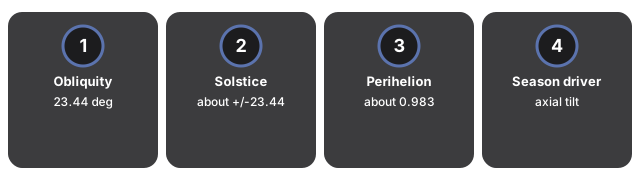
Obliquity is about 23.44 deg. Solstice solar declination reaches about +/-23.44 deg. Perihelion is about 0.983 AU in early January - which proves distance is not the seasonal driver for the northern winter. This is an educational geometry visualization, not a climate or weather model.
Seasons Earth 3D Explorer
FreetoolOnline editorial teamSeasons happen because Earth's spin axis stays tilted about 23.44 deg while Earth orbits the Sun - scrub the year, jump to equinox and solstice, and track the yellow subsolar point between the tropics while the panel lists perihelion about 0.983 AU in early January.
Drag to orbit the view, scroll or pinch to zoom, and press Play year. Jump to Mar/Sep equinox or Jun/Dec solstice, toggle tropic guides, and scrub Day of year to park anywhere on the path.
The facts panel lists obliquity 23.44 deg, approximate solar declination, northern season labels, and perihelion about 0.983 AU. The season driver is axial tilt - not orbital distance - so January perihelion can sit next to northern winter without contradiction.
- Earth on a compressed year orbit with fixed axial tilt 23.44 deg
- Yellow subsolar marker tracking approximate solar declination
- Tropics of Cancer and Capricorn guide circles
- Equinox / solstice jump buttons plus day scrub and Play year
- Published obliquity and perihelion figures in the facts panel
- Runs fully in the browser with the vendored three.js engine - no account, no upload
Teachers use it to show that tilt - not Earth-Sun distance - drives seasons, students jump between solstices to see the subsolar point climb, and curious readers compare January perihelion with northern winter.
| Quantity | Value | Source |
|---|---|---|
| Obliquity | 23.44 deg | IAU / Earth orientation |
| Solstice declination | about +/-23.44 deg | Geometric from obliquity |
| Perihelion | about 0.983 AU (early January) | Earth ephemeris |
| Season driver | axial tilt (not orbital distance) | Standard astronomy literacy |
Everything renders on your device with WebGL. The 3D engine loads once (about 0.7 MB) and is cached; no scene data is sent to a server.
The scene is an educational visualization of tilt geometry - orbit size is compressed, declination is an approximate sine model, and it is not a climate, weather, or insolation-energy model, nor a live ephemeris for today's exact solar declination.
For a step-by-step walkthrough, read the Seasons Earth 3D Explorer step-by-step guide. When you need session fit and limits, see when to use Seasons Earth 3D Explorer. The Space 3D collection also includes a Earth 3D Globe for live day/night and a Precession of the Equinoxes 3D Explorer for long-term pole migration.
Frequently Asked Questions
What does Seasons Earth 3D Explorer show?
Earth with a fixed 23.44 deg axial tilt on a year orbit, a yellow subsolar marker, tropic guides, and a panel with obliquity, declination, and perihelion about 0.983 AU.
How is this different from Earth 3D Globe?
Earth 3D Globe shows live day and night on a zoomable map. Seasons Earth 3D Explorer teaches the seasonal mechanism - tilt, solstice/equinox geometry, and why perihelion does not drive seasons.
Why is perihelion in January during northern winter?
Earth is closest to the Sun around early January (about 0.983 AU), yet northern winter shows that axial tilt - not distance - sets the seasons. The panel states this contrast on purpose.
What are the solstice declinations?
About +/-23.44 deg - the same magnitude as Earth's obliquity - when the subsolar point reaches the Tropic of Cancer or Capricorn.
Is this a climate or weather model?
No. The scene is an educational geometry visualization. It does not compute energy budgets, heat transport, or forecasts.
Are day-of-year labels exact calendar dates?
They are approximate teaching marks (about day 80 / 172 / 266 / 355 for equinoxes and solstices). Real calendars shift slightly with leap years and ephemerides.