
Take a photo of the Sun at the same clock time every day for a year and the images trace a figure-8 in the sky - the analemma. Its side-to-side swing is the equation of time: how far a sundial runs ahead of or behind your clock, by up to about 16 minutes.
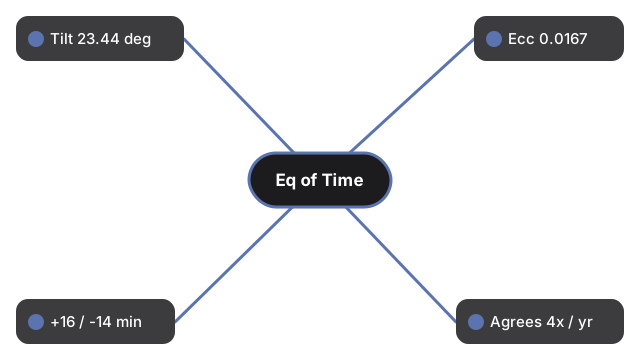
Published literacy: the equation of time comes from Earth axial tilt (23.44 deg) and orbital eccentricity (0.0167); it peaks near +16 min (early November) and -14 min (mid February), and reads zero about four times a year.
Drag to orbit and scroll or pinch to zoom. Pause the Sun or toggle the month markers.
Equation of Time 3D Explorer
Clocks tick out a perfectly even day, but the Sun does not keep such tidy time. If you mark the Sun position at the same clock time every day for a year, the marks trace a graceful figure-8 in the sky called the analemma. Its up-and-down reach is the changing seasons; its side-to-side swing is the equation of time - the gap between sundial time and clock time. This explorer draws that figure-8 and runs the Sun around it.
Two things combine to make it. First, Earth axial tilt of 23.44 degrees means the Sun apparent speed along the sky changes through the year (a twice-a-year effect). Second, Earth orbit is slightly eccentric (0.0167), so the planet moves faster near perihelion and slower near aphelion (a once-a-year effect). Add the two and a sundial can run up to about 16 minutes ahead of the clock in early November, and about 14 minutes behind in mid February; four times a year the two agree. The shape of the analemma does not depend on your latitude - only where it sits in your sky does.
- The analemma figure-8 traced by the Sun over a year
- The Sun moving along it, day by day
- Blue month markers around the loop
- Up-down shows solar declination; left-right shows the equation of time
- Facts panel with the two causes and the +16 / -14 minute extremes
- Runs fully in the browser with the vendored three.js engine - no account, no upload
Students see why noon on a sundial is rarely noon on a clock; teachers separate the tilt effect from the eccentricity effect; curious readers learn what that mysterious figure-8 on old globes and sundials means.
| Figure | Value | Source note |
|---|---|---|
| Axial tilt | 23.44 deg | Twice-a-year term |
| Orbital eccentricity | 0.0167 | Once-a-year term |
| Sundial ahead / behind | +16 min / -14 min | Early Nov / mid Feb |
| Agrees with clock | ~4 times a year | Apr 15, Jun 13, Sep 1, Dec 25 |
Everything renders on your device with WebGL. The 3D engine loads once (about 0.7 MB) and is cached; no scene data is sent to a server.
This is an educational visualization - the analemma uses a standard approximation for the Sun position and is not drawn to exact scale.
For a step-by-step walkthrough, read the Equation of Time 3D Explorer step-by-step guide. The Space 3D collection also includes Earth 3D Globe and Moon Libration 3D.
Frequently Asked Questions
What is the equation of time?
It is the difference between sundial time (where the Sun actually is) and clock time (an even, averaged day). It changes through the year, reaching about +16 and -14 minutes.
What is the analemma?
It is the figure-8 the Sun traces if you photograph it at the same clock time every day for a year. Its width is the equation of time; its height is the Sun changing declination.
Why does a sundial run ahead or behind?
Two reasons combine: Earth axial tilt changes the Sun apparent speed along the sky twice a year, and Earth eccentric orbit makes it move faster or slower once a year. Together they shift solar noon away from clock noon.
When is a sundial correct?
About four times a year, when the equation of time crosses zero - near April 15, June 13, September 1, and December 25.
Does the analemma depend on where I live?
Its shape does not - the figure-8 is the same everywhere. Your latitude and the chosen time of day only change where it appears in your sky and how it tilts.
Is this scene exact?
No. It uses a standard approximation for the Sun position and is not drawn to exact scale. It is meant to show the shape of the analemma and the size of the equation of time.