
Pick the Moon, Earth, Mars, Jupiter, or the Sun and watch four trajectory classes side by side - sub-orbital falls back, circular orbit at v_esc/sqrt(2), escape at v_esc, hyperbolic above v_esc.
Orange is sub-orbital (falls back), green is a closed circular orbit, yellow is escape at v_esc, purple is hyperbolic excess speed. Click the central body for the same facts panel readout.
Drag to orbit the view and scroll or pinch to zoom. Pause paths freezes the moving markers so you can compare curve shapes.
Escape Velocity 3D Explorer
Compare four launch-speed classes relative to the Moon, Earth, Mars, Jupiter, or the Sun - sub-orbital paths fall back, circular orbits close at v_esc/sqrt(2), escape paths reach v_esc, and hyperbolic trajectories carry excess speed.
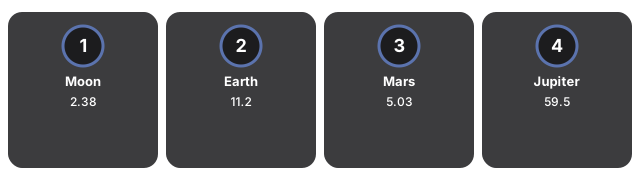
Pick a body from the dropdown and watch colored paths animate together. The facts panel lists NASA JPL Solar System Dynamics escape velocities: Moon 2.38 km/s, Earth 11.2, Mars 5.03, Jupiter 59.5, Sun 617.7.
Pause paths freezes the markers on each curve so you can read the trajectory table without chasing dots. Click the central body for the same readout.
- Five bodies with NASA/SSD published escape velocities (km/s)
- Sub-orbital, circular (v_esc/sqrt(2)), escape (v_esc), and hyperbolic paths shown together
- Facts panel with escape velocity table and circular-orbit speed for the selected body
- Trajectory table button lists all four speed rules in one view
- Runs fully in the browser with the vendored three.js engine - no account, no upload
Physics students see why circular orbit speed is exactly v_esc divided by sqrt(2), spaceflight readers compare how much harder Earth is than the Moon, and curious visitors get a one-screen map of the four trajectory families.
| Body | Escape velocity (km/s) | Circular orbit (km/s) |
|---|---|---|
| Moon | 2.38 | 1.68 |
| Earth | 11.2 | 7.92 |
| Mars | 5.03 | 3.56 |
| Jupiter | 59.5 | 42.0 |
| Sun | 617.7 | 436.7 |
Everything renders on your device with WebGL. The 3D engine loads once (about 0.7 MB) and is cached; no scene data is sent to a server.
The scene is an educational visualization of ideal two-body trajectories - it does not integrate n-body gravity, does not model atmospheric drag or staged rockets, and compresses path shapes for one-screen teaching. The escape velocity figures in the table are NASA JPL SSD published values.
For a step-by-step walkthrough, read the Escape Velocity 3D Explorer step-by-step guide. When you need session fit and limits, see when to use Escape Velocity 3D Explorer. The Space 3D collection also includes the Gravity Well 3D Explorer and the Kepler Orbits 3D Explorer.
Frequently Asked Questions
What does the Escape Velocity 3D Explorer show?
Four trajectory classes relative to a chosen body - sub-orbital (falls back), circular orbit at v_esc/sqrt(2), escape at v_esc, and hyperbolic above v_esc - with NASA/SSD escape velocities for the Moon, Earth, Mars, Jupiter, and Sun.
What are the published escape velocities?
Moon 2.38 km/s, Earth 11.2, Mars 5.03, Jupiter 59.5, and Sun 617.7 - the NASA JPL Solar System Dynamics figures used throughout this page.
Why is circular orbit speed v_esc divided by sqrt(2)?
In the ideal two-body model, a circular orbit has half the kinetic energy of escape at the same radius, so its speed is v_esc / sqrt(2). The facts panel computes that value for whichever body you select.
What is the difference between escape and hyperbolic?
At exactly v_esc the path is parabolic - the probe reaches zero kinetic energy at infinite distance in the ideal model. Above v_esc the path is hyperbolic and the probe keeps excess speed as it recedes.
Where do the numbers come from?
NASA JPL Solar System Dynamics and planetary fact sheets for escape velocities at each body's surface (or photosphere for the Sun). The page cites those published figures and does not invent intermediate values.
Is this an n-body gravity simulation or a rocket game?
No. It is an educational visualization that draws schematic trajectory curves tuned for one-screen teaching. Path shapes and distances are compressed; the escape velocity figures in the panel are real.