
Put a bright galaxy directly behind a massive one and gravity bends its light around every side at once - it appears as a glowing ring. This is an Einstein ring, the most elegant form of gravitational lensing. Drift the alignment and the ring splits into arcs and separate images.
Published literacy: the ring size is the Einstein radius, theta_E = sqrt(4GM/c^2 x D_LS/(D_L D_S)); the Sun bends grazing starlight by 1.75 arcsec (twice the Newtonian value), confirmed by Eddington in 1919; the first Einstein ring (MG1131+0456) was found in 1988.
Drag to orbit and scroll or pinch to zoom. Pause the drift or hide the light rays.
Einstein Ring 3D Explorer
Gravity bends light. When a bright galaxy sits almost exactly behind a massive foreground galaxy, the foreground gravity deflects the background light around every side at once, and we see the distant galaxy smeared into a glowing ring - an Einstein ring. This explorer shows a source behind a lens, the ring it produces, and how that ring breaks into two bright arcs (and eventually separate images) as the alignment drifts off centre.
The ring size is the Einstein radius, theta_E = sqrt(4GM/c^2 x D_LS/(D_L D_S)), set by the lens mass and the distances involved. Light bending is the classic test of general relativity: Einstein predicted the Sun would deflect grazing starlight by 1.75 arcseconds - exactly twice the value from Newtonian gravity - and Arthur Eddington confirmed it during the total solar eclipse of 1919. The first Einstein ring, the radio source MG1131+0456, was found in 1988; the Hubble Space Telescope has since imaged many, and the Einstein Cross shows a single quasar as four images around a lens.
- A source behind a lens galaxy, bent into a ring when aligned
- The ring morphing into two arcs as the alignment drifts
- Illustrative light rays bending over and under the lens
- Pause the drift or hide the light rays
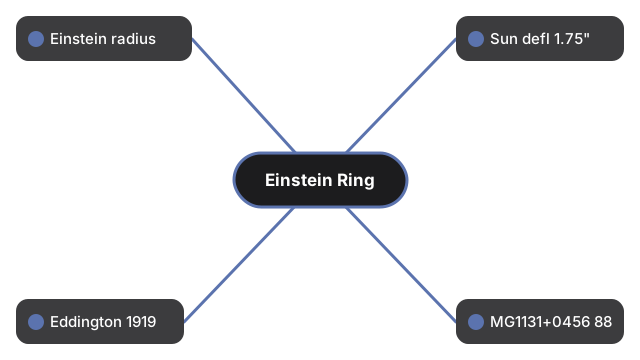
- Facts panel with the Einstein radius, the 1.75 arcsec Sun deflection, and Eddington 1919
- Runs fully in the browser with the vendored three.js engine - no account, no upload
Students see why perfect alignment makes a ring and imperfect alignment makes arcs; teachers connect the bending angle to general relativity; curious readers learn that the "ring" is really the distorted image of a galaxy far behind.
| Figure | Value | Source note |
|---|---|---|
| Einstein radius | theta_E = sqrt(4GM/c^2 x D_LS/(D_L D_S)) | Sets the ring size |
| Sun light deflection | 1.75 arcsec at the limb | Twice the Newtonian value |
| Confirmed | Eddington, 1919 eclipse | Principe + Sobral |
| First ring | MG1131+0456, 1988 | Einstein Cross = 4 images |
Everything renders on your device with WebGL. The 3D engine loads once (about 0.7 MB) and is cached; no scene data is sent to a server.
This is an educational visualization - the alignment, sizes, and ring radius are exaggerated for clarity (real Einstein rings span only a few arcseconds), and the light paths are illustrative, not a ray-traced lens model.
For a step-by-step walkthrough, read the Einstein Ring 3D Explorer step-by-step guide. The Space 3D collection also includes Gravitational Redshift 3D and Spacetime Curvature 3D.
Frequently Asked Questions
What is an Einstein ring?
It is the ring-shaped image of a distant source whose light is bent around a massive foreground object. It appears when the source, the lens, and the observer are in near-perfect alignment.
Why does the ring break into arcs?
A perfect ring needs perfect alignment. When the source is slightly off-centre, the lensing is stronger on the aligned sides, so the ring concentrates into two bright arcs and, at larger offsets, separate images.
How big is an Einstein ring?
Its angular size is the Einstein radius, which grows with the square root of the lens mass and depends on the distances. Galaxy-scale rings are a few arcseconds across; the scene here is greatly exaggerated.
How was light bending first proven?
Einstein predicted the Sun would deflect grazing starlight by 1.75 arcseconds, twice the Newtonian value. Arthur Eddington measured it during the 1919 total solar eclipse, making the prediction famous.
What is the Einstein Cross?
It is a lensing configuration where a single distant quasar appears as four separate images arranged around the foreground lens galaxy - what you get when the alignment is offset rather than exact.
Is this scene physically exact?
No. The alignment, sizes, and ring radius are exaggerated so the effect is visible, and the light paths are illustrative rather than a ray-traced lens model.