
Watch a Cepheid variable pulse and compare periods with the Leavitt Law: M_V = -2.43(log10 P - 1) - 4.05. Delta Cephei pulses about every 5.37 days.
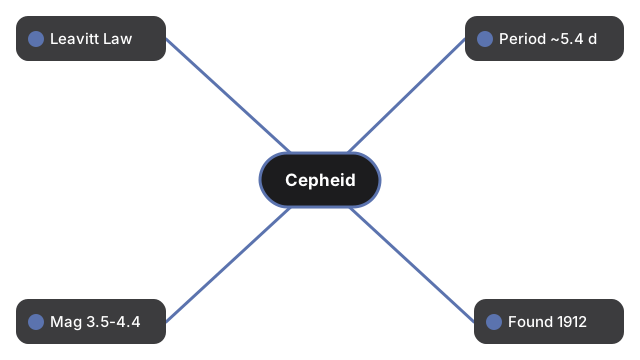
Published literacy: Delta Cephei period ~5.366 days (visual magnitude 3.5 to 4.4); Leavitt Law M_V = -2.43(log10 P - 1) - 4.05 (HST-parallax calibration, Benedict et al. 2007).
Drag to orbit and scroll or pinch to zoom. Switch period presets or pause the pulse.
Cepheid Variable Star 3D Explorer
freetoolonline.com editorial team
This browser explorer shows a pulsating Cepheid variable star and the Leavitt period-luminosity law: M_V = -2.43(log10 P - 1) - 4.05, calibrated from HST parallaxes (Benedict et al. 2007). Delta Cephei, the class prototype, pulses about every 5.366 days.
Cosmic Distance Ladder 3D names the Cepheid rung only, without solving it. Stellar Magnitude 3D owns brightness-ranking literacy. This page owns the pulsation and period-luminosity relation itself.
- A pulsating star that brightens and dims on a stylized cycle
- A scrolling light-curve strip below the star
- Delta Cephei, short-period, and long-period presets
- Live-computed absolute magnitude from the real Leavitt Law formula
- Facts panel lists the formula, Delta Cephei figures, and the Leavitt 1908/1912 discovery
- Distinct from cosmic-distance-ladder and stellar-magnitude
- Runs fully in the browser with the vendored three.js engine - no account, no upload
Students see why period alone predicts brightness; teachers connect this page to the standard-candle idea behind the distance ladder; curious readers learn who discovered the relation and when.
| Figure | Value | Source note |
|---|---|---|
| Leavitt Law formula | M_V = -2.43(log10 P - 1) - 4.05 | HST-parallax calibration, Benedict et al. 2007 |
| Delta Cephei period | ~5.366 days | Published literacy |
| Delta Cephei visual magnitude range | 3.5 to 4.4 | AAVSO |
| Leavitt discovery | 1908, published 1912 | 25 SMC Cepheids of 1777 catalogued variables |
Everything renders on your device with WebGL. The 3D engine loads once (about 0.7 MB) and is cached; no scene data is sent to a server.
This is an educational schematic with a real calibration formula - not a kappa-mechanism pulsation solver. Star size and brightness pulses are stylized for legibility.
For a step-by-step walkthrough, read the Cepheid Variable Star 3D Explorer step-by-step guide. The Space 3D collection also includes Cosmic Distance Ladder 3D and Stellar Magnitude 3D.
Frequently Asked Questions
What does the Cepheid Variable Star 3D Explorer show?
A pulsating star with a scrolling light-curve strip, plus Delta Cephei, short-period, and long-period presets. The facts panel computes absolute magnitude live from the real Leavitt Law formula.
How is this different from Cosmic Distance Ladder 3D?
Cosmic Distance Ladder 3D names the Cepheid rung only, without solving it. This page teaches the pulsation and period-luminosity relation itself.
How is this different from Stellar Magnitude 3D?
Stellar Magnitude 3D teaches apparent versus absolute brightness ranking generally. This page focuses on Cepheid pulsation period and the Leavitt Law.
What is the Leavitt Law?
A period-luminosity relation discovered by Henrietta Swan Leavitt in 1908 and published in 1912: longer pulsation period means a brighter Cepheid, which lets astronomers use them as standard candles.
Is this a stellar pulsation simulator?
No. It applies a real calibration formula live, but it does not solve the kappa-mechanism physics behind why Cepheids pulsate.
What is the period of Delta Cephei?
About 5.366 days, with visual magnitude ranging from 3.5 to 4.4 over that cycle.