
In a close pair of stars, each one holds a teardrop-shaped territory called its Roche lobe. The two lobes touch at a single bridge, the L1 point. Swell the orange donor star until it fills its lobe and you will see gas pour through L1 onto the blue companion - the mass transfer that powers novae and the famous Algol paradox.
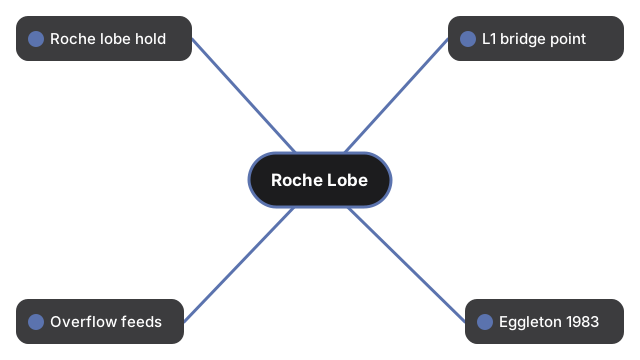
Published literacy: a Roche lobe is the teardrop region where a star gravity dominates in a binary; the two lobes meet at the inner Lagrange point L1; a star that swells to fill its lobe spills matter through L1 onto its companion (Roche-lobe overflow), and the lobe size follows the Eggleton (1983) formula.
Drag to orbit and scroll or pinch to zoom. Slide the donor fill from detached to overflowing, toggle the mass transfer, or pause the motion.
Roche Lobe Binary 3D Explorer
When two stars orbit close together, gravity carves space into two teardrop-shaped territories called Roche lobes - one around each star, meeting nose to nose at a single bridge known as the inner Lagrange point, L1. Inside its lobe, a star holds onto its own gas; at L1 the pull of the two stars balances exactly. This explorer draws those lobes for a real pair and lets you swell the donor star until gas begins to pour across.
As long as both stars sit comfortably inside their lobes, the binary is detached and each evolves alone. But stars grow as they age, and if one swells to fill its Roche lobe, it finds a gap in its own surface at L1 and matter streams through the nozzle onto the companion - a process called Roche-lobe overflow. The falling gas usually cannot hit the small companion directly; it swirls into an accretion disk first. This single idea explains a huge range of sights in the sky: nova outbursts and cataclysmic variables where a white dwarf feeds off a companion, luminous X-ray binaries, and the long-standing Algol paradox, in which the less massive star of a pair looks the more evolved - because it was once the heavier star and gave much of its mass away. The size of each lobe depends only on the mass ratio, captured by the Eggleton (1983) formula, and this scene computes the real Roche equipotential for the chosen masses.
- The true Roche lobes of a binary, computed from the co-rotating potential
- The L1 bridge marked where the two lobes meet
- A donor-fill slider from a detached pair to an overflowing one
- A mass stream through L1 and an accretion disk around the companion
- A mass-transfer toggle and orbital spin
- Runs fully in the browser with the vendored three.js engine - no account, no upload
Students meet the geometry behind binary mass transfer; teachers connect detached, semi-detached, and contact binaries; the curious learn why some doomed stars feed their partners.
| Term | Meaning | Note |
|---|---|---|
| Roche lobe | where a star gravity holds its gas | Teardrop, one per star |
| L1 point | the bridge between the lobes | Gravity balances here |
| Roche-lobe overflow | a filled lobe feeds the companion | Forms an accretion disk |
| Lobe radius | Eggleton 1983 formula of mass ratio | Accurate to under 1% |
Everything renders on your device with WebGL. The 3D engine loads once (about 0.7 MB) and is cached; no scene data is sent to a server.
This is an educational visualization - the lobes are the real Roche equipotential, but the mass stream and accretion disk are schematic, and the scene is not to scale.
For a step-by-step walkthrough, read the Roche Lobe Binary 3D Explorer step-by-step guide. The Space 3D collection also includes Binary Star System 3D and Lagrange Points 3D.
Frequently Asked Questions
What is a Roche lobe?
It is the teardrop-shaped region around a star in a binary where that star gravity dominates and can hold onto its gas. Each star has its own lobe, and the two meet at the L1 point.
What is the L1 point?
The inner Lagrange point, the bridge where the two Roche lobes touch. There the gravitational pull of the two stars balances, so matter can cross from one lobe into the other.
What is Roche-lobe overflow?
When a star swells to fill its Roche lobe, gas escapes through L1 and streams onto the companion. This mass transfer usually forms an accretion disk around the receiving star.
Why does this matter?
Roche-lobe overflow powers nova outbursts and cataclysmic variables, feeds X-ray binaries, and explains the Algol paradox, where the less massive star looks more evolved because it gave away mass.
How big is a Roche lobe?
Its size depends on the mass ratio of the two stars. The Eggleton 1983 formula gives the lobe radius as a fraction of the orbital separation, accurate to better than one percent.
Is this scene to scale?
The lobes themselves are the real Roche equipotential computed in the co-rotating frame. The mass stream and accretion disk are schematic, and the sizes are not to scale.