
Watch Earth's tilted axis (~23.44 deg) sweep a slow precession cone over ~25,772 yr. Pole path, Polaris (now), and Vega (~14,000 CE) mark the teaching cycle at ~1 deg per ~72 yr.
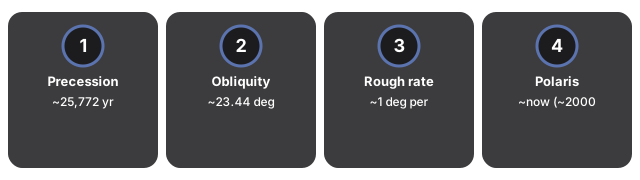
Precession period ~25,772 yr (IAU teaching figure). Rough rate ~1 deg per ~72 yr. Polaris is the current north-star approximation; Vega will be near the pole around ~14,000 CE.
Drag to orbit and scroll or pinch to zoom. Scrub Year across kyr, Jump Polaris / Vega for markers, or Play kyr for a slow cycle with optional Pause.
Precession of the Equinoxes 3D Explorer
Earth's spin axis migrates on a slow cone: obliquity about 23.44 deg sets the cone half-angle, while axial precession completes one loop in about 25,772 yr (IAU teaching figure) at a rough rate of about 1 deg per 72 yr.
The celestial pole traces a ring. Polaris approximates the north star near the present epoch; Vega lies near the pole around 14,000 CE as an order-of-magnitude teaching marker - not a precise catalog epoch.
Use the year scrubber to move across kyr, Jump Polaris / Jump Vega for presets, Play kyr for a slow auto sweep (Pause to stop), and Facts table to restore the teaching figures.
- Earth with tilted spin axis (about 23.44 deg obliquity labeled)
- Slow precession cone and celestial pole path ring
- Markers for Polaris (now) and Vega (about 14 kyr later)
- Year scrub, play/pause across kyr, Jump Polaris / Vega
- Facts panel with period, rate, and approximation honesty
- Runs fully in the browser with the vendored three.js engine - no account, no upload
Students scrub the pole from Polaris toward Vega; teachers demo why north stars change over millennia; curious readers see axial precession without needing an ephemeris.
| Feature | Figure | Source note |
|---|---|---|
| Precession period | about 25,772 yr | IAU teaching figure |
| Obliquity | about 23.44 deg | Axial tilt label on cone |
| Rough rate | about 1 deg per 72 yr | 360 deg / 25,772 yr |
| Polaris | about now (about 2000 CE) | Current north-star approximation |
| Vega | about 14,000 CE | Order-of-magnitude near-pole teaching |
Everything renders on your device with WebGL. The 3D engine loads once (about 0.7 MB) and is cached; no scene data is sent to a server.
The scene is a teaching visualization of axial precession - the spin-axis tip moves on a fixed obliquity cone. It is not an ephemeris, not a Hipparcos or Gaia catalog placement of Polaris or Vega, and it does not model nutation or planetary perturbations.
For a step-by-step walkthrough, read the Precession of the Equinoxes 3D Explorer step-by-step guide. When you need session fit and limits, see when to use Precession of the Equinoxes 3D Explorer. The Space 3D collection also includes Seasons on Earth 3D, the Ecliptic Zodiac 3D Explorer, and the Milankovitch Cycles 3D Explorer for this same precession wobble combined with the other two orbital cycles on one long timeline.
Frequently Asked Questions
What does the Precession of the Equinoxes 3D Explorer show?
Earth's tilted axis (~23.44 deg) sweeping a precession cone, the celestial pole path ring, Polaris (now), and Vega (~14,000 CE) over a ~25,772 yr teaching cycle.
Where does ~25,772 yr come from?
It is an IAU-style teaching figure for the axial precession period used in astronomy literacy. Rough rate ~1 deg per ~72 yr follows from 360 deg / 25,772 yr.
Why Polaris and Vega?
Polaris is the current north-star approximation. Vega will be near the north celestial pole around ~14,000 CE as an order-of-magnitude teaching marker.
Is this an ephemeris or star catalog?
No. It is a teaching visualization of axial precession geometry - not an ephemeris or precise star catalog.
How do I scrub time?
Drag Year across kyr, Jump Polaris or Jump Vega for presets, or Play kyr for a slow auto sweep (Pause to stop). Facts table restores the summary figures.
How is obliquity used here?
~23.44 deg is the labeled cone half-angle between the spin axis and the ecliptic normal - the same teaching obliquity used in seasons demos.