
Sunspots come in opposite-polarity pairs, joined by coronal loops - magnetic flux tubes that arc high into the Sun corona. The umbral field reaches ~0.3 T and channels million-kelvin plasma along these arcs.
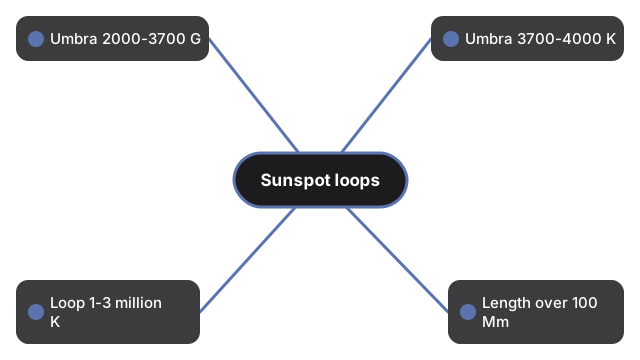
Published literacy: sunspot umbral magnetic field 2000-3700 gauss (0.2-0.37 T); umbra temperature ~3700-4000 K against the ~5800 K photosphere; coronal loops at 1-3 million K spanning tens to over 100 Mm.
Drag to orbit and scroll or pinch to zoom. Pause the plasma flow, toggle the polarity markers, or hide the loops.
Sunspot Magnetic Loops 3D Explorer
Sunspots are not just dark blemishes - they are the footpoints of the Sun magnetic field. They appear in opposite-polarity pairs, and the field threads out of one spot, arcs high into the corona, and dives back into the other. This explorer draws that magnetic arcade of coronal loops over a bipolar sunspot region, with plasma flowing along the arcs.
The magnetic field in a sunspot umbra reaches 2000 to 3700 gauss (0.2 to 0.37 T), dropping to about 700 to 1000 gauss at the penumbra edge. That field is strong enough to choke off convection, so the umbra cools to about 3700 to 4000 K - it looks dark only by contrast with the 5800 K photosphere around it. Along the loops, trapped plasma is heated to 1 to 3 million K and glows in ultraviolet and X-rays; individual loops span from tens of megameters to over 100 Mm (1 Mm is 1000 km).
- A bipolar sunspot pair with an arcade of coronal loops joining them
- Blue and red markers for the two magnetic polarities (Hale, 1908)
- Plasma packets flowing along the loops - pause them any time
- Toggle the polarity markers or hide the loops to see the bare spots
- Facts panel with the umbral field, temperatures, and loop lengths
- Runs fully in the browser with the vendored three.js engine - no account, no upload
Students see why sunspots are dark yet hot; teachers connect the field strength to the loop structure; curious readers learn that the loops they see in solar photos trace invisible magnetic field lines.
| Figure | Value | Source note |
|---|---|---|
| Umbra magnetic field | 2000-3700 gauss (0.2-0.37 T) | Peak in the darkest umbra |
| Umbra temperature | ~3700-4000 K | Vs ~5800 K photosphere |
| Coronal loop temperature | 1-3 million K | Plasma trapped on the loops |
| Loop length | tens to over 100 Mm | 1 Mm = 1000 km |
Everything renders on your device with WebGL. The 3D engine loads once (about 0.7 MB) and is cached; no scene data is sent to a server.
This is an educational visualization - the loop shapes are illustrative (real active regions are far more tangled) and the plasma flow is stylized for clarity.
For a step-by-step walkthrough, read the Sunspot Magnetic Loops 3D Explorer step-by-step guide. The Space 3D collection also includes the 3D Sunspot Cycle explorer and Sun Structure 3D.
Frequently Asked Questions
What are coronal loops?
They are arcs of hot plasma trapped on magnetic field lines that rise out of one sunspot and return to another. They trace the Sun magnetic field high into the corona and glow in ultraviolet and X-rays.
Why are sunspots dark?
Their strong magnetic field, up to about 0.3 tesla, chokes off the convection that carries heat to the surface. The umbra cools to about 3700 to 4000 K, so it looks dark next to the 5800 K photosphere - but it is still glowing.
Why do sunspots come in pairs?
A loop of magnetic field breaking through the surface makes two footpoints of opposite polarity - one where the field comes out and one where it goes back in. Those footpoints are the sunspot pair.
How hot are the loops?
The plasma trapped on coronal loops reaches 1 to 3 million kelvin - far hotter than the surface below, one of the long-standing puzzles of solar physics.
How big are the loops?
They range from tens of megameters to over 100 Mm in length (1 Mm is 1000 km) - many times the diameter of Earth.
Are the loop shapes in this scene accurate?
They are illustrative. Real active regions have many more loops in far more tangled arrangements; this scene simplifies them to a clean arcade so the structure is easy to see.