
Compare three real impact craters side by side, then drag the impactor-size slider to see an illustrative crater form at the same scale.
Published teaching figures: Barringer Crater ~1.19 km, Chicxulub ~180 km, Vredefort Dome ~300 km (original estimate).
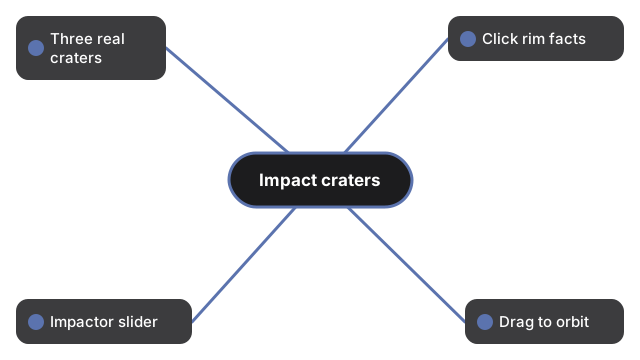
Drag to orbit and scroll or pinch to zoom. Click a crater rim for its facts, or move the impactor slider to compare a test crater against the three real ones.
Impact Crater Formation 3D Explorer
This browser explorer puts three real impact craters on one shared ground plane so you can compare their size directly, then drag an impactor-diameter slider to grow a fourth test crater and see roughly how big an impact of that size would leave behind.
Barringer Crater (Meteor Crater) in Arizona is about 1.19 km across and about 50,000 years old, dug out by an iron meteorite roughly 50 m wide. Chicxulub, buried under the Yucatan Peninsula in Mexico, is about 180 km across and about 66 million years old - the impact tied to the end-Cretaceous extinction. Vredefort Dome in South Africa is estimated at about 300 km across in its original form and about 2.02 billion years old, among the oldest and largest confirmed impact structures on Earth.
Because these three craters span from just over a kilometer to hundreds of kilometers, the scene draws every crater at a compressed (square-root) scale so the smallest stays visible next to the largest - the facts panel always lists the real, uncompressed diameters. The test crater uses a widely cited rule of thumb for simple bowl craters: final diameter is roughly 20 times the impactor's diameter, a scaling relationship that also depends on impact speed, angle, and the rock being hit.
- Three real craters (Barringer, Chicxulub, Vredefort) rendered to a shared comparison scale
- Click any crater rim for its real diameter, age, and impactor size
- Impactor-diameter slider (5 m to 15 km) that regrows a test crater using the 20x scaling rule
- Drag to orbit the camera, scroll or pinch to zoom
- Runs fully in the browser with the vendored three.js engine - no account, no upload
Students see why a 50 m rock left a 1.19 km scar while a 12 km rock left one 180 km wide; teachers use the slider to show how quickly crater size grows with impactor size; curious readers get a feel for how large the dinosaur-extinction impact really was next to the crater in their geography textbook.
| Crater | Diameter | Age |
|---|---|---|
| Barringer Crater (Meteor Crater), Arizona | ~1.19 km | ~50,000 years |
| Chicxulub crater, Mexico | ~180 km | ~66 million years |
| Vredefort Dome, South Africa | ~300 km (original estimate) | ~2.02 billion years |
This page teaches the general crater-formation scaling across Earth's own record. For a single named crater on another world, the collection also has close-up pages: Phobos-Stickney and Mimas-Herschel zoom into one giant crater each on a small moon, and Vesta-Rheasilvia covers the huge impact basin on the asteroid Vesta - each of those pages is about one specific feature, while this page is about the general size-versus-impactor relationship.
Everything renders on your device with WebGL. The 3D engine loads once (about 0.7 MB) and is cached; no scene data is sent to a server.
This is an educational approximation of crater scaling, not a physics solver - real crater size also depends on impact speed, angle, and target rock strength.
Frequently Asked Questions
What does the Impact Crater Formation 3D Explorer show?
Three real impact craters (Barringer, Chicxulub, Vredefort) rendered to a shared comparison scale, plus a test crater you grow with an impactor-diameter slider.
Why is Barringer Crater still visible next to Vredefort Dome on screen?
The scene draws crater radius on a square-root scale, so the smallest real crater (~1.19 km) stays visible next to the largest (~300 km). The facts panel always lists the real, uncompressed diameters.
How does the impactor slider decide the test crater's size?
It uses a widely cited rule of thumb for simple bowl craters: final crater diameter is roughly 20 times the impactor's diameter. This is an illustrative approximation - real crater size also depends on impact speed, angle, and target rock.
How old is the Chicxulub crater?
About 66 million years - the impact linked to the end-Cretaceous mass extinction. It is buried under the Yucatan Peninsula in Mexico and was mapped through geophysical surveys and drilling.
Is Vredefort Dome really the largest impact structure on Earth?
It is among the largest confirmed impact structures, with an original diameter estimated around 300 km before roughly 2.02 billion years of erosion; today's visible dome is smaller than that original scar.
Is this a physics simulation?
No. It is an educational approximation of crater scaling, not a cratering-mechanics solver. The three real craters use published figures; the test crater uses a simple illustrative scaling rule.