
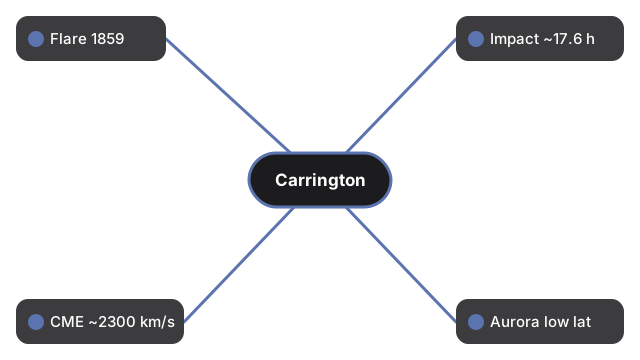
On 1 September 1859, two British astronomers watched the Sun flare brilliantly white - the first solar flare ever recorded. About 17.6 hours later, the eruption it launched slammed into Earth and triggered the most intense geomagnetic storm ever recorded, with aurorae seen as far from the poles as Hawaii and telegraph lines sparking and catching fire. Press play to watch the flare, the eruption's crossing, and the aurora spreading far past where it normally reaches.
Published figures: the flare was observed 1 September 1859; the coronal mass ejection reached Earth about 17.6 hours later at an estimated 2,300 km/s. Aurorae reached as close as about 23-25 degrees from the geomagnetic equator - the most equatorward sighting on record.
Drag to orbit and scroll or pinch to zoom. Press Play, change the speed, or toggle the normal-aurora comparison ring.
Carrington Event 3D Explorer
Just before noon on 1 September 1859, British astronomer Richard Carrington was sketching sunspots through his telescope when he saw something no one had ever knowingly recorded before: a sudden, blinding white patch of light erupting from the Sun's surface. Fellow astronomer Richard Hodgson witnessed the same thing independently, later describing it as "a very brilliant star of light, much brighter than the sun's surface." Neither man knew it yet, but they had just watched the first solar flare ever documented.
About 17.6 hours later, the blast of solar material that flare had launched - traveling at an estimated 2,300 kilometers per second - slammed into Earth's magnetic field. What followed was the most intense geomagnetic storm ever recorded. Aurorae blazed in the night sky as far from the poles as Hawaii and the Caribbean, closer to the equator than any aurora sighting confirmed before or since. The electrical currents the storm induced surged through telegraph wires across Europe and North America, shocking operators and, in places, setting the paper tape alight. Some operators discovered they could keep sending messages with their batteries completely disconnected - the storm itself was powering the line.
- The Sun's first recorded flare, then a coronal mass ejection crossing to Earth
- An aurora ring that spreads far past its normal reach on impact
- A toggle comparing the extreme 1859 reach against a normal, quiet-day aurora
- A speed slider and Play/Pause over the whole compressed sequence
- Runs fully in the browser with the vendored three.js engine - no account, no upload
History readers see exactly what "the most extreme space weather event on record" actually looked like; anyone who has heard modern warnings about grid-threatening solar storms sees where that warning comes from.
| Figure | Value | Source note |
|---|---|---|
| Flare observed | 1 September 1859 | Carrington and Hodgson, independently |
| Time to Earth impact | about 17.6 hours | Cliver and Svalgaard 2005 |
| CME speed | about 2,300 km/s | Modern estimate |
| Aurora reached as close as | about 23-25 degrees from the geomagnetic equator | Most equatorward sighting on record |
| Storm intensity (Dst) | estimated -900 to -1760 nT | Still debated among researchers |
Everything renders on your device with WebGL. The 3D engine loads once (about 0.7 MB) and is cached; no scene data is sent to a server.
This is an educational visualization, not a physical simulation - the Sun-Earth distance, the eruption's travel time, and the aurora's spread are all heavily compressed and exaggerated for a short, legible animation; the real event unfolded over about 17.6 hours and the storm lasted more than six days.
For a step-by-step walkthrough, read the Carrington Event 3D Explorer step-by-step guide. The Space 3D collection also includes Aurora 3D for the everyday version of the same phenomenon.
Frequently Asked Questions
What was the Carrington Event?
The most intense geomagnetic storm ever recorded, on 1-2 September 1859, triggered by a coronal mass ejection following the first solar flare ever documented.
Who first recorded a solar flare?
British astronomers Richard Carrington and Richard Hodgson, independently, on 1 September 1859.
How far did the aurora reach?
As close as about 23 to 25 degrees from the geomagnetic equator - as far south as Hawaii and the Caribbean - the most equatorward sighting confirmed in recorded history.
Did it really set telegraph lines on fire?
Yes. Induced electrical currents shocked operators and sparked equipment across Europe and North America; some stations reported fires, and some operators kept working with their batteries disconnected.
How intense was the storm, exactly?
Still debated. Commonly cited Dst estimates range from about -900 to -1760 nT - a real, acknowledged scientific uncertainty, not a single precise number.
Could this happen again?
Yes. A storm of this magnitude today could cause widespread electrical disruptions, blackouts, and power-grid damage.
Is this scene to scale?
No. The Sun-Earth distance, the eruption's travel time, and the aurora's spread are all heavily compressed for a short, legible animation.