
Point a telescope at a star and you must tilt it slightly toward the way Earth is travelling - the same way you tilt an umbrella forward when you walk into straight-down rain. That tiny tilt is the aberration of starlight, and over a year it makes every star trace a small ellipse. Slide the star latitude and watch the shape change.
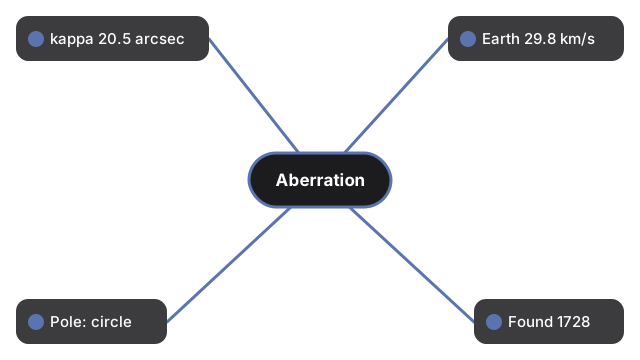
Published literacy: the constant of aberration is 20.5 arcseconds (kappa = v/c, with Earth at 29.8 km/s and light at 299,792 km/s); a star traces a circle at the ecliptic pole and a straight line on the ecliptic; James Bradley discovered it in 1728, proving Earth moves.
Drag to orbit and scroll or pinch to zoom. Slide the star latitude from the ecliptic to the pole, or pause the yearly motion.
Aberration of Starlight 3D Explorer
When you walk through straight-down rain you tilt your umbrella forward; the faster you go, the more you tilt. Starlight behaves the same way. Because light has a finite speed and Earth is racing around the Sun at about 29.8 km/s, a star appears nudged slightly toward the direction Earth is travelling. That tilt is the aberration of starlight, and this explorer shows how it makes every star trace a small yearly ellipse.
The size of the nudge is the constant of aberration, about 20.5 arcseconds - simply Earth speed divided by the speed of light. As Earth swings around its orbit, the direction of the nudge rotates, so over a year the star draws a shape that depends on where it sits: a circle if it is near the pole of the ecliptic, a straight line if it lies on the ecliptic, and an ellipse in between. Slide the latitude control to morph between them. James Bradley discovered the effect in 1728 while hunting for parallax in the star Eltanin; it became the first direct proof that Earth really moves, and let him estimate the speed of light to within a fraction of a percent. Crucially, aberration is not parallax: it is the same 20.5 arcseconds for every star because it depends on Earth speed, not the star distance, and it runs about a quarter-turn out of phase with the far smaller parallax wobble.
- A star nudged toward Earth direction of travel, with the displacement arrow drawn
- The yearly aberration ellipse it traces on the sky
- A small inset of Earth orbiting the Sun with its velocity arrow
- A latitude slider that morphs the ellipse from a line to a circle
- Play to sweep the year, or pause to inspect one moment
- Runs fully in the browser with the vendored three.js engine - no account, no upload
Students see why a finite light speed plus motion tilts every star; teachers contrast velocity-based aberration with distance-based parallax; history buffs meet the measurement that proved Earth moves.
| Figure | Value | Source note |
|---|---|---|
| Constant of aberration | 20.5 arcsec | kappa = v/c (J2000: 20.49552) |
| Earth orbital speed | 29.8 km/s | Mean; light 299,792 km/s |
| Shape at ecliptic pole | circle (radius 20.5 arcsec) | line on the ecliptic |
| Discovered | 1728, James Bradley | First direct proof Earth moves |
Everything renders on your device with WebGL. The 3D engine loads once (about 0.7 MB) and is cached; no scene data is sent to a server.
This is an educational visualization - the aberration ellipse is hugely enlarged so it is visible (the real angle is about the width of Saturn in a telescope), and the scene is not to scale.
For a step-by-step walkthrough, read the Aberration of Starlight 3D Explorer step-by-step guide. The Space 3D collection also includes Stellar Parallax 3D and Stellar Proper Motion 3D.
Frequently Asked Questions
What is the aberration of starlight?
It is a small apparent shift of a star toward the direction Earth is moving, caused by Earth velocity combined with the finite speed of light. Over a year it makes each star trace a tiny ellipse.
How big is the effect?
The maximum shift, called the constant of aberration, is about 20.5 arcseconds - roughly the apparent width of Saturn in a telescope. It equals Earth orbital speed divided by the speed of light.
Why does the shape change with latitude?
A star on the ecliptic traces a straight line, a star at the ecliptic pole traces a full circle, and stars in between trace ellipses. The slider morphs between these by changing the star ecliptic latitude.
How is aberration different from parallax?
Aberration depends on Earth velocity, so it is the same 20.5 arcseconds for every star no matter how far. Parallax depends on Earth position and shrinks with distance. The two also run about a quarter-turn out of phase.
Who discovered it?
James Bradley in 1728, while trying to measure parallax in the star Eltanin. It was the first direct proof that Earth orbits the Sun and gave an early, accurate speed of light.
Is this scene to scale?
No. The real ellipse is far too small to see with the eye, so it is hugely enlarged here. The physics - the tilt toward Earth motion and the shape by latitude - is faithful.