
Watch a moving light source stretch and compress its own wavefronts, then read the real numbers - the hydrogen-alpha line at 656.28 nm shifting with z = v/c, and a Hubble's-law recession example.
The moving light and its ring pulses are a wave-Doppler diagram for intuition - the spectrum bar below it carries the real number: the hydrogen-alpha rest line at 656.28 nm and where it lands after the shift.
This teaches the measurement side of redshift that Milky Way Map 3D Explorer and Kepler Orbits 3D Explorer do not cover - how a spectral line's wavelength itself becomes a distance and velocity reading.
Redshift and Doppler Shift 3D Explorer
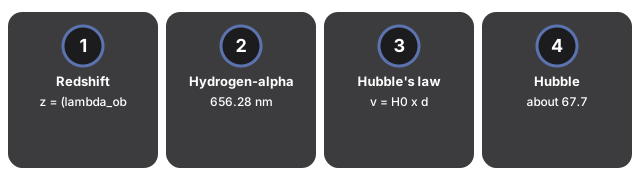
Watch a moving light source stretch and compress its own wavefronts, then read the real numbers - the hydrogen-alpha line at 656.28 nm shifting with z = (lambda_obs - lambda_0) / lambda_0, about equal to v/c for v much less than c (valid roughly for z less than 0.1), and a Hubble's-law recession example.
Drag to orbit the view, scroll or pinch to zoom, and try the At rest, Approaching, and Receding presets at 0.05c. The z = v/c formula and Hubble's-law buttons fill the facts panel with the numbers behind the shift.
The facts panel lists the redshift z, the hydrogen-alpha rest and observed wavelengths, and - on the Hubble's-law preset - an example recession velocity and distance that discloses H0 about 67.7 km/s/Mpc (early-universe/CMB) to about 73 km/s/Mpc (late-universe/distance-ladder), the Hubble tension between methods.
- A light source moving on a track with expanding ring pulses that bunch up ahead and stretch out behind it
- A discretized violet-to-red spectrum bar with a moving tick showing the hydrogen-alpha line's shifted position
- At rest, Approaching (blueshift), and Receding (redshift) presets at 0.05c
- A Hubble's-law preset computing recession velocity and redshift at 100 Mpc
- Distinct from Milky Way Map 3D Explorer and Kepler Orbits 3D Explorer
- Runs fully in the browser with the vendored three.js engine - no account, no upload
Students use it to connect a line on a spectrum plot to a velocity and a distance, teachers use the Hubble's-law preset to introduce the expanding universe, and curious readers see why "redshift" is a wavelength measurement before it is a cosmology term.
| Quantity | Value | Source |
|---|---|---|
| Redshift formula | z = (lambda_obs - lambda_0) / lambda_0, about v/c for v much less than c | Standard spectroscopy; valid roughly z < 0.1 |
| Hydrogen-alpha rest wavelength | 656.28 nm | Standard atomic spectroscopy |
| Hubble's law | v = H0 x d | Hubble-Lemaitre law |
| Hubble constant H0 | about 67.7 (early-universe/CMB) to about 73 km/s/Mpc (late-universe/distance-ladder) | NASA StarChild; the "Hubble tension" between methods |
Everything renders on your device with WebGL. The 3D engine loads once (about 0.7 MB) and is cached; no scene data is sent to a server.
The scene is an educational visualization - the moving-source ring pulses are a wave-Doppler diagram for intuition, not a relativistic Doppler solver or light-speed-accurate physical simulation, and the Hubble's-law preset is a textbook example, not a cosmological distance-ladder pipeline or live telescope feed.
For a step-by-step walkthrough, read the Redshift and Doppler Shift 3D Explorer step-by-step guide. When you need session fit and limits, see when to use Redshift and Doppler Shift 3D Explorer. The Space 3D collection also includes a Milky Way Map 3D Explorer for galactic structure and a Kepler Orbits 3D Explorer for orbital mechanics.
Frequently Asked Questions
What does Redshift and Doppler Shift 3D Explorer show?
A light source moving on a track with expanding ring pulses, plus a spectrum bar where a tick shows how the hydrogen-alpha line moves as the source approaches or recedes.
What is the redshift formula?
z = (lambda_obs - lambda_0) / lambda_0. For speeds much slower than light this is well approximated by z about equal to v / c, valid roughly for z under 0.1.
What is the hydrogen-alpha line?
A spectral line at a rest wavelength of 656.28 nm, commonly used to measure how much a star or galaxy's light has shifted.
What does the Hubble's-law preset compute?
v = H0 x d. At 100 Mpc with H0 about 70 km/s/Mpc, the example works out to about 7,000 km/s and a redshift near 0.023. Modern measurements disagree on H0 - about 67.7 from early-universe methods versus about 73 from late-universe methods.
How is this different from Milky Way Map 3D Explorer or Kepler Orbits 3D Explorer?
Those pages teach galactic structure and orbital mechanics. Redshift and Doppler Shift 3D Explorer isolates the spectral-line measurement that tells astronomers how fast something is moving toward or away from Earth.
Is this a real physics simulation?
No. The moving-source ring pulses are a wave-Doppler diagram used for intuition, not a relativistic Doppler solver, and the Hubble's-law preset is a textbook example, not a cosmological distance-ladder pipeline.