
Jupiter does not travel alone. Two great swarms of asteroids share its orbit, parked 60 degrees ahead and 60 degrees behind the planet at the stable L4 and L5 Lagrange points. This explorer shows both swarms co-orbiting the Sun and slowly librating in tadpole loops.
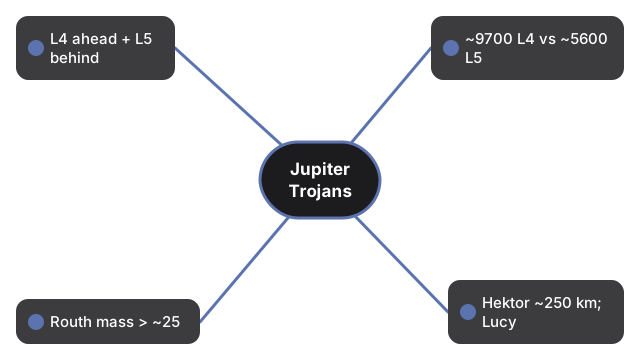
Published literacy: Trojans occupy L4 (60 deg ahead) and L5 (60 deg behind) in Jupiter 1:1 resonance (semi-major axis ~5.2 AU); about 9,700 are known at L4 versus 5,600 at L5; the points are stable because the Sun-to-Jupiter mass ratio (~1047) far exceeds the 24.96 limit.
Drag to orbit and scroll or pinch to zoom. Pause the motion, toggle the L4 and L5 markers, or Co-rotate to watch the tadpole libration.
Jupiter Trojan Asteroids 3D Explorer
Sharing Jupiter orbit around the Sun are two vast crowds of asteroids - the Trojans. They are not scattered randomly: they gather around two special spots called L4 and L5, the Lagrange points that sit 60 degrees ahead of and 60 degrees behind Jupiter. This explorer shows both swarms orbiting the Sun in lockstep with Jupiter, each asteroid tracing a slow tadpole loop around its Lagrange point.
These are real "gravitational parking spots". At L4 and L5 the pull of the Sun, the pull of Jupiter, and the orbital motion balance so well that a strayed asteroid gets nudged back by the Coriolis force - a stable tadpole orbit. That balance only holds when the central body is far heavier than the planet: the Routh criterion needs the mass ratio above about 24.96, and the Sun is roughly 1,047 times Jupiter mass, so the points are rock-solid. Astronomers know about 9,700 Trojans at the leading L4 "Greek camp" and about 5,600 at the trailing L5 "Trojan camp" (the leading camp is richer). The biggest is 624 Hektor at about 250 km, and NASA Lucy spacecraft, launched in 2021, is on its way to visit eight of them.
- Jupiter on its orbit with two asteroid swarms 60 degrees ahead and behind
- L4 (Greek camp, blue) and L5 (Trojan camp, orange) markers you can toggle
- A Co-rotate view that freezes Jupiter so you can watch the tadpole libration
- Pause the motion or toggle the Lagrange-point markers
- Facts panel with the 60-degree geometry, the counts, and the stability limit
- Runs fully in the browser with the vendored three.js engine - no account, no upload
Students see why the swarms stay put relative to Jupiter; teachers connect the 60-degree geometry to the Lagrange points; curious readers learn that thousands of asteroids ride along with the giant planet.
| Figure | Value | Source note |
|---|---|---|
| Location | L4 (60 deg ahead) + L5 (60 deg behind) | Jupiter 1:1 resonance, a ~5.2 AU |
| Known count | ~9,700 (L4) vs ~5,600 (L5) | Greek camp richer than Trojan camp |
| Stability limit | mass ratio > ~24.96 (Routh) | Sun/Jupiter ~1047 |
| Largest / visitor | 624 Hektor ~250 km; Lucy (2021) | NASA Discovery mission |
Everything renders on your device with WebGL. The 3D engine loads once (about 0.7 MB) and is cached; no scene data is sent to a server.
This is an educational visualization - swarm counts, sizes, and libration are illustrative, not a full N-body integration, and distances are not to scale.
For a step-by-step walkthrough, read the Jupiter Trojan Asteroids 3D Explorer step-by-step guide. The Space 3D collection also includes Hill Sphere 3D and Asteroid Belt 3D.
Frequently Asked Questions
What are Trojan asteroids?
They are asteroids that share a planet orbit, gathered around the L4 and L5 Lagrange points 60 degrees ahead of and behind the planet. Jupiter has by far the largest known Trojan population.
Why do they stay 60 degrees from Jupiter?
L4 and L5 are stable equilibrium points where the combined pull of the Sun and Jupiter, plus the orbital motion, traps material. A strayed asteroid is nudged back by the Coriolis force into a slow tadpole loop.
What are the Greek and Trojan camps?
The leading L4 swarm is nicknamed the Greek camp and the trailing L5 swarm the Trojan camp, after heroes of the Iliad. About 9,700 are known at L4 and 5,600 at L5.
Why are L4 and L5 stable?
Stability needs the central body to be much heavier than the planet - the Routh criterion requires a mass ratio above about 24.96. The Sun is roughly 1,047 times Jupiter mass, so the points are very stable.
Is anything visiting them?
Yes. NASA Lucy spacecraft, launched in 2021, is on a twelve-year tour to fly past eight Jupiter Trojans in both the L4 and L5 swarms, plus main-belt asteroids on the way.
Is this scene an accurate simulation?
No. The swarm counts, sizes, and libration are illustrative and distances are not to scale. It is meant to show the 60-degree geometry and the tadpole motion, not to integrate real orbits.