
Scrub the timeline to watch the Milky Way and the Andromeda Galaxy (M31) close a real 2.5-million-light-year gap and merge into one galaxy over billions of years - drag to orbit, scroll or pinch to zoom.
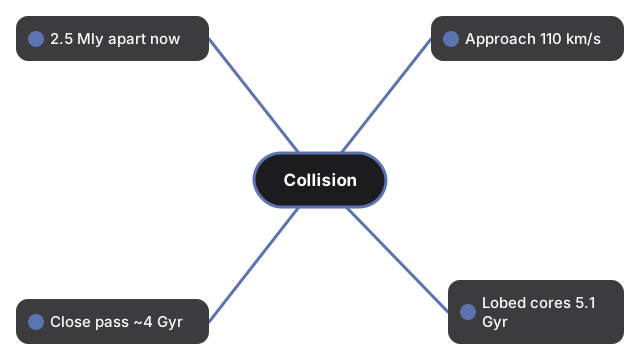
Published figures: current separation about 2.5 million light-years, approach speed about 110 km/s, first close pass in about 3.75-4 billion years, full merger by about 7 billion years (van der Marel et al. 2012). A 2025 study briefly lowered the merger odds to about 50%; a 2026 recalibration raised it back to about 90%, re-confirming the classic timeline shown here.
Drag to orbit and scroll or pinch to zoom. Scrub the Time slider or press Play to watch the merger unfold.
Milky Way - Andromeda Collision 3D Explorer
freetoolonline.com editorial team
This explorer renders the real, published timeline for the Milky Way's eventual merger with the Andromeda Galaxy (M31) - scrub the Time slider from today out to about 10 billion years and watch two spiral disks close a 2.5-million-light-year gap, stretch into tidal tails, and settle into one merged galaxy.
Because the whole scene is a real 3D view rather than a flat animation, you can drag to orbit the two galaxies and look at the merger from any angle - above the disks, edge-on, or from behind the forming tidal tails - and scroll or pinch to zoom in as the streams of stars pull loose and later wind back into a single elliptical galaxy. That freedom to move the camera is what lets you read the three-dimensional shape of each phase, not just its flat silhouette. A Fullscreen button expands the scene edge to edge, which is where the faint tidal tails read best - useful on a phone or a projector - and while the 3D view is still assembling, a short status line beneath the canvas reads "Preparing the 3D scene", so you can tell the merger is loading rather than stalled before you start scrubbing the timeline.
The published merger timeline this page renders
Andromeda is approaching at about 110 km/s, measured from its blueshift, and the classic Hubble-based scenario places the first close pass in roughly 3.75 to 4 billion years, with the two cores visible as a lobed pair by about 5.1 billion years and a full merger into one elliptical galaxy by about 7 billion years.
What the tidal tails and the end state look like on screen
Scrub past the 3.75-billion-year mark and the two disks visibly stretch into long tidal tails as gravity pulls stars out of their original orbits - the same distortion astronomers observe in real merging galaxy pairs today, such as the Antennae Galaxies. Keep scrubbing past 7 billion years and the tails wind back down into a single, roughly spherical galaxy with no obvious spiral structure left - the expected end state of a major galaxy merger.
What the Andromeda Collision explorer lets you change
- Two procedurally-rendered spiral disks (Milky Way and Andromeda) with a Time slider spanning 0-10 billion years
- Approach, tidal-tail stretching, and merger phases driven by the real published timeline, with a facts panel that updates per phase
- Play auto-advances the timeline; drag the slider to jump straight to any point in the merger
- Honest probability caveat: a 2025 study briefly lowered the merger odds to about 50%, and a 2026 recalibration raised them back to about 90%
- Runs in-browser with three.js - no account, no upload
Real Andromeda collision figures at a glance
| Quantity | Published value |
|---|---|
| Current separation | ~2.5 million light-years |
| Approach speed | ~110 km/s (blueshift) |
| First close pass | ~3.75-4 billion years from now |
| Cores visible as a lobed pair | ~5.1 billion years from now |
| Full merger | ~7 billion years from now (van der Marel et al. 2012) |
| Merger probability (2025 estimate) | ~50% within 10 Gyr (Sawala et al. 2025) |
| Merger probability (2026 recalibration) | ~90%, re-confirming the classic scenario |
Why the merger probability was revised twice
The merger probability itself is a genuine example of science self-correcting as data improves: the 2025 estimate used the most precise Gaia proper-motion data available at the time and found real uncertainty from M33's and the Large Magellanic Cloud's orbits; the 2026 recalibration used improved Gaia data and pushed the estimate back toward the classic near-certain outcome. Neither study disputes the separation, approach speed, or merger timeline shown here - only the probability that it fully completes.
How this page differs from the other galaxy explorers
The Spiral Galaxy 3D Explorer renders one galaxy's shape in isolation; this page renders what happens when two real galaxies - ours and our nearest large neighbor - actually meet. For the walkthrough, see the step-by-step guide. The Space 3D collection also includes Milky Way Map 3D Explorer.
Limits of this educational approximation
This is an educational approximation tuned to teach the sequence, not a gravitational simulation - the disk shapes, tidal-tail stretching, and the speed of the on-screen timeline are illustrative, while the separation, approach speed, and Gyr milestones in the table above are the real published figures. Both galaxies are drawn far larger relative to their separation than their true scale so the merger stays visible on screen. Renders on-device with WebGL - loads once (about 0.7 MB), cached by the browser, no data sent to a server.
Frequently Asked Questions
What does the Milky Way - Andromeda Collision 3D Explorer show?
The real, published timeline for the eventual merger of the Milky Way and the Andromeda Galaxy (M31). Scrub the Time slider from today out to about 10 billion years, or press Play, to watch the two galaxies approach, stretch into tidal tails, and merge.
Will the Milky Way really collide with Andromeda?
The classic Hubble-based scenario says yes, with a first close pass in about 3.75-4 billion years and a full merger by about 7 billion years. A 2025 study lowered the merger probability to about 50% using then-current data; a 2026 recalibration using improved Gaia data raised it back to about 90%, largely re-confirming the classic outcome.
How is this different from the Spiral Galaxy 3D Explorer?
Spiral Galaxy 3D Explorer renders one galaxy's shape in isolation. This page renders two real galaxies - the Milky Way and Andromeda - approaching and merging over billions of years on the real published timeline.
Why do the galaxies stretch into long tails?
Tidal tails form when each galaxy's gravity pulls stars out of the other's disk during a close pass - the same distortion astronomers observe today in real merging pairs like the Antennae Galaxies. The tails appear here once the timeline passes the first close pass at about 3.75 billion years.
Is this a live simulation of real gravity?
No. It is an educational approximation tuned to teach the sequence of a galaxy merger, not a gravitational simulation. The separation, approach speed, and Gyr milestones shown in the facts panel are the real published figures; the disk shapes and tail stretching are illustrative.
Will anyone be around to see this happen?
No. The first close pass is roughly 3.75-4 billion years away and the full merger roughly 7 billion years away - both far beyond any human timescale, and even beyond the Sun's own expected lifetime as a normal star.
Are the galaxies drawn to their real scale and distance?
No. Both galaxies are drawn far larger relative to their separation than their true scale, so the merger stays visible on screen - disclosed in the facts panel and the page text above.