
See the gap between how bright a star looks from Earth (apparent magnitude) and how bright it would be at a standard distance (absolute magnitude), then switch views to compare stars on one scale.
Apparent mode sizes spheres from Earth-sky magnitudes. Absolute mode resizes them as if each star sat at 10 pc - the Sun drops to a modest size while distant stars keep their absolute ranks.
Each magnitude step changes flux by about 2.512 (Pogson). Sphere sizes use a softened display scale so the Sun does not blow out the camera - not angular diameters or a Hipparcos map.
Stellar Magnitude Scale Explorer
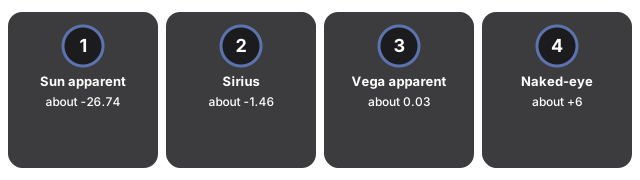
Compare apparent and absolute magnitude on a Pogson brightness rail - Sun about -26.74, Sirius about -1.46, Vega about 0.03, naked-eye limit about +6, and each mag step about 2.512x in flux (5 mag = 100x).
Drag to orbit the view, scroll or pinch to zoom, and toggle Apparent vs Absolute mag. Absolute mode places the same references at 10 pc so the Sun shrinks toward about +4.83 absolute. Sun, Sirius, Vega, and Naked-eye limit fill the facts panel.
- Four reference points on a magnitude teaching rail
- Apparent magnitude mode (brightness as seen from Earth)
- Absolute magnitude mode (brightness at 10 pc)
- Pogson step about 2.512x flux per magnitude
- Distinct from Star Lifecycle 3D Explorer and Milky Way Map 3D Explorer
- Runs fully in the browser with the vendored three.js engine - no account, no upload
Teachers use it to show why negative magnitudes are brighter, students toggle Absolute mode to see the Sun shrink at 10 pc, and curious readers compare Sirius and Vega without opening a catalog table alone.
| Quantity | Value | Source |
|---|---|---|
| Sun apparent magnitude | about -26.74 | Standard solar V-band magnitude |
| Sirius apparent magnitude | about -1.46 | Brightest night-sky star (V) |
| Vega apparent magnitude | about 0.03 | Near-zero historic magnitude zero-point |
| Naked-eye limit | about +6 | Typical dark-site visual limit |
| Flux ratio per mag | about 2.512x | Pogson scale (5 mag = 100x) |
Everything renders on your device with WebGL. The 3D engine loads once (about 0.7 MB) and is cached; no scene data is sent to a server.
The scene is an educational visualization - sphere sizes are a softened flux display scale (Sun capped for the camera), not measured angular diameters, not a Hipparcos or Gaia catalog map, and not photometric reduction software.
For a step-by-step walkthrough, the reference magnitude values, and the sessions this explorer does not fit, read the Stellar Magnitude Scale Explorer step-by-step guide. The Space 3D collection also includes a Star Lifecycle 3D Explorer for evolutionary stages and a Milky Way Map 3D Explorer for galactic structure.
Frequently Asked Questions
What does Stellar Magnitude Scale Explorer show?
A teaching rail of Sun, Sirius, Vega, and the naked-eye limit with sphere sizes scaled from Pogson flux, plus a toggle between apparent and absolute magnitude.
What is apparent vs absolute magnitude?
Apparent magnitude is brightness as seen from Earth. Absolute magnitude is how bright the object would look if placed at 10 parsecs.
Why is the Sun so bright in apparent mode?
Its apparent magnitude is about -26.74 - vastly brighter than Sirius at about -1.46 - so the display uses a softened size so the camera stays usable.
What does Absolute mag change?
Each sphere resizes from absolute magnitude at 10 pc. The Sun becomes much smaller because its absolute magnitude is about +4.83, not -26.74.
How is this different from Star Lifecycle 3D Explorer?
Star Lifecycle 3D Explorer scrubs evolutionary stages. Stellar Magnitude Scale Explorer isolates the brightness scale so Pogson steps and apparent vs absolute stay easy to see.
Are sphere sizes real angular diameters?
No. Sizes follow a softened flux display from magnitude so contrasts stay readable - not measured angular sizes or a Hipparcos sky map.