
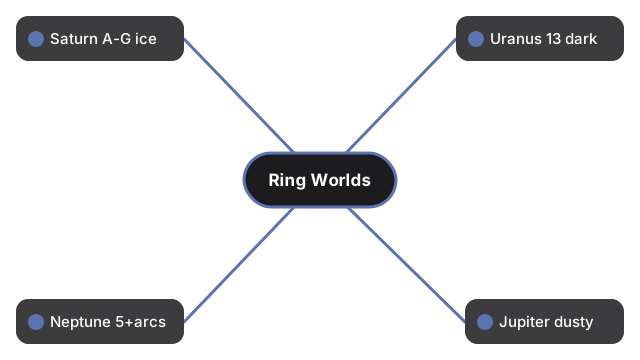
Compare all four planetary ring systems side by side: Saturn ~7 major rings of water ice, Uranus ~13 narrow dark rings, Neptune ~5 rings with partial arcs, and Jupiter faint dusty ring.
Published literacy: Saturn 7 major rings (water ice, found 1655); Uranus 13 rings (dark, found 1977); Neptune 5 rings with arcs (confirmed 1989); Jupiter faint dusty ring (found 1979).
Drag to orbit and scroll or pinch to zoom. Click Jupiter, Saturn, Uranus, or Neptune to highlight and compare.
Planetary Rings Comparison 3D Explorer
This explorer lines up all four planetary ring systems: Saturn ~7 major rings of water ice (1655, Huygens); Uranus ~13 dark, carbon-rich rings (1977, occultation); Neptune ~5 rings with partial arcs (1989, Voyager 2); Jupiter a faint dusty ring (1979, Voyager 1).
Saturn Rings 3D is a single-planet deep dive; this page owns the cross-planet comparison.
- All four ring systems rendered at a compressed scale
- A pulsing highlight ring marks the selected planet
- Jupiter, Saturn, Uranus, Neptune selector buttons
- Facts panel lists ring count, composition, and discovery year
- Runs in-browser with three.js - no account, no upload
Saturn's rings are far brighter than the rest; Neptune's are partial arcs, not full rings.
| Planet | Ring system | Discovered |
|---|---|---|
| Saturn | 7 major rings (A-G), water ice | 1655 (Huygens) |
| Uranus | 13 dark, carbon-rich rings | 1977 (occultation) |
| Neptune | 5 main rings, including partial arcs | 1989 (Voyager 2) |
| Jupiter | Faint dusty ring (halo+main+2 gossamer) | 1979 (Voyager 1) |
Renders on-device with WebGL - loads once (~0.7 MB), cached, no data sent to a server.
An educational schematic - ring width, brightness, and size are compressed for the lineup, not real scale.
For the walkthrough, see the step-by-step guide. The Space 3D collection also includes Saturn Rings 3D.
Frequently Asked Questions
What does the Planetary Rings Comparison 3D Explorer show?
Jupiter, Saturn, Uranus, and Neptune lined up side by side with their real ring systems rendered at a compressed comparison scale. Click a planet to highlight it and read its facts.
How is this different from Saturn Rings 3D?
Saturn Rings 3D is a deep dive into one planet - Cassini Division, A-ring edge, and ice composition. This page compares all four ring systems against each other.
Which planet has the brightest rings?
Saturn, by far. Its rings are made almost entirely of water ice, making them the brightest and most massive ring system in the solar system.
Does Neptune have full rings or just arcs?
Both. Neptune has 5 main rings, and some of that ring material is concentrated into partial arcs rather than complete circles.
Is this scene to real relative scale?
No. Ring width, brightness, and planet size are compressed for a legible side-by-side comparison, not real relative scale.
When was each ring system discovered?
Saturn in 1655 (Huygens), Uranus in 1977 (stellar occultation), Jupiter in 1979 (Voyager 1), and Neptune confirmed in 1989 (Voyager 2).