
Vesta's southern hemisphere is dominated by Rheasilvia - a basin about 500 kilometers across with a central peak among the tallest mountains in the Solar System. Press play to spin the asteroid, face the south pole, and highlight the peak rising from the basin floor.
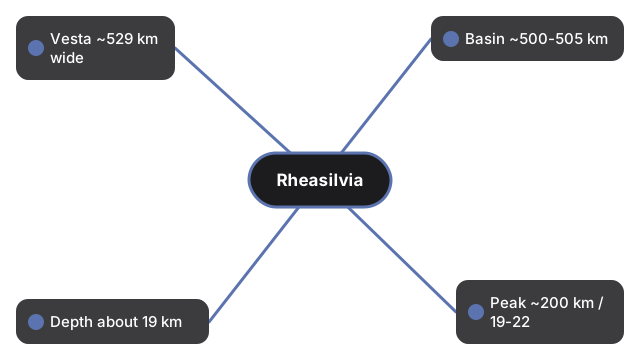
Published figures: Rheasilvia ~500-505 km across and ~19 km deep; central peak ~200 km wide rising ~19-22 km; Vesta mean diameter ~529 km; Dawn 2011; basin age ~1 billion years (NASA Dawn / Science 2012).
Drag to orbit and scroll or pinch to zoom. Press Play or toggle Peak.
Vesta Rheasilvia Basin 3D Explorer
Vesta is one of the largest bodies in the asteroid belt - mean diameter about 529 kilometers. Hubble saw a south-polar depression in 1997; NASA's Dawn spacecraft mapped it in 2011 and named the younger basin Rheasilvia after the mythological vestal Rhea Silvia. Dawn found Rheasilvia about 500 kilometers wide and roughly 19 kilometers deep, covering most of the southern hemisphere, with a central peak complex about 200 kilometers across that rises some 19 to 22 kilometers from the floor - one of the tallest mountains known in the Solar System.
Rheasilvia partly overlaps an older ~400 kilometer basin called Veneneia. Both basins are unexpectedly young, roughly 1 to 2 billion years, and their excavated debris is linked to the Vestoid asteroid family and HED meteorites. This explorer focuses on Rheasilvia's bowl and central peak so you can see how large the scar is relative to Vesta itself.
- Vesta with a south-polar Rheasilvia basin bowl
- Highlightable central peak mountain
- A faint older Veneneia rim hint for overlap context
- Speed slider and Play/Pause rotation
- Runs fully in the browser with the vendored three.js engine - no account, no upload
Anyone comparing giant impacts on small worlds gets a concrete sense of a basin that spans most of a hemisphere.
| Figure | Value | Source note |
|---|---|---|
| Vesta mean diameter | ~529 km | Dawn / Wikipedia synthesis |
| Rheasilvia diameter | ~500-505 km | Dawn; Science 2012 (~500 km) |
| Basin depth | ~19 km | Dawn topography |
| Central peak width / height | ~200 km / ~19-22 km | Dawn / NASA |
| Veneneia (older) | ~400 km | Partly obliterated |
| Basin age | ~1-2 billion years | Science 2012 |
Everything renders on your device with WebGL. The 3D engine loads once (about 0.7 MB) and is cached; no scene data is sent to a server.
This is an educational visualization - Vesta is a smooth ellipsoid, the basin and peak are schematic, and Veneneia is only a faint rim hint, not a full topographic mesh.
For a step-by-step walkthrough, read the Vesta Rheasilvia Basin 3D Explorer step-by-step guide. The Space 3D collection also includes Asteroid Belt 3D Explorer and Phobos Stickney Crater 3D Explorer for related small-body context.
Frequently Asked Questions
How big is Rheasilvia compared with Vesta?
About 500-505 kilometers across on a body with mean diameter near 529 kilometers - it covers most of the southern hemisphere.
How tall is the central peak?
Roughly 19 to 22 kilometers above the basin floor, with a complex about 200 kilometers wide - among the tallest mountains known in the Solar System.
What is Veneneia?
An older ~400 kilometer south-polar basin that Rheasilvia partly obliterated. This page shows only a faint rim hint.
When was Rheasilvia mapped?
Hubble saw the depression in 1997; Dawn mapped and named it in 2011.
Is the shape exact?
No. Dawn topography is far more irregular; the scene uses a smooth ellipsoid and schematic basin for readability.
Does this model Vestoid ejecta?
No. The copy notes the link to Vestoids and HED meteorites, but the scene does not animate ejecta streams.
Is this a physics simulation?
No. It is an educational visualization with compressed relief, not an impact hydrocode.