YORP Effect 3D Explorer vs Yarkovsky Effect 3D Explorer
freetoolonline.com editorial teamBoth pages teach a real, non-gravitational, sunlight-powered mechanism in one page load - 0 MB installed, USD 0, no account. The YORP Effect 3D Explorer covers the net torque that changes an asteroid's spin rate; the Yarkovsky Effect 3D Explorer covers the net force that shifts an asteroid's orbit instead.
The numbers side by side
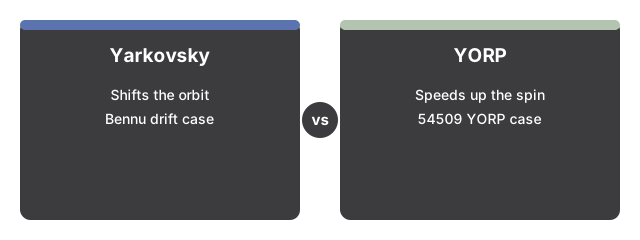
| Aspect | Yarkovsky Effect Explorer | YORP Effect Explorer |
|---|---|---|
| Install size | 0 MB - runs in the browser | 0 MB - runs in the browser |
| Price | USD 0 | USD 0 |
| What changes | the orbit (semimajor axis) | the spin rate |
| Real measured case | asteroid Bennu, -284.6 +/- 1.5 m/year | asteroid 54509 YORP, (2.0 +/- 0.2) x 10^-4 deg/day^2 |
| Mechanism | net force from thermal-lag re-emission | net torque from asymmetric-facet reflection/re-emission |
Where the Yarkovsky Effect Explorer wins
The Yarkovsky Effect Explorer wins when the question is about how an asteroid's orbit itself drifts over time - the semimajor-axis change that matters for long-term impact-risk refinement, as it did for Bennu.
Where the YORP Effect Explorer wins
The YORP Effect Explorer wins when the question is about why an asteroid's rotation rate itself speeds up or slows down, and why that is a torque, not a force - it is the only page on the site with a torque-couple visualization and a spin-up/spin-down toggle.
A reasonable rule
As a reasonable rule, use the Yarkovsky Effect Explorer first to see how sunlight can quietly reshape an asteroid's orbit, then use the YORP Effect Explorer to learn the companion mechanism that reshapes the same body's spin instead.
See how to use the YORP Effect 3D Explorer for a step-by-step walkthrough.
Why trust these tools
- Ten-plus years of web tooling. The freetoolonline editorial team has shipped browser-based utilities since 2015. The goal has never changed: get you to a working output fast, without an install.
- No install, no sign-up. Open a tool and get a working output in seconds - nothing to download and no account to create. Tools that need heavy processing run it on our service, so even a low-powered machine gets the job done.
- Analytics stops at the page view. We measure which pages get visited, not what you type or upload inside a tool. There is nothing to sign in to and no profile is attached to your input.
- Open-source core components. The processing engines underneath (libheif, libde265, pdf-lib, terser, clean-css, ffmpeg.wasm, and others) are public and audit-able. We link to each one in its tool page's footer.
- Free, with or without ads. All tools are fully functional without sign-up. The Disable Ads button in the header is always available if you need a distraction-free run.