
Drag to rotate Becklespinax, scroll or pinch to zoom, and click the head, the tail, or a leg to read a short fossil fact. The panel beside the model carries the published figures.
Becklespinax is known only from three fused back vertebrae with unusually tall neural spines, found in Early Cretaceous rocks of southern England. This viewer builds a plausible full body around that fragment so you can see how the tall spines translate into a low ridge along the back rather than a tall sail.
Fossils preserve bone, not soft tissue or color, and in this case only three vertebrae survive at all, so the body shown here is a stylized artistic reconstruction, not a fossil-accurate skeleton. Panel figures use a published mid-range estimate.
Becklespinax 3D Viewer
This page renders Becklespinax as a 3D model you can spin in the browser - drag to rotate, scroll or pinch to zoom, toggle a 1.8 m person beside it for scale, and click the head, the tail, or a leg to read a fact about that part.
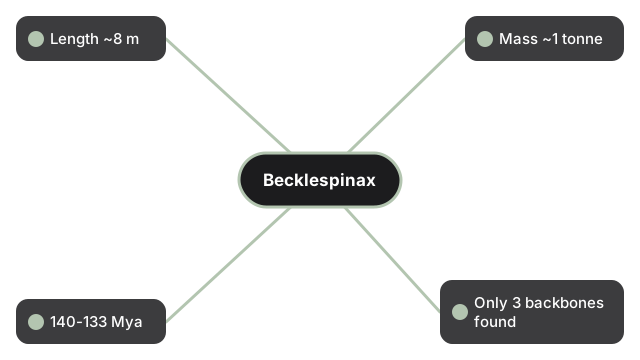
Becklespinax altispinax is a theropod dinosaur known only from three fused posterior dorsal vertebrae with unusually tall neural spines, collected in the 1850s by fossil hunter Samuel Husband Beckles at Battle, East Sussex, in the Wadhurst Clay Formation. Richard Owen first described the vertebrae in 1856; the fossil passed through several names, including Altispinax dunkeri, before George Olshevsky placed it in the new genus Becklespinax in 1991, honoring its discoverer. Because so little of the skeleton survives, length and mass are composite genus-level estimates rather than direct measurements: Gregory Paul (1988) put it at about 7.6 m long and about 1 tonne, smaller than the roughly 8 m Acrocanthosaurus specimen he compared it to; other published estimates run up to about 9 m and 1.8 tonnes.
| Measure | Figure |
|---|---|
| Length | about 7.6-9 m (panel ~7.6 m) |
| Weight | about 1-1.8 t (panel ~1 t) |
| When it lived | about 140-133 Mya (Early Cretaceous, Berriasian-Valanginian) |
| Diet | Carnivore |
| Known from | Three fused dorsal vertebrae (holotype NHMUK R1828) |
Everything runs on your device with WebGL, so the model works without an account and without sending anything to a server. The skin tone, body proportions, and dorsal ridge are an artistic reconstruction, because fossils do not preserve color or soft tissue and only three vertebrae are known at all; this model is not a fossil-accurate skeleton. For a sibling large theropod with a similar low dorsal ridge, see the Acrocanthosaurus 3D Viewer.
Frequently Asked Questions
How big was Becklespinax?
Because only three back vertebrae survive, size estimates are indirect. Gregory Paul (1988) estimated about 7.6 m long and about 1 tonne; other published estimates run up to about 9 m and 1.8 tonnes. The facts panel uses the 7.6 m and 1 t figures as mid-range values. Turn on the human figure to compare against a 1.8 m person.
What fossils of Becklespinax actually exist?
The entire known fossil record of Becklespinax is three fused posterior dorsal vertebrae with unusually tall neural spines, found in the Wadhurst Clay Formation near Battle, East Sussex, England, and held at the Natural History Museum, London (specimen NHMUK R1828). No skull, limb, or tail bones are known.
Why has this dinosaur had different names?
Richard Owen first described the vertebrae in 1856. Over the following century they were referred to several names, including Altispinax dunkeri, before George Olshevsky placed them in a new genus, Becklespinax, in 1991, naming it after collector Samuel Husband Beckles.
Did it have a sail like Spinosaurus?
Probably not a tall sail. The unusually high neural spines are generally interpreted as supporting a low muscular ridge along the back, similar to the pattern seen in Acrocanthosaurus, rather than a tall Spinosaurus-style sail.
Is the model scientifically accurate?
The published figures are real, but because only three vertebrae are known, the body shape, arms, legs, head, and skin color shown here are an artistic reconstruction, not a fossil-accurate skeleton.
Do I need to install anything to view it?
No. The model renders in your browser with WebGL - no app, no account. When available, a free-licensed glTF model may swap in after first paint.