
Therizinosaurus in 3D - click its giant hand claws, its long neck, or a leg for a fact (full controls on the Dinosaurs 3D hub).
Therizinosaurus was a giant plant-eating theropod built around one striking feature - turn on the human figure to see how a person compares to its huge frame and its dramatically enlarged hand claws.
and for this species the overall body shape is inferred from more complete relatives, since only the arms, claws, and a few other bones of Therizinosaurus itself have been recovered. The measurements in the panel follow published estimates, with ranges shown where sources disagree.
Therizinosaurus 3D Viewer
Drag to spin the Therizinosaurus model below, zoom in close, and click the giant hand claws, the neck, or a leg to read a fact about that part (full controls on the Dinosaurs 3D hub).
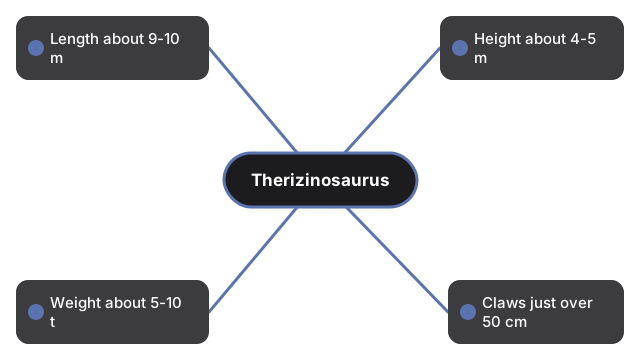
Therizinosaurus lived in the Late Cretaceous, roughly 72 to 66 million years ago, in what is now the Nemegt Formation of the Gobi Desert, Mongolia. Published length estimates run about 9 to 10 m with a height around 4 to 5 m, and it is the only known member of its family to reach such a large size. Its most famous feature is its hand claws: the bone core alone measures just above 50 cm, making them the longest claws of any known land animal, living or extinct.
Therizinosaurus is genuinely unusual among dinosaur discoveries - it is known almost entirely from its arms and claws, with very little of the rest of the skeleton ever recovered. Because of this, the overall body shape shown here is inferred from more complete relatives such as Beipiaosaurus and Nothronychus, not from this genus's own fossils. Weight estimates vary widely by method, from about 5 to 10 tonnes; the Natural History Museum (London) does not commit to a single mass figure for this genus at all. Therizinosaurus was named by Evgeny Maleev in 1954, from a holotype (specimen PIN 551-483) discovered in 1948. Despite its predator-like claws, it was a herbivore, using its long neck and long arms to browse high vegetation. No feathers are directly preserved on Therizinosaurus itself; feathering is inferred from quill-like structures found on the smaller, more completely known relative Beipiaosaurus.
| Measure | Figure |
|---|---|
| Length | about 9-10 m |
| Height | about 4-5 m |
| Weight | wide range, about 5-10 t depending on method (NHM abstains from a single figure) |
| Claw length (bone core) | just above 50 cm - the longest of any known land animal |
| When it lived | about 72-66 million years ago (Late Cretaceous, Maastrichtian, possibly late Campanian) |
| Diet | Herbivore (high-browser) |
Colors here are an artistic reconstruction - fossils don't preserve them; for this species the body shape itself is inferred from more complete relatives, since Therizinosaurus's own fossils cover mainly the arms and claws. The numbers above are real published values, and ranges are shown because sources vary.
Frequently Asked Questions
How long were Therizinosaurus's claws?
The bone core of each hand claw measures just above 50 cm - the longest claws of any known land animal, living or extinct. Click the giant claws in the viewer to read this fact directly on the model.
How big was Therizinosaurus?
Published estimates put it at roughly 9 to 10 m long and about 4 to 5 m tall. Weight is much less certain - estimates range from about 5 to 10 tonnes depending on the method used, and the Natural History Museum (London) does not commit to a single mass figure at all. Turn on the human figure in the viewer to see the scale against a 1.8 m person.
Was Therizinosaurus a predator?
No - despite its huge, predator-like claws, Therizinosaurus was a herbivore. Its long neck and long arms are thought to have helped it browse vegetation that other animals could not reach, and the claws may have helped pull down branches, feed, or defend itself.
Why is the body shape uncertain for this dinosaur?
Therizinosaurus is known almost entirely from its arms and claws - very little of the rest of its skeleton has ever been recovered. The overall body shape shown in this viewer is inferred from more complete relatives, such as Beipiaosaurus and Nothronychus, rather than from Therizinosaurus's own fossils.
Did Therizinosaurus have feathers?
No feather fossils have been found directly on Therizinosaurus itself. Feathering is inferred from quill-like structures preserved on the smaller, more completely known relative Beipiaosaurus, so it is a reasonable inference rather than a direct observation for this genus.
When and where did Therizinosaurus live?
In the Late Cretaceous, roughly 72 to 66 million years ago, in what is now the Nemegt Formation of the Gobi Desert, Mongolia - the same rock formation that produced several other dinosaurs shown on this site. It was named by Evgeny Maleev in 1954 from a holotype discovered in 1948.
Is the model scientifically accurate?
The claw and body proportions follow published figures and closely related therizinosaurids, but the skin color and soft-tissue outline are an artistic reconstruction - fossils preserve bone, not soft tissue or color. This model is not a fossil-accurate skeleton, and because so little of the skeleton is known for this species specifically, the overall body shape carries more uncertainty than most other dinosaurs shown on this site. The length, height, weight, and age figures shown are real published values, with ranges cited because sources vary.