
Drag to rotate the Monolophosaurus, scroll or pinch to zoom, and click a body part - the crest, the snout, or a hind leg - to read what fossils tell us about it. The panel beside the model carries the real figures.
Monolophosaurus was a mid-sized Middle Jurassic predator from China, best known for the single fused crest running along the top of its snout - turn on the human figure to see how a person compares to its long, low skull and lean body.
The colors and skin here are an artistic reconstruction; fossils preserve bone, not soft tissue or color. This model is not a fossil-accurate skeleton. The measurements in the panel follow published estimates, with ranges shown where sources disagree.
Monolophosaurus 3D Viewer
This page renders a Monolophosaurus as a 3D model you can spin in the browser - drag to rotate, scroll or pinch to zoom, toggle a 1.8 m person beside it for scale, and click the crest, snout, or a hind leg to read a fact about that part.
Monolophosaurus lived in the Middle Jurassic, about 163 to 161 million years ago, in the Shishugou Formation of the Junggar Basin, Xinjiang, China. Dong Zhiming found the skeleton in 1981 during an oil-industry survey, and Zhao Xijin and Philip Currie formally named and described it in 1993 as Monolophosaurus jiangi. Its name means "single-crested lizard," after the single bony crest that runs along the midline of the snout - unlike the paired crests of Dilophosaurus or the forward-swept single crest of Cryolophosaurus, both already shown in this collection.
The crest is built from the fused nasal and lacrimal bones, is hollow inside, and connects to the antorbital fossa (the opening in front of the eye) through small internal passages - researchers think it may have played a role in display or species recognition rather than combat. The skull is long and low, about 800 mm from the front of the upper jaw to the back of the skull, with rows of serrated teeth (13 in the upper jaw, 17-18 along each side of the lower jaw). It was originally classified as a "megalosaur" or allosauroid; a 2007 study placed it instead among the more basal tetanuran theropods.
| Measure | Figure |
|---|---|
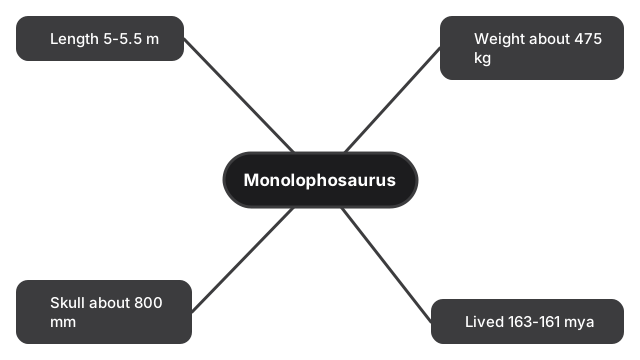
| Length | about 5-5.5 m (16-18 ft) |
| Weight | about 475 kg (1,047 lb) by the commonly cited estimate |
| Skull length | about 800 mm, front of upper jaw to back of skull |
| When it lived | 163-161 million years ago (Middle Jurassic) |
| Diet | Carnivore |
| Described | Named by Zhao Xijin and Philip Currie, 1993, from a skeleton found in 1981 by Dong Zhiming, Shishugou Formation, Xinjiang, China |
Everything runs on your device with WebGL, so the model works without an account and without sending anything to a server. The skin tone, crest color, and pattern are an artistic reconstruction, because fossils do not preserve color or soft tissue, and this model is not a fossil-accurate skeleton; the numbers above are real published values, and a few older popular sources give larger figures (up to about 7.5 m) that the 1993 description does not support.
Frequently Asked Questions
How big was Monolophosaurus?
The commonly cited estimate is about 5 to 5.5 m long and around 475 kg. A few older popular sources give much larger figures, up to about 7.5 m, but the 1993 scientific description does not support those numbers. Turn on the human figure in the viewer to see the scale against a 1.8 m person.
What was the crest on its head for?
The single crest runs along the midline of the snout and is built from the fused nasal and lacrimal bones. It is hollow inside and connects to the antorbital fossa (the opening in front of the eye) through small internal passages. Researchers think it more likely served display or species recognition than a weapon, since it is thin and not well suited to fighting.
How is Monolophosaurus different from Dilophosaurus or Cryolophosaurus?
All three are crested Jurassic theropods, but the crests differ: Monolophosaurus carries a single fused ridge along the snout midline, Dilophosaurus (North America) carries a pair of parallel crests, and Cryolophosaurus (Antarctica) carries a single crest that sweeps forward like a pompadour. Monolophosaurus is also the only one of the three known from China.
When and where did Monolophosaurus live?
In the Middle Jurassic, about 163 to 161 million years ago, in the Shishugou Formation of the Junggar Basin, Xinjiang, China. Dong Zhiming found the skeleton in 1981 while surveying rock layers for the oil industry, and Zhao Xijin and Philip Currie formally named it Monolophosaurus jiangi in 1993.
Is the model scientifically accurate?
The proportions follow published figures, but the skin color and soft-tissue outline are an artistic reconstruction - fossils preserve bone, not soft tissue or color. This model is not a fossil-accurate skeleton. The length, weight, skull length, and age figures shown are real published values.
Do I need to install anything to view it?
No. The model renders in your browser with WebGL - no app, no account, and nothing about your visit is sent to a server. The 3D engine loads once and is then cached. When available, a free-licensed glTF model may swap in after first paint.