
Drag to rotate the Amargasaurus, scroll or pinch to zoom, and click a body part - the head, neck, body, leg, or tail - to read what fossils tell us about it. The panel beside the model carries the real figures.
Amargasaurus was a relatively small sauropod about 9 to 13 m long, famous for two parallel rows of tall spines along its neck - turn on the human figure to compare.
The colors and soft outline here are an artistic reconstruction; fossils preserve bone, not soft tissue or color. This model is not a fossil-accurate skeleton. The measurements in the panel use mid-range figures within published ranges.
Amargasaurus 3D Viewer
This page renders an Amargasaurus as a 3D model you can spin in the browser - drag to rotate, scroll or pinch to zoom, toggle a 1.8 m person beside it for scale, and click the head, neck, body, a leg, or the tail to read a fact about that part.
Amargasaurus was a dicraeosaurid sauropod from the Early Cretaceous of what is now Neuquen, Argentina, in the La Amarga Formation. It was smaller than classic whip-tailed giants like Diplodocus or Barosaurus, with a shorter neck typical of dicraeosaurids. Its most striking feature is two parallel rows of tall neural spines running along the neck - researchers still debate whether those spines supported a sail-like membrane of skin or stood as bony cores for keratin sheaths; this page treats that question as open rather than settled.
Leonardo Salgado and Jose Bonaparte named the genus in 1991 from holotype MACN-N 15. Published length estimates span about 9 to 13 m and mass estimates about 2.5 to 4 t; this viewer uses about 10 m and about 3.2 t as mid-range panel values within those ranges.
| Measure | Figure |
|---|---|
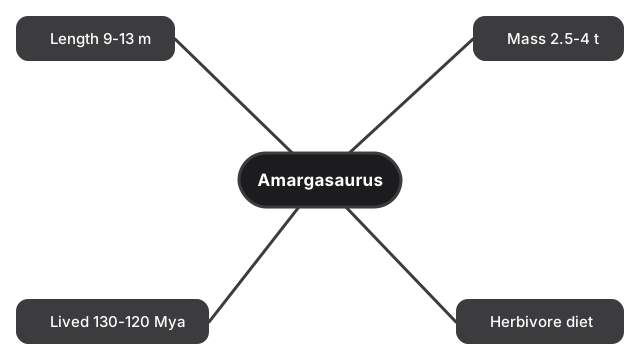
| Length | about 9-13 m (panel ~10 m) |
| Weight | about 2.5-4 t (panel ~3.2 t) |
| When it lived | about 130-120 Mya (Early Cretaceous) |
| Diet | Herbivore |
| Group | Dicraeosaurid sauropod |
Everything runs on your device with WebGL, so the model works without an account and without sending anything to a server. The skin tone and pattern are an artistic reconstruction, because fossils do not preserve color or soft tissue; this model is not a fossil-accurate skeleton. For a longer-necked sauropod sibling in the same collection, see the Barosaurus 3D Viewer or the Diplodocus 3D Viewer.
Beyond the drag and pinch, a row of buttons under the scene lets you stop the slow auto-spin when you want a steady side view, switch on a gentle idle motion, or open the model fullscreen for a closer look. Tapping the head, neck, body, a leg, or the tail swaps the side panel to a short fossil note about that part, and clicking any empty space brings the full species fact sheet back.
Frequently Asked Questions
How big was Amargasaurus?
Published figures put Amargasaurus at about 9 to 13 m long and about 2.5 to 4 tonnes. This viewer uses 10 m and 3.2 t as mid-range values within those ranges. Turn on the human figure to compare scale against a 1.8 m person.
What are the neck spines for?
Fossils show two parallel rows of tall neural spines along the neck. Scientists debate whether they supported a sail-like skin membrane, stood as bony cores for keratin sheaths, or served another display or thermoregulatory role - the page treats that as an open question, not settled fact.
When and where was Amargasaurus found?
In the Early Cretaceous, about 130 to 120 million years ago, in the La Amarga Formation of Neuquen, Argentina. Leonardo Salgado and Jose Bonaparte named the genus in 1991 from holotype MACN-N 15.
How is Amargasaurus different from Diplodocus or Barosaurus?
All three are sauropods, but Amargasaurus was a dicraeosaurid - smaller, with a shorter neck than the long-necked diplodocids - and is defined by its twin rows of tall neck spines rather than an extremely elongated neck or whip tail.
Is the model scientifically accurate?
The proportions follow published length and mass ranges, but the skin color, soft-tissue outline, and the exact shape of the neck spines are an artistic reconstruction - fossils preserve bone, not color or soft tissue. This model is not a fossil-accurate skeleton.
Do I need to install anything to view it?
No. The model renders in your browser with WebGL - no app, no account, and nothing about your visit is sent to a server. The 3D engine loads once and is then cached.