
Protoceratops in 3D - click the frill, the beak, or a leg for a fact (full controls on the Dinosaurs 3D hub).
Protoceratops was much smaller than its horned relative Triceratops - about the size of a large dog or pig rather than a car - and carried only a modest bony frill with no brow or nose horns. Turn on the human figure to see how the whole animal compares to a person.
No fossil preserves actual skin color, so what you see is an artistic choice. Frill and body size do follow the known skeleton, and panel figures reflect the published range.
Protoceratops 3D Viewer
Spin this Protoceratops model by dragging, zoom for detail, and click the frill, the beak, or a leg to surface a fact about it (see the Dinosaurs 3D hub for the full control list).
Protoceratops lived in the Late Cretaceous, roughly 75 to 71 million years ago, in what is now the Gobi Desert of Mongolia. It was one of the most common dinosaurs of the Djadokhta Formation there, known from more fossils - including a full growth series from hatchling to adult - than almost any other dinosaur. Unlike its larger relative Triceratops, it had no brow or nose horns, only a modest bony frill at the back of the skull and a parrot-like beak. Published length and weight estimates vary widely across sources, roughly 1.8 to 2.5 m long and 62 to 245 kg; the figures below use the middle of that commonly cited range.
Walter W. Granger and William K. Gregory named the genus in 1923, based on a partial juvenile skull (holotype AMNH 6251) that expedition photographer J. B. Shackelford found on 2 September 1922 during the American Museum of Natural History's Central Asiatic Expeditions, led by Roy Chapman Andrews - the person the genus honors. Protoceratops is also central to the 1971 "Fighting Dinosaurs" fossil (specimen MPC-D 100/512), preserving a Protoceratops locked in combat with a Velociraptor (MPC-D 100/25) as direct fossil evidence the two species fought each other.
| Measure | Figure |
|---|---|
| Length | about 1.8-2.5 m (range across sources) |
| Weight | about 62-245 kg (wide range across sources) |
| When it lived | 75-71 million years ago (Late Cretaceous, Campanian) |
| Diet | Herbivore |
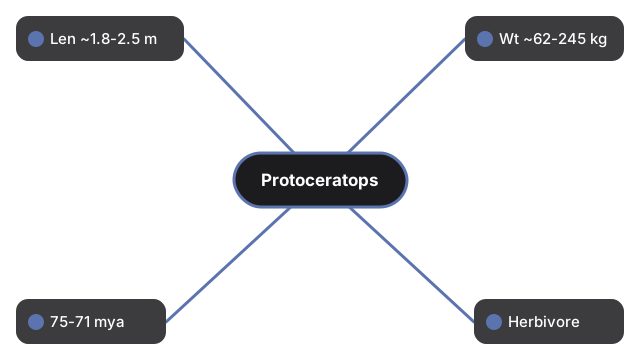
Colors here are an artistic reconstruction - fossils don't preserve them; the numbers above are real published values, with a range given where sources disagree.
Frequently Asked Questions
How big was a real Protoceratops?
Published estimates vary widely across sources, roughly 1.8 to 2.5 m long and 62 to 245 kg - much smaller than Triceratops. Turn on the human figure in the viewer to see the scale against a person.
Did Protoceratops have horns?
No. Unlike its larger relative Triceratops, Protoceratops had no brow or nose horns - only a modest bony frill at the back of the skull and a parrot-like beak.
What is the "Fighting Dinosaurs" fossil?
It is a famous 1971 fossil find (specimen MPC-D 100/512) that preserves a Protoceratops locked in combat with a Velociraptor (MPC-D 100/25) - direct fossil evidence that the two species fought each other.
Is the model scientifically accurate?
The frill, beak, and body proportions follow the fossil skeleton, but the skin color and texture are an artistic reconstruction - fossils preserve bone, not soft tissue or color. The length, weight, and age figures shown are real published values.
When and where did Protoceratops live?
In the Late Cretaceous, roughly 75 to 71 million years ago, in what is now the Gobi Desert of Mongolia. It was named in 1923 by Walter W. Granger and William K. Gregory from a partial skull found in 1922 during the American Museum of Natural History's Central Asiatic Expeditions.
Do I need to install anything to view it?
No. The model renders in your browser with WebGL - no app, no account, and nothing about your visit is sent to a server. The 3D engine loads once and is then cached.