
Drag to rotate the Compsognathus, scroll or pinch to zoom, and click a body part - the head, an arm, a leg, or the long tail - to read what fossils tell us about it. The panel beside the model carries the real figures.
Compsognathus was a chicken-sized Late Jurassic theropod - turn on the human figure to see how a roughly 1.25 m adult compares with a person. Two famous specimens come from Germany and France.
The colors and skin pattern here are an artistic reconstruction; fossils preserve bone, not soft tissue or color. The measurements in the panel are published figures with ranges where sources disagree.
Compsognathus 3D Viewer
This page renders a Compsognathus as a 3D model you can spin in the browser - drag to rotate, scroll or pinch to zoom, toggle a 1.8 m person beside it for scale, and click a body region to read a fact.
Compsognathus was a small bipedal theropod from the Late Jurassic of Europe, about 150 million years ago. Wagner named the genus in 1859. The German Solnhofen specimen is commonly reconstructed near 0.7-0.9 m and 0.3-0.6 kg; the larger French Canjuers specimen reaches about 1.25-1.4 m and 2.5-3.5 kg. For decades it was cited as among the smallest non-avian dinosaurs.
| Measure | Figure |
|---|---|
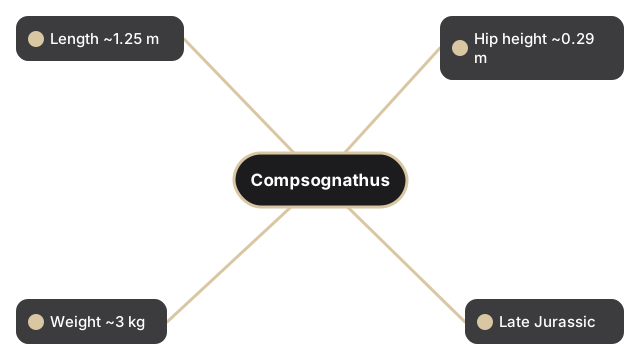
| Length | about 0.7-1.4 m across specimens (panel baseline 1.25 m, French adult) |
| Hip height | about 0.20-0.29 m (panel baseline 0.29 m) |
| Weight | about 0.3-3.5 kg across specimens (panel baseline 3 kg) |
| When it lived | about 150 million years ago (Late Jurassic) |
| Diet | Carnivore (small vertebrates) |
Everything runs on your device with WebGL - no account, nothing sent to a server. Soft-tissue color is an artistic reconstruction; this model is not a fossil-accurate skeleton. Compare with the Coelophysis 3D Viewer (an earlier, lightly built theropod) or the Microraptor 3D Viewer (a small feathered dromaeosaur).
Frequently Asked Questions
How big was Compsognathus?
Size depends on the specimen. The German fossil is commonly reconstructed near 0.7-0.9 m and 0.3-0.6 kg; the French adult reaches about 1.25-1.4 m and 2.5-3.5 kg. The panel uses the French adult baselines. Turn on the human figure for scale.
When and where did it live?
Late Jurassic Europe, about 150 million years ago. Fossils come from Solnhofen limestone in Germany and Canjuers in France.
What does the name mean?
Compsognathus means elegant jaw, referring to its slender snout and delicate skull.
Is Compsognathus a dinosaur?
Yes. It is a small theropod dinosaur in the compsognathid family, not a bird and not a marine reptile.
Is the model scientifically accurate?
Size follows published figures with ranges by specimen, but skin color and soft tissue are artistic. This is not a fossil-accurate skeleton.
Do I need to install anything to view it?
No. The model renders in your browser with WebGL - no app, no account, and nothing about your visit is sent to a server. When available, a free-licensed glTF model may swap in after first paint.