
Tsintaosaurus in 3D - click crest, the duck-bill snout, or a shoulder for a fact (full controls on the Dinosaurs 3D hub).
Tsintaosaurus was a Late Cretaceous lambeosaurine from Shandong, China, with an upright nasal crest; turn on the human figure to see how a person compares to its body.
The measurements in the panel follow published estimates, with ranges shown where sources disagree. Older art often shows a unicorn-like spike; newer reconstructions favor a broader lobate crest built around that nasal process.
Tsintaosaurus 3D Viewer
Below, a Tsintaosaurus you can drag to turn, zoom closer, and click the crest, duck-bill snout, or a shoulder for a fact about that part (the Dinosaurs 3D hub lists every control).
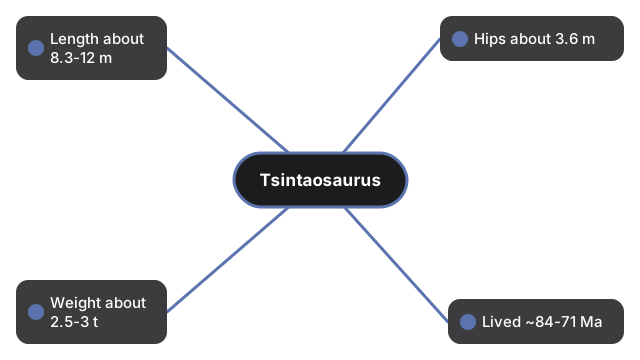
Tsintaosaurus lived in the Late Cretaceous, about 84 to 71 million years ago, in Shandong, China (Jingangkou Formation, near Laiyang). Length estimates run about 8.3 to 12 m; mass about 2.5 to 3 tonnes. It is a lambeosaurine hadrosaur named by C. C. Young in 1958 - different from Parasaurolophus (long tubular crest) and Edmontosaurus (no bony crest).
| Measure | Figure |
|---|---|
| Length | about 8.3-12 m (Wikipedia ~8.3 m; NHM lists 12.0 m) |
| Standing height | about 3.6 m at the hips for a large adult (commonly cited) |
| Weight | about 2.5-3 tonnes commonly cited |
| When it lived | about 84-71 million years ago (Late Cretaceous) |
| Diet | Herbivore |
This runs client-side through WebGL - no account to create, and nothing about your visit is transmitted to a server.
Frequently Asked Questions
Did Tsintaosaurus really have a unicorn horn?
Early reconstructions showed a tall, nearly upright nasal spike. Later work argues the preserved process was part of a broader, lobate crest rather than a lone unicorn horn. This viewer treats the crest as an artistic reconstruction guided by that debate, not a finished fossil map.
How big was Tsintaosaurus?
Published estimates usually fall around 8.3 to 12 m long and about 2.5 to 3 tonnes. The NHM directory lists 12.0 m; Wikipedia commonly cites about 8.3 m and 2.5 tonnes. Turn on the human figure to see the scale against a 1.8 m person.
When and where did it live?
In the Late Cretaceous, about 84 to 71 million years ago (Campanian), in Shandong, China - especially the Jingangkou Formation near Laiyang. The name refers to Qingdao (older transliteration Tsintao).
How is it different from Parasaurolophus or Edmontosaurus?
Parasaurolophus has a long, tubular, backward-curving crest. Edmontosaurus is a flat-headed saurolophine without a bony crest. Tsintaosaurus is a Chinese lambeosaurine with an upright nasal crest process. This site has separate viewers for comparison.
Is the model scientifically accurate?
The proportions follow published figures, but soft-tissue color is an artistic reconstruction. This model is not a fossil-accurate skeleton. Length, weight, and age figures are real published values, with ranges cited because sources vary.
Do I need to install anything to view it?
No. The model renders in your browser with WebGL - no app, no account, and nothing about your visit is sent to a server. When available, a free-licensed glTF model may swap in after first paint.