
Drag to rotate the Troodon, scroll or pinch to zoom, and click a body part - the head, an arm, a leg, or the raised tail - to read what fossils tell us about it. The panel beside the model carries the real figures.
Troodon is best known for two things fossils can actually measure: an unusually large brain relative to its body, and large, forward-set eyes - turn on the human figure to see how a roughly 2.4 m adult compares with a person.
The colors and feather pattern here are an artistic reconstruction; fossils preserve bone, not soft tissue or color. The measurements in the panel are published figures, and this page notes where the genus name itself is still scientifically debated.
Troodon 3D Viewer
This page renders a Troodon as a 3D model you can spin in the browser - drag to rotate, scroll or pinch to zoom, toggle a 1.8 m person beside it for scale, and click a body region to read a fact.
Troodon lived in what is now western North America during the Late Cretaceous, about 77-76.5 million years ago. Joseph Leidy named it in 1856 from a single tooth found in Montana - one of the first dinosaurs ever named from North America. Fossils show an unusually large brain for its body size and large, forward-set eyes, which some researchers read as evidence of sharp vision for hunting in low light. A sickle-shaped claw on the raised second toe and up to about 35 small serrated teeth per jaw side round out the picture. Because the name rests on that single tooth, its scientific validity has long been debated - other troodontid fossils from the same region have at times been placed in separate genera such as Stenonychosaurus, Latenivenatrix, and Pectinodon. A 2025 study proposed a new reference specimen to keep "Troodon formosus" as the name for this animal, which this page follows.
| Measure | Figure |
|---|---|
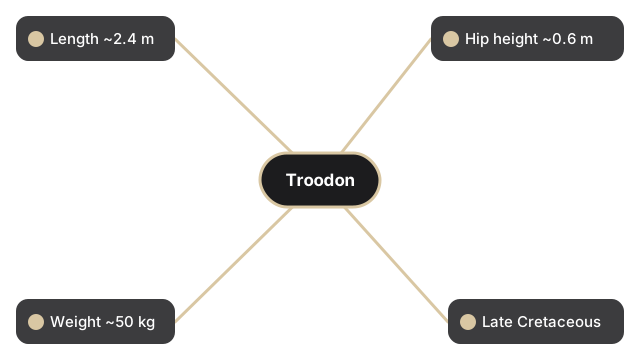
| Length | about 1-3 m across published estimates (panel baseline 2.4 m) |
| Hip height | about 0.6 m (panel baseline) |
| Weight | about 10-50 kg across published estimates (panel baseline 50 kg) |
| When it lived | about 77-76.5 million years ago (Late Cretaceous, Campanian) |
| Diet | Omnivore (debated - tooth shape hints at both meat and plants) |
| Named | Joseph Leidy, 1856, from a single tooth (Judith River Formation, Montana) |
Everything runs on your device with WebGL - no account, nothing sent to a server. Feather color and pattern are an artistic reconstruction; this model is not a fossil-accurate skeleton. Compare the sickle-shaped claw with the already-shipped Velociraptor 3D Viewer, or see an earlier small theropod in the Coelophysis 3D Viewer.
Frequently Asked Questions
Why is Troodon called the smartest dinosaur?
Because fossils show it had one of the largest brain-to-body-size ratios of any known dinosaur, alongside large, forward-set eyes. This does not mean it was as intelligent as a modern mammal - only that its brain was unusually large for its size among dinosaurs.
How big was Troodon?
Published estimates vary by source, roughly 1-3 m long and 10-50 kg. The panel uses commonly cited middle-of-range figures: about 2.4 m long and 50 kg. Turn on the human figure for scale.
Is "Troodon" a valid dinosaur name?
It is debated. The name was based on a single tooth found in 1855, so for decades other troodontid fossils from the same region were sometimes placed in separate genera (Stenonychosaurus, Latenivenatrix, Pectinodon). A 2025 study proposed a new reference specimen to keep the name Troodon formosus, which this page follows.
What did Troodon eat?
Its diet is debated. The serrated teeth resemble those of meat-eating dinosaurs, but their shape also resembles some plant-eating dinosaurs' teeth, so many researchers consider Troodon likely omnivorous.
Is the model scientifically accurate?
Size and era follow published figures, but feather color and pattern are artistic. This is not a fossil-accurate skeleton - fossils do not preserve original skin or feather color.
Do I need to install anything to view it?
No. The model renders in your browser with WebGL - no app, no account, and nothing about your visit is sent to a server. When available, a free-licensed glTF model may swap in after first paint.