
Drag to rotate the Dimetrodon, scroll or pinch to zoom, and click a body part - the sail, the head, or a leg - to read what fossils tell us about it. The panel beside the model carries the real figures.
Dimetrodon was not a dinosaur - it was a sail-backed synapsid from the Early Permian, more closely related to mammals than to dinosaurs, and it lived tens of millions of years before the first dinosaurs.
The colors and skin here are an artistic reconstruction; fossils preserve bone, not soft tissue or color. The measurements in the panel are the real published ones.
Dimetrodon 3D Viewer
This page renders a Dimetrodon as a 3D model you can spin in the browser - drag to rotate, scroll or pinch to zoom, toggle a 1.8 m person beside it for scale, and click the sail, the head, or a leg to read a fact about that part.
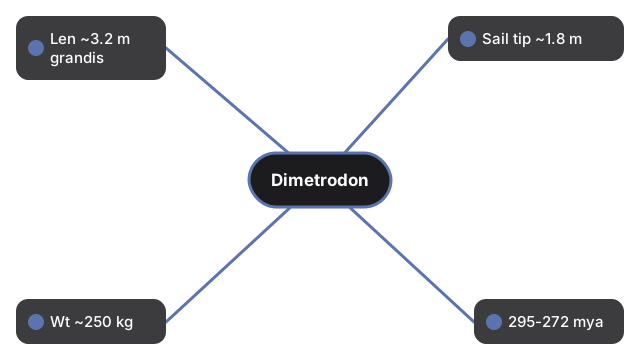
Dimetrodon lived in the Early Permian, about 295 to 272 million years ago. It was a synapsid, not a dinosaur - more closely related to mammals - and lived tens of millions of years before the first dinosaurs. D. grandis is about 3.2 m and about 250 kg; the genus ranges about 1.7-4.6 m and about 28-250 kg. Named by Cope in 1878.
| Measure | Figure |
|---|---|
| Length | about 3.2 m for D. grandis (genus about 1.7-4.6 m) |
| Standing height | about 1.8 m to the sail tip for a large adult (proportionate estimate) |
| Weight | about 250 kg for D. grandis (genus about 28-250 kg) |
| When it lived | about 295-272 million years ago (Early Permian) |
| Group | Synapsid (not a dinosaur) |
| Diet | Carnivore |
Everything runs on your device with WebGL - no account, nothing sent to a server. Soft-tissue color is an artistic reconstruction; this model is not a fossil-accurate skeleton. Figures above are published values with ranges where sources disagree.
Frequently Asked Questions
Was Dimetrodon a dinosaur?
No. Dimetrodon was a synapsid - on the branch that leads toward mammals - and it lived in the Early Permian, tens of millions of years before the first dinosaurs. This viewer includes it because it is a popular prehistoric animal with a distinctive sail.
How big was Dimetrodon?
D. grandis is about 3.2 m long and about 250 kg. Across the genus, adults range about 1.7-4.6 m and about 28-250 kg. Turn on the human figure to judge the scale.
What was the sail for?
The sail is made of elongated neural spines from the vertebrae. Researchers have proposed thermoregulation and display among other ideas; soft tissue between the spines is not preserved, so color and membrane detail are interpretive.
When and where did Dimetrodon live?
About 295-272 million years ago in the Early Permian. Many fossils come from the Red Beds of Texas and Oklahoma; others are known from Germany.
Is the model scientifically accurate?
The body shape and sail follow fossil reconstructions, but the skin color and texture are an artistic reconstruction. Fossils preserve bone, not color. The figures shown are real published values with ranges where sources disagree.