
Dilophosaurus in 3D - click the head, an arm, the tail, or a leg for a fact (full controls on the Dinosaurs 3D hub).
Dilophosaurus hunted in what is now northern Arizona early in the age of dinosaurs - turn on the human figure to see how a person compares to its twin head crests and long, narrow jaws.
Colors are an artistic reconstruction - fossils preserve bone, not color or the exact outward shape of the crests. This model is not a fossil-accurate skeleton. The measurements in the panel follow published estimates, with ranges shown where sources disagree.
Dilophosaurus 3D Viewer
Click and drag the Dilophosaurus model to spin it, zoom for a closer look, and click a body part to read a fact (the Dinosaurs 3D hub covers all controls).
Dilophosaurus lived early in the Jurassic, roughly 195 to 184 million years ago (often cited around 193 million years ago), in what is now northern Arizona, United States. The holotype skeleton (UCMP 37302) measures about 6 m long and an estimated 283 kg; the largest known specimen reached about 7 m and roughly 400 kg. Its signature feature was a pair of thin, arched crests running along the top of the skull, formed mainly by the nasal and lacrimal bones - their full outward shape and covering are not completely preserved in the fossils, but they were most likely covered in keratin.
Samuel Welles first described the species in 1954 as a new species of Megalosaurus, then created the new genus Dilophosaurus - meaning "two-crested lizard" - for it in 1970. Jurassic Park (1993) gave this dinosaur a fictional neck frill and a venom-spitting ability for dramatic effect; neither is supported by any fossil evidence, and the real animal's twin crests were solid, immobile head ornaments, not a deployable frill.
| Measure | Figure |
|---|---|
| Length | about 6 m (holotype); largest known specimen about 7 m |
| Weight | about 283 kg (holotype); largest known specimen about 400 kg |
| When it lived | 195-184 million years ago (Early Jurassic; often cited as about 193 million years ago) |
| Diet | Carnivore |
| Described | 1954 as a Megalosaurus species by Samuel Welles; reclassified into the new genus Dilophosaurus in 1970; Kayenta Formation, Arizona, United States |
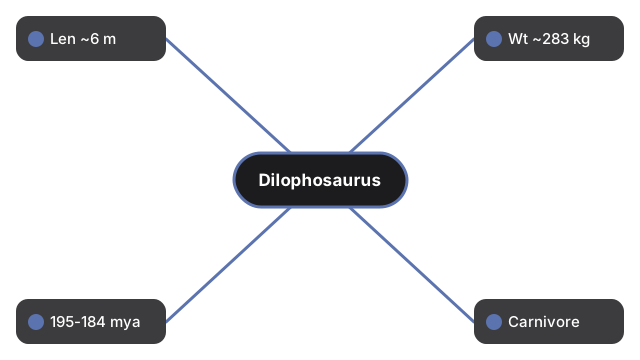
Colors here are an artistic reconstruction - fossils don't preserve them; the exact outward shape of the crests is likewise not fully preserved, so treat that detail as an educated estimate rather than a direct fossil reading. The numbers above are real published values, with ranges shown because sources vary.
Frequently Asked Questions
How big was Dilophosaurus?
The holotype skeleton measures about 6 m long and an estimated 283 kg; the largest known specimen reached about 7 m and roughly 400 kg. Turn on the human figure in the viewer to see the scale against a 1.8 m person.
Did Dilophosaurus really have a neck frill and spit venom?
No. Jurassic Park (1993) invented both a deployable neck frill and a venom-spitting ability for dramatic effect. No fossil evidence supports either. The real animal's twin head crests were solid, fixed ornaments, not a frill, and there is no evidence it produced venom.
What were the head crests for?
Fossils show a pair of thin, arched crests running along the top of the skull, formed mainly by the nasal and lacrimal bones. Their exact outward shape and covering are not fully preserved, though they were most likely covered in keratin; their function - display, species recognition, or something else - is not settled.
Is the model scientifically accurate?
The body proportions follow the holotype skeleton, but the skin color and the exact outward shape of the crests are an artistic reconstruction - fossils do not preserve color, and this model is not a fossil-accurate skeleton. The length, weight, and age figures shown are real published values, with ranges cited where sources disagree.
When and where did Dilophosaurus live?
Early in the Jurassic, roughly 195 to 184 million years ago (often cited around 193 million years ago), in what is now northern Arizona, United States. Samuel Welles first described it in 1954, then created the new genus Dilophosaurus for it in 1970.
Do I need to install anything to view it?
No. The model renders in your browser with WebGL - no app, no account, and nothing about your visit is sent to a server. The 3D engine loads once and is then cached.