
Gallimimus in 3D - click its long neck, toothless beak, or a leg for a fact (full controls on the Dinosaurs 3D hub).
Gallimimus was a fast, toothless, beaked dinosaur built along ostrich-like lines - turn on the human figure to see how a person compares to its long-necked, long-legged body.
The measurements in the panel follow published estimates, with ranges shown where sources disagree.
Gallimimus 3D Viewer
Rotate the Gallimimus with a drag, zoom in with scroll or pinch, and click the neck, the beak, or a leg to read a fact (full control reference on the Dinosaurs 3D hub).
Gallimimus lived in the Late Cretaceous, about 70 million years ago, in what is now the Gobi Desert of Mongolia. It is commonly cited at around 6 m long and about 1.9 m tall at the hip, with weight estimated at about 400 to 490 kg (some estimates run as low as 227 kg). Its toothless, keratinous beak, proportionally long neck, and long slender legs gave it an estimated running speed of about 42 to 56 km/h - the fastest estimate of any species shown on this site.
Gallimimus was named by Halszka Osmolska, Ewa Roniewicz, and Rinchen Barsbold in 1972, from a holotype discovered in 1964 by Zofia Kielan-Jaworowska at Tsaagan Khushuu in the Nemegt Formation, Gobi Desert, Mongolia. Its genus name means "chicken mimic" (Latin gallus, chicken, plus Greek mimos, mimic), referencing similarities between its neck vertebrae and those of chickens and other gallinaceous birds. Its diet is genuinely unresolved - small-prey carnivory, aquatic filter-feeding, herbivory, and opportunistic omnivory have all been proposed, with no consensus. No direct feather fossils are known from Gallimimus itself; feathering is inferred from quill-knob fossils on the closely related Ornithomimus.
| Measure | Figure |
|---|---|
| Length | about 6 m (some sources note largest individuals up to 7-8 m) |
| Hip height | about 1.9 m |
| Weight | about 400-490 kg (other estimates run as low as 227 kg) |
| Running speed | estimated 42-56 km/h (Thulborn, 1982) |
| When it lived | about 70 million years ago (Late Cretaceous, Maastrichtian) |
| Diet | Unresolved - carnivory, filter-feeding, herbivory, and omnivory all proposed |
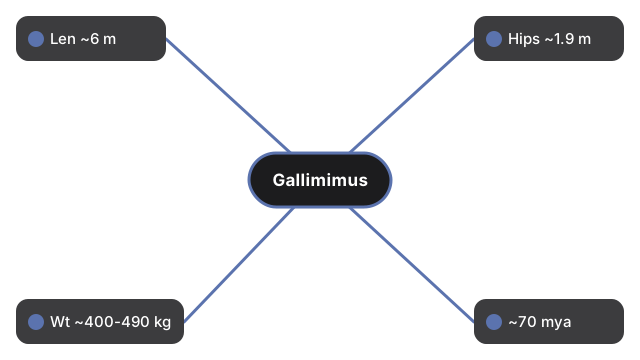
Colors here are an artistic reconstruction - fossils don't preserve them; the numbers above are real published values, and ranges are shown because sources vary.
Frequently Asked Questions
How big was Gallimimus?
Gallimimus is commonly cited at around 6 m long (some sources note the largest individuals up to 7-8 m) and about 1.9 m tall at the hip, with weight estimated at about 400 to 490 kg. Turn on the human figure in the viewer to see the scale against a 1.8 m person.
How fast could Gallimimus run?
An estimated 42 to 56 km/h (Thulborn, 1982), based on its long slender legs - the fastest estimated running speed of any species shown on this site. Speed estimates for extinct animals carry real uncertainty since they rely on leg proportions and trackway data rather than a direct measurement.
What did Gallimimus eat?
Its diet is genuinely unresolved. Small-prey carnivory, aquatic filter-feeding, herbivory, and opportunistic omnivory have all been proposed by different researchers, and no single diagnosis has consensus support.
Did Gallimimus have feathers?
No feather fossils have been found directly on Gallimimus itself. Feathering is inferred from quill-knob fossils preserved on the closely related Ornithomimus, so it is a reasonable inference rather than a direct observation for this genus.
When and where did Gallimimus live?
In the Late Cretaceous, about 70 million years ago, in what is now the Nemegt Formation of the Gobi Desert, Mongolia - the same region and rock formation that produced several other dinosaurs shown on this site.
Is the model scientifically accurate?
The body proportions and toothless beak follow published figures, but the skin color and soft-tissue outline are an artistic reconstruction - fossils preserve bone, not soft tissue or color. This model is not a fossil-accurate skeleton. The length, weight, speed, and age figures shown are real published values, with ranges cited because sources vary.