
Allosaurus in 3D - click the head, an arm, the tail, or a leg for a fact (full controls on the Dinosaurs 3D hub).
Allosaurus was the apex predator of the Late Jurassic Morrison Formation - turn on the human figure to see how a person compares to its long, muscular tail and three-clawed hands.
The measurements in the panel follow published estimates, with ranges shown where sources disagree.
Allosaurus 3D Viewer
Turn the Allosaurus with a drag, zoom closer with scroll, and click a body part to get a fact about it - the Dinosaurs 3D hub lists every control.
Allosaurus lived in the Late Jurassic, roughly 155 to 143 million years ago, mainly in the Morrison Formation of the western United States, with possible remains also reported from Portugal. Average length is often cited around 8.5 m, with the largest confirmed individuals near 9.7 m; weight estimates commonly range from about 1.5 to 2.7 tonnes depending on the individual and the study. Small bony ridges called lacrimal horns sat above each eye, each hand carried three clawed fingers, and the jaws held dozens of blade-like serrated teeth. Wikipedia's synthesis of the literature describes it as an apex predator that probably preyed on large herbivorous dinosaurs of its time.
Paleontologist Othniel Charles Marsh named Allosaurus in 1877 from fossils found at Garden Park, Colorado. In 2023 the International Commission on Zoological Nomenclature designated the Allosaurus skeleton at the Smithsonian's National Museum of Natural History (specimen USNM 4734) as the species' neotype - the single physical reference specimen researchers use when describing new Allosaurus fossils.
| Measure | Figure |
|---|---|
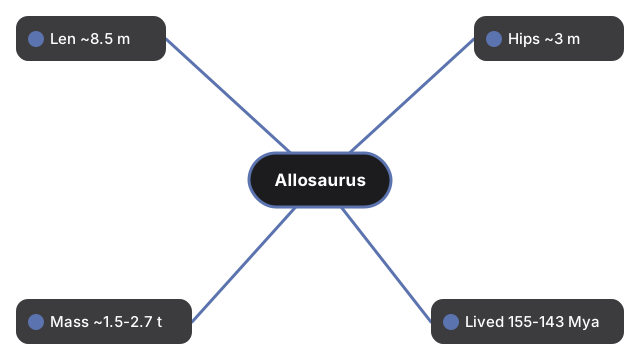
| Length | about 8.5 m on average; largest confirmed individuals about 9.7 m |
| Hip height | about 3 m (published ranges run roughly 2.9-4.9 m) |
| Weight | about 1.5-2.7 tonnes |
| When it lived | 155-143 million years ago (Late Jurassic) |
| Diet | Carnivore |
Colors here are an artistic reconstruction - fossils don't preserve them; the numbers above are real published values, with ranges shown because sources vary.
See also Ceratosaurus and Megalosaurus, large Jurassic theropod relatives.
Frequently Asked Questions
How big was Allosaurus?
Average length is often cited around 8.5 m, with the largest confirmed individuals near 9.7 m; weight estimates commonly range from about 1.5 to 2.7 tonnes. Turn on the human figure in the viewer to see the scale against a 1.8 m person.
Was Allosaurus the same as Tyrannosaurus rex?
No. Allosaurus lived about 90 million years earlier, in the Late Jurassic (about 155-143 million years ago), while Tyrannosaurus rex lived at the very end of the Cretaceous (about 68-66 million years ago); the two are not closely related despite both being large, two-legged carnivores. Allosaurus also had proportionally longer, more functional forelimbs with three clawed fingers, unlike the very reduced two-fingered arms of Tyrannosaurus rex.
When and where did Allosaurus live?
In the Late Jurassic, roughly 155 to 143 million years ago, mostly in the Morrison Formation of the western United States. Othniel Charles Marsh named the genus in 1877 from fossils found at Garden Park, Colorado.
Is the model scientifically accurate?
The proportions follow published figures, but the skin color and texture are an artistic reconstruction - fossils preserve bone, not soft tissue or color. This model is not a fossil-accurate skeleton. The length, weight, and age figures shown are real published values, with ranges cited where sources disagree.
Do I need to install anything to view it?
No. The model renders in your browser with WebGL - no app, no account, and nothing about your visit is sent to a server. The 3D engine loads once and is then cached.