Ophthalmosaurus in 3D - click the head, a flipper, or the tail for a fact (full controls on the Dinosaurs 3D hub).
Ophthalmosaurus was a marine reptile, not a dinosaur - a dolphin-shaped hunter named for its enormous eyes, likely an adaptation for hunting in dim or deep water. Published length estimates range roughly 4 to 6 m depending on the source.
Colors are an artistic reconstruction (fossils don't preserve them). The measurements in the panel are the real published ones.
Ophthalmosaurus 3D Viewer
Spin this Ophthalmosaurus model by dragging, zoom for detail, and click the head, a flipper, or the tail to surface a fact about it (see the Dinosaurs 3D hub for the full control list).
Ophthalmosaurus lived roughly 165 to 157 million years ago, in the Middle to Late Jurassic, and hunted fish and soft-bodied cephalopods with small, weakly developed teeth rather than the larger, heavier bite of some other ichthyosaurs. Its name means "eye lizard" - the bony sclerotic ring around each eye socket measures about 220 to 230 mm (roughly 9 in) across, proportionally the largest eyes of any known vertebrate, and likely helped it hunt in dim or deep water, possibly at night. A commonly cited scientific estimate (Motani et al.) puts a typical individual at about 4 m long and 930 to 950 kg, though some other sources give lengths up to around 6 m for the genus. It was not a dinosaur - it belonged to a separate group of marine reptiles - so the model shows a streamlined, dolphin-shaped body with a dorsal fin, paired paddle flippers, and a crescent-shaped tail fluke.
Ophthalmosaurus was described by British palaeontologist Harry Govier Seeley in 1874, based on fossils from the Oxford Clay Formation near Peterborough, England - a site that has produced many well-preserved ichthyosaur specimens from the Jurassic seas that once covered the region.
| Measure | Figure |
|---|---|
| Length | about 4 m (some sources cite up to ~6 m for the genus) |
| Weight | about 930-950 kg for a ~4 m individual |
| Eye (sclerotic ring) | about 220-230 mm (~9 in) across - proportionally the largest of any known vertebrate |
| When it lived | 165-157 million years ago (Middle-Late Jurassic) |
| Group | Marine reptile (Ichthyosauria), not a dinosaur |
| Diet | Carnivore (fish and soft-bodied cephalopods) |
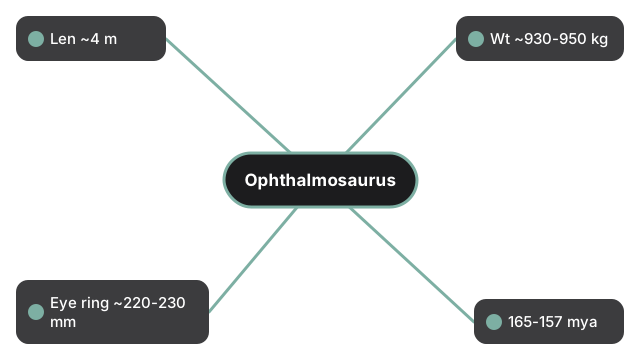
Colors here are an artistic reconstruction - fossils don't preserve them; the numbers above are real published values, with a range given where sources disagree.
Frequently Asked Questions
Was Ophthalmosaurus a dinosaur?
No. Ophthalmosaurus was a marine reptile - a member of the Ichthyosauria - that lived alongside dinosaurs but is a separate group. This viewer includes it because it is one of the most-searched prehistoric marine animals.
Why were its eyes so big?
Ophthalmosaurus had the proportionally largest eyes of any known vertebrate - the bony sclerotic ring around each eye socket measures about 220-230 mm (roughly 9 in) across. Researchers think this helped it see and hunt in dim or deep water, possibly at night.
How big was Ophthalmosaurus?
A commonly cited scientific estimate puts a typical individual at about 4 m long and 930-950 kg, though some other sources give lengths up to around 6 m for the genus. Turn on the human figure in the viewer to judge the scale.
What did Ophthalmosaurus eat?
Fish and soft-bodied cephalopods (squid-like animals). Its teeth were small and only weakly developed - suited to grabbing soft prey rather than crushing hard shells.
Is the model scientifically accurate?
The body shape - a streamlined, dolphin-like torso, a dorsal fin, paired paddle flippers, and a crescent tail fluke - follows the fossil skeleton, but the skin color and texture are an artistic reconstruction. Fossils preserve bone, not color. The figures shown are real published values.
Where was Ophthalmosaurus first found?
Near Peterborough, England, in the Oxford Clay Formation. It was described by British palaeontologist Harry Govier Seeley in 1874.
Do I need to install anything to view it?
No. The model renders in your browser with WebGL - no app, no account, and nothing about your visit is sent to a server. The 3D engine loads once and is then cached.