
Drag to rotate the Brachylophosaurus, scroll or pinch to zoom, and click a body part - the head, the short crest, a limb, or the tail - to read what fossils tell us about it. The panel beside the model carries the real figures.
Brachylophosaurus was a duck-billed hadrosaur with a short, flat crest - turn on the human figure to see how a person compares to its roughly 9 m body.
The colors and skin here are an artistic reconstruction; fossils preserve bone, not soft tissue or color. This model is not a fossil-accurate skeleton. The measurements in the panel follow published estimates, with ranges shown where sources disagree.
Brachylophosaurus 3D Viewer
This page renders a Brachylophosaurus as a 3D model you can spin in the browser - drag to rotate, scroll or pinch to zoom, toggle a 1.8 m person beside it for scale, and click the head, short crest, a limb, or the tail to read a fact about that part.
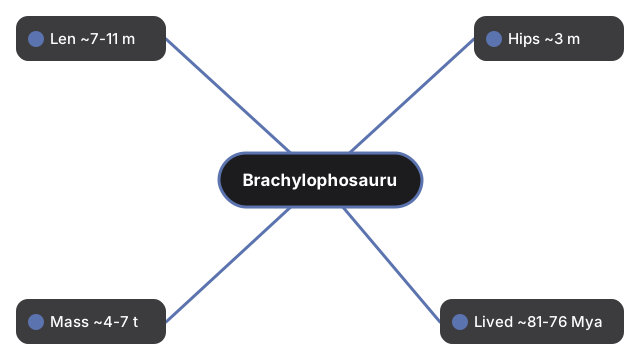
Brachylophosaurus lived about 81-76 million years ago in the Late Cretaceous (Campanian) of western North America (Oldman Formation in Alberta; Judith River Formation in Montana). Charles M. Sternberg named B. canadensis in 1953. Adults reached at least about 9 m; published length figures range from the NHM directory's 7.0 m up to Gregory S. Paul's 2010 maximum near 11 m, and mass estimates about 4-7 tonnes. This page uses 9 m and 5500 kg as panel baselines.
| Measure | Figure |
|---|---|
| Length | about 7-11 m (panel baseline 9 m; NHM 7.0 m; Paul 2010 max ~11 m) |
| Hip height | about 3 m (panel baseline) |
| Weight | about 4-7 tonnes (panel baseline 5500 kg) |
| When it lived | about 81-76 million years ago (Late Cretaceous, Campanian) |
| Diet | Herbivore |
Everything runs on your device with WebGL - no account, nothing sent to a server. Soft-tissue color is an artistic reconstruction; this model is not a fossil-accurate skeleton. Compare with the crestless Edmontosaurus 3D Viewer and the long-crested Parasaurolophus 3D Viewer.
Frequently Asked Questions
How big was Brachylophosaurus?
Adults reached at least about 9 m long. Published figures range from the Natural History Museum directory's 7.0 m up to Gregory S. Paul's 2010 maximum near 11 m and about 7 tonnes; other mass estimates fall around 4-5 tonnes. This page uses 9 m and 5500 kg as the facts-panel baselines. Turn on the human figure in the viewer to see the scale against a 1.8 m person.
What does the short crest mean?
The genus name means short-crested lizard. Unlike the long tubular crest of Parasaurolophus, Brachylophosaurus had a low, flat, paddle-like crest of bone on top of the skull. Soft-tissue color around the crest is not known from fossils.
When and where did Brachylophosaurus live?
In the Late Cretaceous Campanian, about 81 to 76 million years ago, in floodplain deposits of the Oldman Formation in Alberta and the Judith River Formation in Montana. Charles M. Sternberg named Brachylophosaurus canadensis in 1953.
Is the model scientifically accurate?
The proportions follow published figures, but the skin color and soft-tissue outline are an artistic reconstruction - fossils preserve bone, not soft tissue or color. This model is not a fossil-accurate skeleton. The length, weight, and age figures shown are real published values, with ranges cited where sources disagree.
Do I need to install anything to view it?
No. The model renders in your browser with WebGL - no app, no account, and nothing about your visit is sent to a server. The 3D engine loads once and is then cached. When available, a free-licensed glTF model may swap in after first paint.