
Drag to rotate the Alioramus, scroll or pinch to zoom, and click a body part - the head, a limb, or the tail - to read what fossils tell us about it. The panel beside the model carries the real figures.
Alioramus was a Late Cretaceous long-snouted tyrannosaurid from Mongolia - turn on the human figure to see how a person compares to its roughly 5.5 m body.
The colors and skin here are an artistic reconstruction; fossils preserve bone, not soft tissue or color. This model is not a fossil-accurate skeleton. The measurements in the panel follow published estimates, with ranges shown where sources disagree.
Alioramus 3D Viewer
This page renders an Alioramus as a 3D model you can spin in the browser - drag to rotate, scroll or pinch to zoom, toggle a 1.8 m person beside it for scale, and click the head, a limb, or the tail to read a fact about that part.
Four buttons sit under the scene. The model turns on a slow automatic turntable by default, so Stop rotation freezes it when you want to line up a single angle, and Idle motion layers on a gentle sway for a more lifelike pose. Fullscreen expands the viewer to fill the screen for a closer look, and the controls stay visible while you explore.
Alioramus lived in the Late Cretaceous of Mongolia (Nemegt Formation), about 72-66 million years ago. Sergei Kurzanov named Alioramus remotus in 1976; a second species, A. altai, was named by Brusatte and colleagues in 2009. It is a slender, long-snouted tyrannosaurid in the tribe Alioramini, distinct from the much larger contemporary Tarbosaurus.
| Measure | Figure |
|---|---|
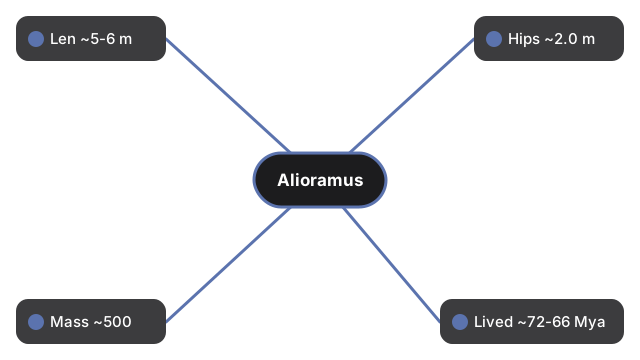
| Length | about 5.5 m panel baseline (Molina-Perez and Larramendi 2016 for A. remotus); Kurzanov 1976 about 5-6 m; Paul 1988 about 6 m |
| Hip height | about 2.0 m (panel reconstruction baseline) |
| Weight | about 500 kg panel baseline (Molina-Perez and Larramendi 2016 for A. remotus); Paul 1988 about 700 kg; A. altai about 385 kg |
| When it lived | about 72-66 million years ago (Late Cretaceous, Nemegt Formation, Mongolia) |
| Diet | Carnivore |
Everything runs on your device with WebGL - no account, nothing sent to a server. Soft-tissue color is an artistic reconstruction; this model is not a fossil-accurate skeleton. Compare with the larger Mongolian predator Tarbosaurus 3D Viewer and the North American albertosaurine Gorgosaurus 3D Viewer.
Frequently Asked Questions
How big was Alioramus?
Kurzanov (1976) estimated about 5-6 m for Alioramus remotus. Molina-Perez and Larramendi (2016) give about 5.5 m and 500 kg for A. remotus, and about 5 m and 385 kg for A. altai. Paul (1988) listed about 6 m and 700 kg. This page uses 5.5 m and 500 kg as facts-panel baselines and notes the range. Turn on the human figure to compare with a 1.8 m person.
What kind of dinosaur was Alioramus?
It is a tyrannosaurid theropod in the tribe Alioramini - a long-snouted branch separate from Tarbosaurus and Tyrannosaurus. Specimens show a slender build and distinctive nasal crests or bumps along the snout.
When and where did Alioramus live?
In Late Cretaceous rocks of the Nemegt Formation in Mongolia, about 72-66 million years ago. Sergei Kurzanov named Alioramus remotus in 1976; Brusatte and colleagues named A. altai in 2009 from a more complete skeleton.
Is the model scientifically accurate?
The proportions follow published figures, but the skin color and soft-tissue outline are an artistic reconstruction - fossils preserve bone, not soft tissue or color. This model is not a fossil-accurate skeleton. The length, weight, and age figures shown are real published values, with ranges cited where sources disagree.
Do I need to install anything to view it?
No. The model renders in your browser with WebGL - no app, no account, and nothing about your visit is sent to a server. The 3D engine loads once and is then cached. When available, a free-licensed glTF model may swap in after first paint.