
Drag to rotate the Panoplosaurus, scroll or pinch to zoom, and click the head, the armored body, or a leg to read what fossils tell us about it. The panel beside the model carries the real figures.
Panoplosaurus was a heavily armored nodosaurid with no club at the end of its tail and no prominent spikes, unlike the already-shipped Ankylosaurus - turn on the human figure to see how a person compares to its broad, plated body.
The colors and skin here are an artistic reconstruction; fossils preserve bone, not soft tissue or color. This model is not a fossil-accurate skeleton. The measurements in the panel follow published estimates, with ranges shown where sources disagree.
Panoplosaurus 3D Viewer
This page renders a Panoplosaurus as a 3D model you can spin in the browser - drag to rotate, scroll or pinch to zoom, toggle a 1.8 m person beside it for scale, and click the head, the armored body, or a leg to read a fact about that part.
Charles M. Sternberg found the first skeleton in 1917 at Quarry 8 near Little Sandhill Creek, and Lawrence M. Lambe named Panoplosaurus mirus in 1919 - the name means "well-armoured lizard". The holotype comes from the Dinosaur Park Formation in Alberta, Canada, and dates to about 76-75 million years ago in the Late Cretaceous (Campanian), making Panoplosaurus one of the last known nodosaurids.
Unlike the already-shipped Ankylosaurus and Pinacosaurus, Panoplosaurus had no club at the end of its tail and lacked prominent spikes anywhere on its body. Instead it carried dense, regularly shaped armor plates and a broad, blunt-snouted skull with lumpy bone ornamentation, plus a shoulder blade fused solid in a way not seen in other known ankylosaurs.
| Measure | Figure |
|---|---|
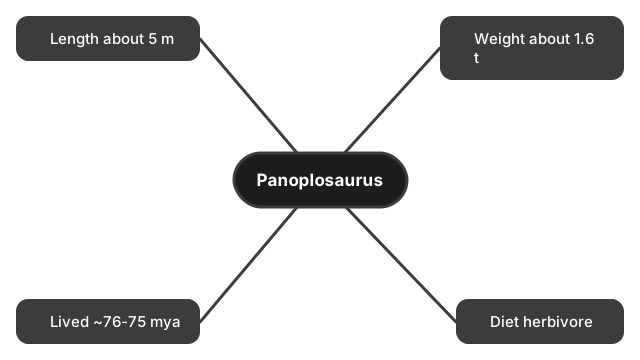
| Length | about 5 m (16 ft) |
| Weight | about 1.6 t (1,600 kg) |
| When it lived | about 76-75 Mya (Late Cretaceous, Campanian) |
| Diet | Herbivore - foliage and occasional fruit |
| Described | Named by Lawrence M. Lambe, 1919, from a 1917 find by Charles M. Sternberg, Dinosaur Park Formation, Alberta, Canada |
Everything runs on your device with WebGL, so the model works without an account and without sending anything to a server. The skin tone and pattern are an artistic reconstruction, because fossils do not preserve color or soft tissue; this model is not a fossil-accurate skeleton. For sibling nodosaurids and ankylosaurids on this site, see the Sauropelta 3D Viewer or the club-tailed Ankylosaurus 3D Viewer. A few million years earlier and from the neighboring Oldman Formation, the horned Wendiceratops grazed the same Late Cretaceous Alberta landscape, defended by a nasal horn and hooked frill spikes instead of body armor.
Frequently Asked Questions
How big was Panoplosaurus?
Published estimates put it at about 5 m (16 ft) long and roughly 1.6 tonnes (1,600 kg). Turn on the human figure in the viewer to compare scale against a 1.8 m person.
Did Panoplosaurus have a tail club like Ankylosaurus?
No. Panoplosaurus had no club at the end of its tail and lacked prominent spikes anywhere on its body, unlike the already-shipped Ankylosaurus and Pinacosaurus. It relied instead on dense, regularly shaped armor plates covering its neck and back.
When and where was it found?
Charles M. Sternberg found the first skeleton in 1917 at Quarry 8 near Little Sandhill Creek, Alberta, Canada. Lawrence M. Lambe formally named Panoplosaurus mirus in 1919, from the Dinosaur Park Formation, dated to about 76-75 million years ago.
What made Panoplosaurus unusual among ankylosaurs?
Its shoulder blade (scapulocoracoid) was completely fused, a feature not seen in other known ankylosaurs. Its broad, blunt-snouted skull carried lumpy bone ornamentation, and it was one of the last nodosaurids known before the group's decline at the end of the Cretaceous.
Is the model scientifically accurate?
The proportions follow published length and mass estimates, but the exact armor plate pattern, skin color, and soft-tissue outline are an artistic reconstruction - fossils preserve bone, not color or muscle shape. This model is not a fossil-accurate skeleton.
Do I need to install anything to view it?
No. The model renders in your browser with WebGL - no app, no account, and nothing about your visit is sent to a server. When available, a free-licensed glTF model may swap in after first paint.