Brachylophosaurus Size Comparison
Brachylophosaurus 3D Viewer pairs published hadrosaurid figures with a 1.8 m person - length about 7-11 m (panel 9 m), mass about 4-7 tonnes (panel 5500 kg) - so the scale gap stays readable at a glance.
Brachylophosaurus published figures
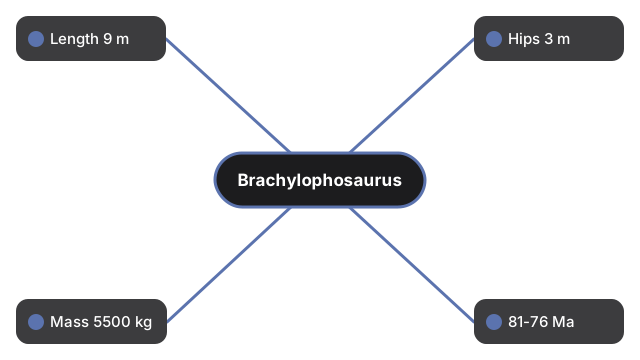
The Brachylophosaurus facts panel and this table use the same real published measures (a range where sources disagree):
| Measure | Figure | Vs a 1.8 m person |
|---|---|---|
| Length | about 7-11 m (panel baseline 9 m; NHM 7.0 m; Paul 2010 max about 11 m) | ~5x a person end-to-end at the panel figure; Size vs human uses 9 m |
| Hip height | about 3 m (panel baseline) | taller than adult standing height |
| Weight | about 4-7 tonnes (panel baseline 5500 kg) | many times a human body mass |
| When it lived | about 81-76 million years ago | Late Cretaceous Campanian; Oldman Formation, Alberta; Judith River Formation, Montana |
| Crest note | Named Charles M. Sternberg 1953 | short flat paddle-like crest; not the long tubular crest of Parasaurolophus |
How the Brachylophosaurus size-vs-human toggle stays honest
The Brachylophosaurus model is drawn to a fixed on-screen length so it fits the canvas; the Size vs human control then places a 1.8 m person at the true length ratio to the catalogue 9 m panel baseline (within the published about 7-11 m range). Tap Size vs human under the canvas to show or hide the scale figure - the comparison is proportional, not a decorative sticker.
What a person would see beside a Brachylophosaurus
What a person would see is a hadrosaurid whose panel length is about 9 m - roughly five body lengths of a 1.8 m person laid end to end - with hips about 3 m high in the panel. Turn on Size vs human and orbit beside the short crest to feel how the duck-billed body sits next to the scale figure.
What the Brachylophosaurus size numbers are not
What these size numbers are not is a single invented length outside the published 7-11 m range, and they do not invent the long tubular crest of Parasaurolophus. Soft-tissue color in the viewer is still an artistic reconstruction. For the control walkthrough see how to view Brachylophosaurus in 3D. For trade-offs versus phone AR apps see Brachylophosaurus 3D viewer vs AR apps.
Why trust these tools
- Ten-plus years of web tooling. The freetoolonline editorial team has shipped browser-based utilities since 2015. The goal has never changed: get you to a working output fast, without an install.
- No install, no sign-up. Open a tool and get a working output in seconds - nothing to download and no account to create. Tools that need heavy processing run it on our service, so even a low-powered machine gets the job done.
- Analytics stops at the page view. We measure which pages get visited, not what you type or upload inside a tool. There is nothing to sign in to and no profile is attached to your input.
- Open-source core components. The processing engines underneath (libheif, libde265, pdf-lib, terser, clean-css, ffmpeg.wasm, and others) are public and audit-able. We link to each one in its tool page's footer.
- Free, with or without ads. All tools are fully functional without sign-up. The Disable Ads button in the header is always available if you need a distraction-free run.