
Ground Sloth in 3D - click the head, a foreleg, or the tail for a fact (full controls on the Dinosaurs 3D hub).
Megatherium was a giant Ice Age mammal, not a dinosaur - turn on the human figure to see how it towered over a person on four legs, let alone when it rose onto its hind legs to reach tree branches.
Coat color is guesswork - fossils never preserve it. Body proportions trace the actual skeleton, and the panel's numbers are the figures scientists published.
Ground Sloth (Megatherium) 3D Viewer
Drag to rotate the Megatherium model below - the giant ground sloth - zoom in, and click a body part for a fact (full controls on the Dinosaurs 3D hub). Megatherium was a mammal, not a dinosaur.
Megatherium americanum lived in South America during the Pleistocene Ice Age, roughly 400,000 to 12,000 years ago - tens of millions of years after the dinosaurs went extinct. Adults reached about 6 m long and an estimated 3,700 to 4,000 kg, roughly the weight of an Asian elephant, and could rise onto their hind legs, bracing on a heavy tail like a third leg, to browse leaves too high for a typical four-legged herbivore.
The first fossil was found in 1787 by Fray Manuel de Torres on the bank of the Lujan River in what is now Argentina, and the genus was formally described in 1796 by French naturalist Georges Cuvier. Megatherium went extinct about 12,000 years ago as part of the end-Pleistocene extinction event; a butchered skeleton found at Campo Laborde, Argentina shows early humans hunted it.
| Measure | Figure |
|---|---|
| Length | about 6 m / 20 ft |
| Weight | about 3,700-4,000 kg (roughly an Asian elephant) |
| When it lived | about 400,000-12,000 years ago (Middle to Late Pleistocene, Ice Age) |
| Diet | Herbivore (foliage, twigs, and fruit, using a flexible rhino-like upper lip) |
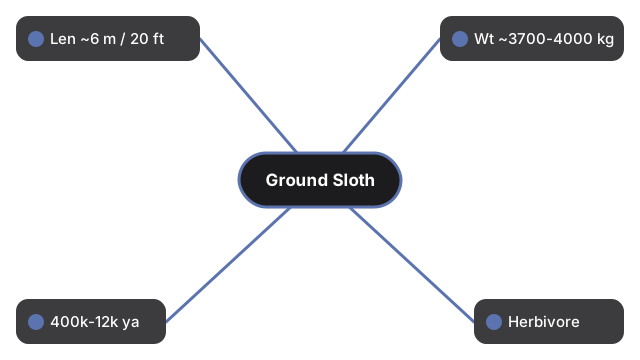
Colors here are an artistic reconstruction - fossils don't preserve them; the numbers above are real published values, with a range given where sources disagree.
Frequently Asked Questions
How big was a real Megatherium?
Adults are commonly cited at about 6 m long and an estimated 3,700-4,000 kg, roughly the weight of an Asian elephant. Turn on the human figure in the viewer to see the scale against a person.
Was Megatherium a dinosaur?
No. Megatherium was a mammal, a giant ground sloth, that lived during the Pleistocene Ice Age - tens of millions of years after the dinosaurs went extinct. It is grouped with today's tree sloths and anteaters, not with any dinosaur lineage.
Could it really stand on two legs?
Fossil evidence of its large hind feet, thick pelvis, and heavy tail suggests Megatherium could rise onto its hind legs in a stable stance, bracing on its tail like a third leg, to reach leaves higher up in trees.
Is the model scientifically accurate?
The body proportions follow the fossil skeleton, but the fur color and texture are an artistic reconstruction - fossils preserve bone, not soft tissue or color. The length, weight, and age figures shown are real published values.
When and where did it live, and when did it go extinct?
In South America, roughly 400,000 to 12,000 years ago (Middle to Late Pleistocene). It went extinct about 12,000 years ago as part of the end-Pleistocene extinction event; a butchered skeleton found at Campo Laborde, Argentina shows early humans hunted it.
Do I need to install anything to view it?
No. The model renders in your browser with WebGL - no app, no account, and nothing about your visit is sent to a server. The 3D engine loads once and is then cached.