
Drag to rotate the Albertosaurus, scroll or pinch to zoom, and click a body part - the head, a limb, or the tail - to read what fossils tell us about it. The panel beside the model carries the real figures.
Albertosaurus was a Late Cretaceous tyrannosaurid from Alberta, Canada - turn on the human figure to see how a person compares to its roughly 9 m body.
The colors and skin here are an artistic reconstruction; fossils preserve bone, not soft tissue or color. This model is not a fossil-accurate skeleton. The measurements in the panel follow published estimates, with ranges shown where sources disagree.
Albertosaurus 3D Viewer
This page renders an Albertosaurus as a 3D model you can spin in the browser - drag to rotate, scroll or pinch to zoom, toggle a 1.8 m person beside it for scale, and click the head, a limb, or the tail to read a fact about that part.
Albertosaurus sarcophagus lived in the Late Cretaceous of what is now Alberta, Canada, about 76-70 million years ago. A partial skull was found in 1884 by Joseph Burr Tyrrell; Henry Fairfield Osborn named the species in 1905. It was more lightly built than its larger relative Tyrannosaurus rex. The Dry Island Bonebed, discovered by Barnum Brown, holds the remains of at least 26 individuals - the largest concentration of a large Cretaceous theropod known from one site, and part of why some researchers think tyrannosaurids may have been at least loosely gregarious.
| Measure | Figure |
|---|---|
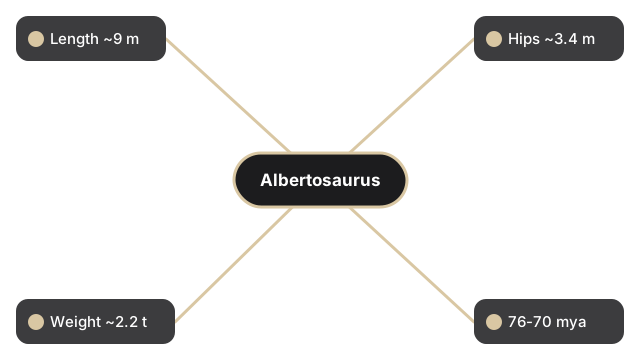
| Length | about 9 m panel baseline (typical adult); largest known individual, from the Dry Island Bonebed, estimated past 10 m |
| Hip height | about 3.4 m |
| Weight | about 1.8-2.7 t (2-3 short tons); panel baseline 2.2 t |
| When it lived | about 76-70 million years ago (Late Cretaceous, Campanian-Maastrichtian, Alberta, Canada) |
| Diet | Carnivore |
Everything runs on your device with WebGL - no account, nothing sent to a server. Soft-tissue color is an artistic reconstruction; this model is not a fossil-accurate skeleton. Compare with the larger, more heavily built Tyrannosaurus rex 3D Viewer and its closer albertosaurine relative Gorgosaurus 3D Viewer.
On screen, three buttons control the view: Stop rotation holds the model still, Idle motion adds a gentle sway, and Fullscreen fills the browser window for a closer look. A fourth button, Size vs human, drops a person beside the model so the scale reads at a glance. As you spin the model or click a part, the facts panel keeps its length, hip height, and weight in view.
Frequently Asked Questions
How big was Albertosaurus?
Typical adults are cited around 9 m long and about 3.4 m tall at the hip, weighing roughly 1.8-2.7 t (2-3 short tons). The largest known individual, recovered from the Dry Island Bonebed, is estimated to have exceeded 10 m. This page uses 9 m and 2.2 t as facts-panel baselines. Turn on the human figure to compare with a 1.8 m person.
What kind of dinosaur was Albertosaurus?
It was a tyrannosaurid theropod, a smaller and more lightly built relative of Tyrannosaurus rex. It belongs to the albertosaurine branch of the tyrannosaurid family, alongside the closely related Gorgosaurus.
When and where did Albertosaurus live?
In Late Cretaceous rocks of Alberta, Canada, roughly 76-70 million years ago. A partial skull was found in 1884 by Joseph Burr Tyrrell; Henry Fairfield Osborn named the species Albertosaurus sarcophagus in 1905.
What is the Dry Island Bonebed?
A fossil site in Alberta, discovered by Barnum Brown, containing the remains of at least 26 Albertosaurus individuals - the largest known concentration of a large Cretaceous theropod at a single site. It is one reason some researchers think tyrannosaurids may have been at least loosely gregarious, though the fossils cannot fully settle how the group came together.
Is the model scientifically accurate?
The proportions follow published figures, but the skin color and soft-tissue outline are an artistic reconstruction - fossils preserve bone, not soft tissue or color. This model is not a fossil-accurate skeleton. The length, weight, and age figures shown are real published values, with ranges cited where sources disagree.
Do I need to install anything to view it?
No. The model renders in your browser with WebGL - no app, no account, and nothing about your visit is sent to a server. The 3D engine loads once and is then cached. When available, a free-licensed glTF model may swap in after first paint.