
Ceratosaurus in 3D - click the horned head, a leg, or the tail for a fact (full controls on the Dinosaurs 3D hub).
Ceratosaurus was a Late Jurassic predator named for the blade-like nasal horn on its snout - turn on the human figure to see how a person compares to its body beside Morrison Formation contemporaries such as Allosaurus.
The measurements in the panel follow published estimates, with ranges shown where sources disagree.
Ceratosaurus 3D Viewer
Rotate the Ceratosaurus below by dragging, zoom in with the scroll wheel, and click a body part to reveal a fact (see the Dinosaurs 3D hub for every control).
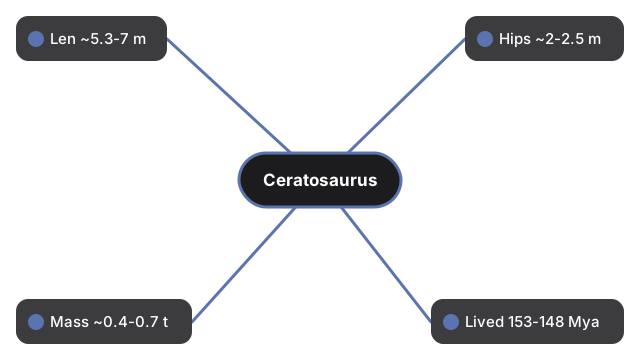
Ceratosaurus lived in the Late Jurassic, about 153 to 148 million years ago, in what is now the western United States (Morrison Formation), with related remains also reported from Portugal. The holotype skeleton is about 5.3 to 5.7 m long; larger Morrison specimens reach about 7 m. Published mass estimates for the holotype range from about 0.4 to 0.7 tonnes, while the largest known individuals are estimated near 1.1 tonnes. Its name means "horned lizard" for the midline nasal horn plus smaller brow ridges.
Othniel Charles Marsh named Ceratosaurus nasicornis in 1884 from a nearly complete skeleton found in Colorado. Unlike most large theropods of its day, it kept four fingers on each hand and carried a row of bony osteoderms along the midline of the back and tail. It shared floodplain habitat with Allosaurus and Torvosaurus but is much rarer in the fossil record. The Natural History Museum of Utah mounts a Cleveland-Lloyd specimen that shows the distinctive nasal horn clearly.
| Measure | Figure |
|---|---|
| Length | about 5.3-7 m (holotype about 5.3-5.7 m; larger specimens about 7 m) |
| Standing height | about 2-2.5 m at the hips |
| Weight | about 0.4-0.7 tonnes (holotype estimates); largest known individuals up to about 1.1 tonnes |
| When it lived | 153-148 million years ago (Late Jurassic, Kimmeridgian-Tithonian) |
| Diet | Carnivore (other dinosaurs and possibly aquatic prey) |
The skin tone and pattern are an artistic reconstruction, because fossils preserve bone, not soft tissue or color; this model is not a fossil-accurate skeleton, and the numbers above are real published values with ranges where sources disagree.
See also Allosaurus and Megalosaurus, fellow large Jurassic theropods.
Frequently Asked Questions
How big was Ceratosaurus?
The holotype skeleton is about 5.3 to 5.7 m long, with published mass estimates around 0.4 to 0.7 tonnes. Larger Morrison Formation specimens reach about 7 m and up to about 1.1 tonnes. Turn on the human figure in the viewer to see the scale against a 1.8 m person.
What is the nasal horn for?
Ceratosaurus means "horned lizard." The midline nasal horn, plus smaller ridges over the eyes, is the genus's signature feature. Paleontologists usually treat it as a display or recognition structure rather than a stabbing weapon, because the horn core is relatively short and lightly built.
How is Ceratosaurus different from Allosaurus?
Both lived in the Late Jurassic Morrison Formation, but Ceratosaurus is rarer, kept four fingers on each hand, carried midline osteoderms on the back and tail, and is defined by its nasal horn. Allosaurus is more common and lacks that horned skull profile.
When and where did Ceratosaurus live?
In the Late Jurassic, about 153 to 148 million years ago, mainly in western North America. Othniel Charles Marsh named Ceratosaurus nasicornis in 1884 from a Colorado skeleton; related remains are also known from Portugal.
Is the model scientifically accurate?
The proportions follow published figures, but the skin color and soft-tissue outline are an artistic reconstruction - fossils preserve bone, not soft tissue or color. This model is not a fossil-accurate skeleton. The length, weight, and age figures shown are real published values, with ranges cited because sources vary.
Do I need to install anything to view it?
No. The model renders in your browser with WebGL - no app, no account, and nothing about your visit is sent to a server. The 3D engine loads once and is then cached. When available, a free-licensed glTF model may swap in after first paint.