
Drag to rotate the Pinacosaurus, scroll or pinch to zoom, and click a body part - the head, an armor plate, the tail club, or a leg - to read what fossils tell us about it. The panel beside the model carries the real figures.
Pinacosaurus was a low, armor-plated plant-eater from the Gobi Desert, best known for the unusual group of extra openings around its nostrils and for the sheer number of juvenile skeletons found together - turn on the human figure to see how a person compares to its broad, studded body and stubby tail club.
The colors and skin here are an artistic reconstruction; fossils preserve bone, not soft tissue or color. This model is not a fossil-accurate skeleton. The measurements in the panel follow published estimates, with ranges shown where sources disagree.
Pinacosaurus 3D Viewer
This page renders a Pinacosaurus as a 3D model you can spin in the browser - drag to rotate, scroll or pinch to zoom, toggle a 1.8 m person beside it for scale, and click the head, an armor plate, the tail club, or a leg to read a fact about that part.
Pinacosaurus lived in the Late Cretaceous, about 75 to 71 million years ago (the Campanian), in what is now Mongolia and northern China. Paleontologist Charles Gilmore named and described the genus in 1933 from a skeleton found ten years earlier, in 1923, by Walter Granger during the American Museum of Natural History's Central Asiatic Expeditions to the Flaming Cliffs (Bayn Dzak) in the Gobi Desert. Gregory Paul's systematic estimate puts a fully-grown adult at about 5 m long and 1.9 to 2.1 tonnes; because the more than 20 known skeletons are dominated by smaller, younger animals closer to 4 m and around 1 tonne, cited sizes vary with the growth stage a source is describing. Small rectangular armor plates called caputegulae covered the skull, and the genus name means "plank lizard" after them.
The most unusual feature is a group of extra small openings around each nostril - as many as five pairs counted in one juvenile skull - whose function is still debated among researchers, with salt glands, heat exchange, and vocal resonance all proposed as explanations. A group of five small Pinacosaurus skeletons found together in the Gobi Desert suggests young animals travelled in groups. The tail ended in a bony club, but a smaller one than Ankylosaurus carried, and it had not yet fully developed in the juveniles found so far.
| Measure | Figure |
|---|---|
| Length | about 5 m for a fully-grown adult (Gregory Paul's estimate); around 4 m for the smaller, more commonly-found juvenile skeletons |
| Weight | about 1.9-2.1 tonnes for an adult; around 1 tonne for the smaller juveniles most known specimens represent |
| When it lived | 75-71 million years ago (Late Cretaceous, Campanian) |
| Diet | Herbivore - beaked jaws suited to tough leaves and pulpy fruit |
| Described | Named by Charles Gilmore, 1933, from a holotype found in 1923 at the Flaming Cliffs, Djadokhta Formation, Mongolia |
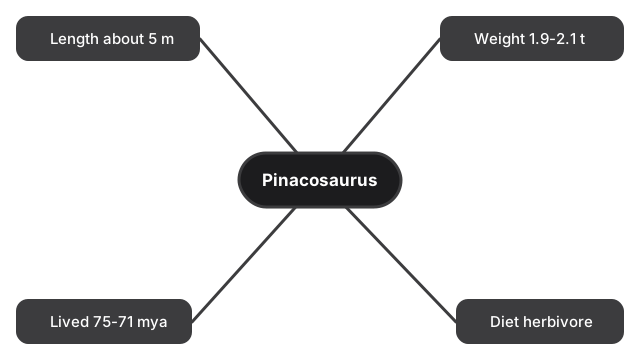
Everything runs on your device with WebGL, so the model works without an account and without sending anything to a server. The skin tone, armor color, and pattern are an artistic reconstruction, because fossils do not preserve color or soft tissue, and this model is not a fossil-accurate skeleton; the numbers above are real published values, and ranges are shown because sources vary by growth stage and specimen.
Frequently Asked Questions
How big was Pinacosaurus?
Gregory Paul's systematic estimate puts a fully-grown adult at about 5 m long and 1.9 to 2.1 tonnes. Most known skeletons are smaller, younger individuals closer to 4 m and around 1 tonne, so cited sizes vary with the growth stage a source is describing. Turn on the human figure in the viewer to see the scale against a 1.8 m person.
Why does Pinacosaurus have extra holes around its nose?
Each nostril sits inside a group of several smaller openings - researchers have counted as many as five pairs in one juvenile skull. The exact purpose is still an open question: salt glands, a heat-exchange system for a dry habitat, and chambers for vocal resonance have all been proposed, but no single explanation has been confirmed.
Did Pinacosaurus have a tail club?
Yes, but a smaller one than Ankylosaurus carried, and it had not yet fully developed in the young animals found so far. Small rectangular armor plates called caputegulae also covered the skull, and the genus name Pinacosaurus means "plank lizard" after them.
When and where did Pinacosaurus live?
In the Late Cretaceous, about 75 to 71 million years ago, in what is now Mongolia and northern China. Walter Granger found the first fossils in 1923 at the Flaming Cliffs (Bayn Dzak) during the American Museum of Natural History's Central Asiatic Expeditions, and Charles Gilmore named the genus in 1933. More than 20 skeletons are now known - among the most of any armored dinosaur - and most are juveniles, including a group of five small individuals found together, suggesting young Pinacosaurus travelled in groups.
Is the model scientifically accurate?
The proportions follow published figures, but the skin color and soft-tissue outline are an artistic reconstruction - fossils preserve bone, not soft tissue or color. This model is not a fossil-accurate skeleton. The length, weight, and age figures shown are real published values, with ranges cited because sources vary by growth stage and specimen.
Do I need to install anything to view it?
No. The model renders in your browser with WebGL - no app, no account, and nothing about your visit is sent to a server. The 3D engine loads once and is then cached. When available, a free-licensed glTF model may swap in after first paint.