
Deinonychus in 3D - click the head, tail, an arm, or a leg for a fact (full controls on the Dinosaurs 3D hub).
Deinonychus stood about 0.87 m tall at the hip and stretched roughly 3.3 to 3.4 m from snout to tail - turn on the human figure to see it was a person-sized predator, considerably larger than the already-shipped Velociraptor, and much closer in size to the "Velociraptor" Jurassic Park put on screen.
Colors are an artistic reconstruction (fossils don't preserve them). No feather fossils are directly preserved on Deinonychus itself, so none are shown here; any guess at where feathers might sit would have to borrow from smaller, better-preserved cousins like Velociraptor rather than this genus's own bones. The panel's figures are the ones actually published.
Deinonychus 3D Viewer
Below is a rotating Deinonychus - drag to turn it, zoom in close, and click on a body part to read a fact (controls are detailed on the Dinosaurs 3D hub).
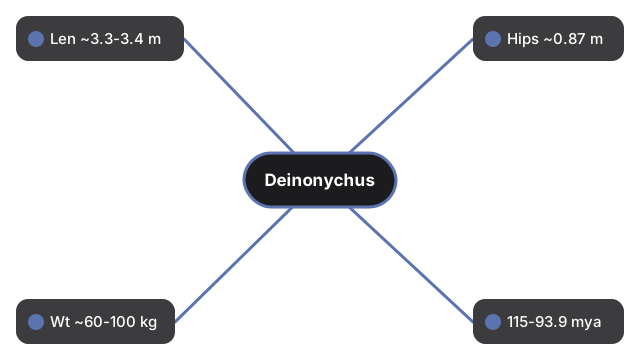
Deinonychus lived in the Early to early Late Cretaceous, roughly 115 to 93.9 million years ago, in what is now the Cloverly Formation of Montana and Wyoming and the Antlers Formation of Oklahoma, Utah, and Texas. Published figures put it at about 3.3 to 3.4 m long and roughly 0.87 m tall at the hip - noticeably larger than the already-shipped Velociraptor. Weight estimates vary by method: about 60-73 kg using mass-estimation methods (Paul, 1988/2016), or up to about 100 kg using a bone-circumference method (Campione et al., 2014). A large, sickle-shaped, retractable claw tipped the second toe of each foot, held raised off the ground to keep its edge sharp, alongside a stiffened tail that acted as a dynamic counterbalance during movement.
The first fossil material was collected in 1931 by Barnum Brown near Billings, Montana, but was never formally described. John Ostrom's Yale Peabody Museum expeditions, starting August 1964 near Bridger, Montana, recovered over 1,000 bone fragments and confirmed Brown's earlier material was the same animal; Ostrom formally named the genus in 1969, a description widely credited with starting the "Dinosaur Renaissance" - the shift toward viewing dinosaurs as active, bird-like animals. Shed teeth found alongside remains of the much larger plant-eater Tenontosaurus are direct fossil evidence that Deinonychus preyed on or scavenged it, hinting at possible pack or group behavior. Jurassic Park's on-screen "Velociraptor" was modeled on Deinonychus's real size and proportions, not the real Velociraptor, which was roughly half as long and far lighter.
| Measure | Figure |
|---|---|
| Length | about 3.3-3.4 m |
| Hip height | about 0.87 m |
| Weight | about 60-100 kg (60-73 kg by mass-estimation methods; up to about 100 kg by a bone-circumference method) |
| When it lived | 115-93.9 million years ago (Early to early Late Cretaceous, Aptian-Cenomanian) |
| Diet | Carnivore - fossil evidence of preying on or scavenging the much larger Tenontosaurus |
| Described | 1969 by John Ostrom; Cloverly Formation (Montana/Wyoming) and Antlers Formation (Oklahoma/Utah/Texas) |
Colors here are an artistic reconstruction - fossils don't preserve them; no feather fossils are directly known from Deinonychus itself, so feathering is left unrendered rather than assumed for this genus. The numbers above are real published values, and ranges are shown because sources and estimation methods vary.
Frequently Asked Questions
Is Deinonychus the same dinosaur as Jurassic Park's Velociraptor?
No, but it is the animal the film's on-screen "Velociraptor" was really sized on. The real Velociraptor was only about 2 m long and turkey-sized; Deinonychus, at about 3.3-3.4 m long and roughly 0.87 m tall at the hip, matches the movie's size far more closely.
How big was Deinonychus?
About 3.3 to 3.4 m long and roughly 0.87 m tall at the hip. Weight estimates depend on the method used: about 60-73 kg by mass-estimation methods, or up to about 100 kg by a bone-circumference method. Turn on the human figure in the viewer to see the scale against a 1.8 m person.
What did Deinonychus eat?
It was a carnivore. Shed teeth found alongside the remains of Tenontosaurus, a much larger plant-eating dinosaur, are direct fossil evidence that Deinonychus preyed on or scavenged it - and may point to pack or group behavior.
Did Deinonychus have feathers?
No feather fossils have been found directly on Deinonychus itself. Feathering is inferred only from closely related dromaeosaurids, such as Velociraptor and Microraptor, so this model leaves feathers unrendered rather than assuming them for this genus specifically.
When and where did Deinonychus live?
In the Early to early Late Cretaceous, roughly 115 to 93.9 million years ago, in what is now the Cloverly Formation of Montana and Wyoming and the Antlers Formation of Oklahoma, Utah, and Texas. The genus was named by John Ostrom in 1969, from material first collected in 1931 by Barnum Brown.
Is the model scientifically accurate?
The proportions follow published fossil figures, but the skin color and texture are an artistic reconstruction - fossils preserve bone, not soft tissue or color. The length, weight, and age figures shown are real published values, with ranges cited because sources and estimation methods vary.